

Bead Mill for Battery Recycling: Grinding Black Mass for Lithium, Cobalt, and Nickel Recovery

Author: Moeez Ullah Published: September 8, 2026

Bead Mill for Battery Recycling: Grinding Black Mass for Lithium, Cobalt, and Nickel Recovery
Black mass is the powdered mixture of cathode and anode materials recovered after shredding end-of-life lithium-ion batteries, and it typically contains lithium, cobalt, nickel, and manganese.
Particle size directly controls how much metal a recycler can extract: grinding too coarse leaves valuable material locked inside unliberated particles, while poor particle size control can also reduce leaching efficiency.
Mechanical pretreatment recovery rates for black mass commonly range from roughly 75% to 90%, depending on crushing particle size and screening efficiency.
Because black mass is fine, conductive, and can be moisture- and heat-reactive, processing equipment typically needs to meet ATEX explosion-proof and safety handling requirements.
Grinding decisions made during mechanical pretreatment directly affect the efficiency of the downstream hydrometallurgical (acid or alkaline leaching) recovery step.
At a Glance | Detail |
Focus keyword | Bead mill for battery recycling black mass |
What black mass is | Powdered cathode/anode material mixture recovered from shredded end-of-life batteries |
Why particle size matters | Controls metal liberation and downstream leaching efficiency |
Typical mechanical recovery rate | Roughly 75–90%, depending on crushing/screening |
Key materials recovered | Lithium, cobalt, nickel, manganese |
Safety consideration | ATEX/explosion-proof equipment often required due to fine, reactive powder |
What is black mass? Black mass is the concentrated powder mixture of cathode and anode active materials recovered after end-of-life lithium-ion batteries are discharged, shredded, and mechanically processed — the feedstock that hydrometallurgical recycling converts into recovered lithium, cobalt, nickel, and manganese. Why does grinding matter for battery recycling? Because particle size, set during this mechanical pretreatment stage, directly determines how much of that valuable metal a recycler can actually extract in the leaching step that follows. A bead mill for battery recycling black mass processing sits right at that control point.
What Is Black Mass, and Why Does Grinding Come First?
Battery recycling generally follows two stages: mechanical pretreatment (discharging, shredding, crushing, and separating the battery into material streams) followed by hydrometallurgical recovery (acid or alkaline leaching to extract specific metals from the resulting black mass) (lithium-ion battery recycling 2026 overview, Alchemie Labs). Grinding happens in that first stage, and it sets the ceiling on how well the second stage can perform — a coarsely or unevenly ground black mass simply can't be leached as efficiently, no matter how well-optimized the chemistry is downstream.
Why Particle Size Directly Controls Metal Recovery

The Liberation Problem
What is liberation in battery recycling? Liberation refers to physically separating individual battery components — active material, current collector foil, binder, separator — from each other during crushing and grinding, so each material stream can be processed and recovered independently. Research on end-of-life battery characterization has specifically noted that black mass leaching characteristics can depend on whether different battery components were successfully liberated during crushing and grinding at the recycling facility (black mass phase characterization study, Recycling journal) — meaning under-liberated material can leach less completely even with an otherwise well-designed chemical process.
Mechanical Activation Can Improve Leaching, But Not Uniformly
Does grinding improve metal recovery from black mass? Yes, but the effect varies by metal. Research on mechanical activation of NMC black mass found that grinding time and temperature meaningfully influenced lithium dissolution during leaching, while cobalt, nickel, and manganese dissolution did not benefit significantly from the same mechanical activation under the conditions tested (mechanical activation effects on black mass leachability, Springer). That's a genuinely useful, non-obvious finding: grinding parameters that help recover one metal don't automatically help recover all of them equally.
Mechanical Recovery Rates in Industrial Practice
What recovery rate is typical for black mass processing? Industry process guidance indicates the mechanical recovery rate for black mass commonly ranges from approximately 75% to 90%, with residual binder content, crushing particle size, and screening efficiency all cited as influencing factors (battery recycling line process overview, Suny Group). Every percentage point below that ceiling represents recoverable lithium, cobalt, and nickel left on the table.
Why Particle Size Consistency Matters as Much as Fineness

Different Materials Break Down Differently
Do all battery materials grind the same way? No. Research on battery pretreatment has observed that graphite, being more brittle, breaks into smaller particles during grinding, while polymeric separator material tends to transform into larger flakes instead — meaning a single grinding process produces a genuinely wide particle size distribution across the different materials present in a battery (pyrolysis pretreatment appraisal for battery recycling, PMC). Downstream separation steps (screening, magnetic separation, air classification) depend on that size differential actually existing in a predictable, controllable way.
Why Uniform Particle Size Isn't Automatically the Goal Here
Unlike most applications covered in this series, black mass grinding doesn't always aim for one narrow target particle size — it often aims to create a size and density differential wide enough for downstream separation equipment (screening, magnetic separation, air classification) to sort materials effectively. That's a genuinely different design goal than the fine, uniform dispersion targeted in most of our other application guides.
Safety and Equipment Requirements Specific to Black Mass
Why does black mass need special handling equipment? Because it combines fine particle size, conductive metal content, and potentially explosive or moisture-reactive behavior — properties that impose strict technical requirements around confined or ATEX-rated processing environments, alongside human safety and regulatory compliance considerations (black mass processing equipment guide, Palamatic Process). Equipment specified for this application needs to account for these hazards directly, not as an afterthought.
Where Wet Grinding Fits in the Recycling Process
While much of the mechanical pretreatment stage in industrial battery recycling uses dry crushing, shredding, and classification equipment, wet grinding has a specific role where finer, more controlled particle size reduction is needed — particularly for pre-leach material conditioning where a more uniform, finer feed can improve leaching kinetics for specific target metals. A bead mill's ability to deliver controlled, tunable particle size reduction is relevant specifically at that finer-processing stage, downstream of the initial coarse shredding and separation steps.
Battery Recycling Grinding vs. Battery Materials Production Grinding
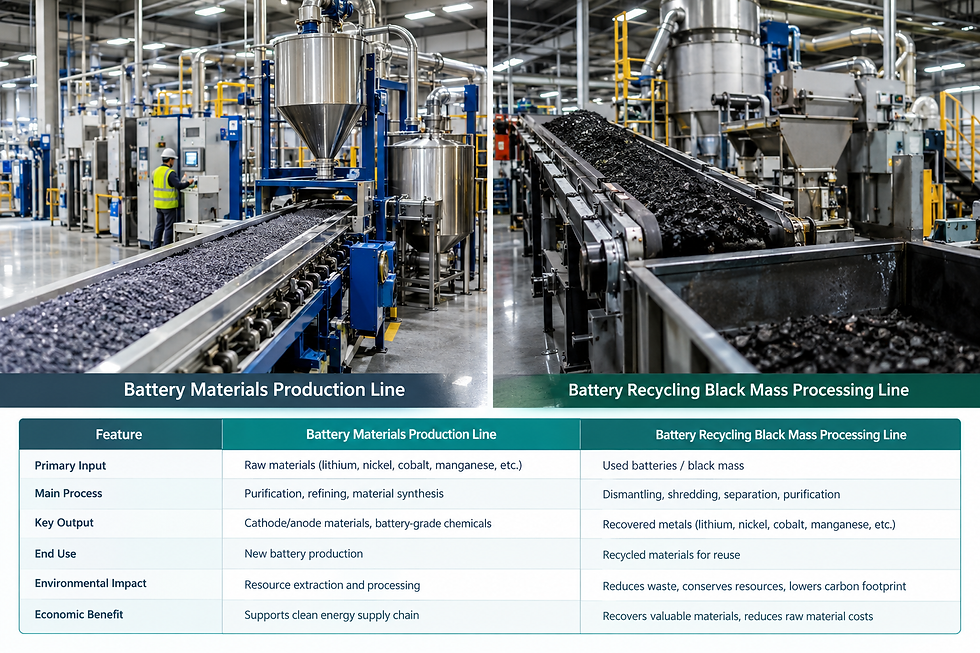
Factor | Producing New Battery Materials | Recycling Black Mass |
Feed material | Purified, engineered starting powders | Mixed, contaminated end-of-life material |
Particle size goal | Tight, uniform target (D50/D90) | Often a differential for downstream separation |
Success metric | Consistency and purity | Metal liberation and recovery percentage |
Safety considerations | Standard industrial handling | ATEX/explosion-proof requirements common |
Downstream process | Electrode coating, sintering | Hydrometallurgical leaching |
Why This Market Is Worth Targeting Now

The wave of EV batteries reaching end-of-life is accelerating, and recycling economics depend directly on how efficiently recyclers can separate and purify recovered metals — the more complete that recovery, the more viable domestic and regional battery recycling becomes as a supply source for new battery production (lithium-ion battery recycling 2026 overview, Alchemie Labs). As recycling capacity scales to meet that demand, the grinding and particle size control step behind it becomes a bigger lever on recycler profitability, not a smaller one.
Conclusion
Battery recycling economics come down to how much lithium, cobalt, and nickel actually gets recovered — and that recovery ceiling is set earlier in the process than most people assume, at the grinding and particle size control stage. Contact Sanxing Feirong Machinery to discuss bead mill configuration for battery recycling and black mass processing applications.
FAQs
What is black mass in battery recycling?
Black mass is the concentrated powder mixture of cathode and anode active materials recovered after end-of-life lithium-ion batteries are discharged, shredded, and mechanically processed — it's the feedstock for hydrometallurgical metal recovery.
Does finer grinding always improve metal recovery from black mass?
Not uniformly, research has shown mechanical activation can meaningfully improve lithium leaching while having less measurable effect on cobalt, nickel, and manganese recovery under the same conditions, so grinding strategy should be matched to the specific target metal.
Why does black mass processing require special safety equipment?
Because black mass combines fine particle size, conductive metal content, and potentially explosive or moisture-reactive behavior, which typically requires ATEX-rated or confined processing environments rather than standard industrial equipment.
What's a typical mechanical recovery rate for black mass processing?
Industry guidance commonly cites a range of roughly 75% to 90%, influenced by residual binder content, crushing particle size, and screening efficiency.


Comments