

Bead Mill for Graphene Exfoliation: Peeling Graphite Apart Instead of Breaking It Down

Author: Moeez Ullah Published: September 5, 2026

Bead Mill for Graphene Exfoliation: Peeling Graphite Apart Instead of Breaking It Down
At a Glance | Detail |
Focus keyword | Bead mill for graphene exfoliation |
Core problem solved | Peeling layered graphite into thin graphene sheets without destroying the sheet structure |
Why it's mechanically unique | The goal is exfoliation (separating layers) — not fracturing particles down to a target diameter |
Typical output | Few-layer graphene sheets roughly 0.8–1.8nm thick, lateral sizes from tens of nanometers to hundreds of microns |
Production route | Graphite feedstock → wet bead/ball milling in liquid medium → centrifugation/classification → graphene dispersion or powder |
Primary applications | Conductive additives for batteries, polymer nanocomposites, coatings, flame-retardant materials |
Every wet-grinding application covered in this series shares one implicit goal: making particles smaller in every dimension. Graphene production inverts that logic entirely. Graphite is already made of graphene layers stacked on top of each other — the job of a bead mill for graphene exfoliation isn't to fracture particles down to size, it's to peel those stacked layers apart while keeping each individual sheet as intact and wide as possible.
What Is Graphene Exfoliation, and Why Is It Different From Grinding?

Graphite is a naturally layered material — stacks of graphene sheets held together by relatively weak interlayer forces. Exfoliation means separating those layers from each other, ideally down to single or few-layer graphene, without breaking the strong in-plane carbon bonds that give each sheet its exceptional strength and conductivity. Wet ball and bead milling has been demonstrated as an effective route for exactly this: research using wet ball milling in a liquid medium successfully exfoliated multi-layered graphite nanosheets down to single- and few-layer graphene sheets (three layers or fewer), with a measured thickness around 0.8–1.8nm (wet ball milling graphene exfoliation study, Journal of Materials Chemistry).
Shear-Dominated Peeling vs. Impact-Dominated Fracturing
The mechanism that matters most here is shear, not impact. Shear forces slide adjacent graphene layers past each other, overcoming the weak interlayer attraction without applying the kind of direct impact force that would fracture the sheet itself or shatter it into smaller, less useful fragments. Process design for graphene exfoliation has to favor that shear-dominant mode deliberately, rather than defaulting to the higher-impact settings that work well for particle fracturing applications.
The Yield Problem: Why Graphene Exfoliation Has Historically Been Inefficient

Most Graphite Doesn't Convert to Graphene in a Single Pass
Direct mass exfoliation of graphene from bulk graphite at high yield has long been recognized as genuinely difficult for commercial-scale production. Recent research addressing this problem directly reported a breakthrough: a self-grinding exfoliation approach using microbeads as the grinding medium to drive shear friction between graphite particles substantially improved graphene yield from just 6.3% up to 100%, while achieving total graphite-to-graphene conversion at kilogram scale with a productivity of 7.5 g per hour per liter (microbead-driven self-grinding exfoliation study, Science China Materials). That's a striking illustration of how much room there's historically been for process improvement in this specific application.
What Good Output Actually Looks Like
That same research produced graphene nanosheets with an average lateral size of roughly 298nm while preserving the same carbon-to-oxygen atomic ratio as the starting graphite — meaning the exfoliation process didn't introduce the oxidative damage that some alternative graphene production routes (like reduction of graphene oxide) are known to leave behind. The resulting material showed good electrical conductivity and strong potential as a battery conductive additive, directly improving specific capacity and cycling stability in lithium-ion cell testing.
Wet Milling vs. Other Graphene Production Methods
Why Wet Milling Remains Attractive at Production Scale
Compared to chemical vapor deposition or graphene oxide reduction routes, wet milling in a bead or ball mill offers a comparatively simple, scalable, lower-cost path that doesn't require dangerous reagents or extreme temperature and pressure conditions — a meaningful advantage when the goal is commercial-volume production rather than lab-scale material characterization (graphene-wrapped nanoparticle wet milling study, PMC).
Solvent Selection and Process Environment
Liquid-phase exfoliation processes commonly use organic dispersant phases such as NMP or DMF, though process patents also describe water-based systems with added surfactants — solvent choice affects both exfoliation efficiency and the final dispersion's compatibility with downstream applications like battery slurries or polymer composites (wet-jet milling exfoliation patent, US10407308).
How Sanxing's Bead Mill Technology Supports Graphene Exfoliation
Tunable Shear-to-Impact Ratio
Because graphene exfoliation favors controlled shear over aggressive impact, Sanxing's vertical bead mill platforms — with adjustable rotor speed, bead loading, and residence time — allow processors to bias the grinding regime toward gentler, shear-dominant conditions rather than defaulting to maximum-impact settings tuned for particle fracturing applications.
Circulation Grinding for Higher Conversion Yield
Given how much conversion yield can vary between processes, circulation grinding — recirculating the graphite slurry through the mill over multiple passes — supports the kind of progressive, controlled exfoliation that's been shown to dramatically improve graphite-to-graphene conversion compared to a single aggressive pass.
Lab-Scale Process Development
Because exfoliation efficiency depends heavily on solvent choice, bead size, rotor speed, and processing time working together, validating a specific graphite feedstock and solvent system at lab scale on Sanxing's F4/W Series bead mills before scaling to production reduces the risk of low-yield outcomes at full batch size.
Graphene Exfoliation vs. Conventional Particle Fracturing

Factor | Conventional Particle Fracturing (Battery Powders, Pigments) | Graphene Exfoliation From Graphite |
Mechanical goal | Reduce particle size in all dimensions | Separate stacked layers while preserving sheet integrity |
Dominant force | Impact plus shear | Shear-dominant, with impact minimized |
Failure mode from over-processing | Reagglomeration, contamination | Sheet fracturing, reduced lateral size, defect introduction |
Historical yield challenge | Generally moderate to high | Historically low (single-digit percent in many early processes) |
Key output metric | Particle size (D50/D90) | Layer count, lateral sheet size, structural integrity (C/O ratio) |
Why This Market Is Worth Targeting Now
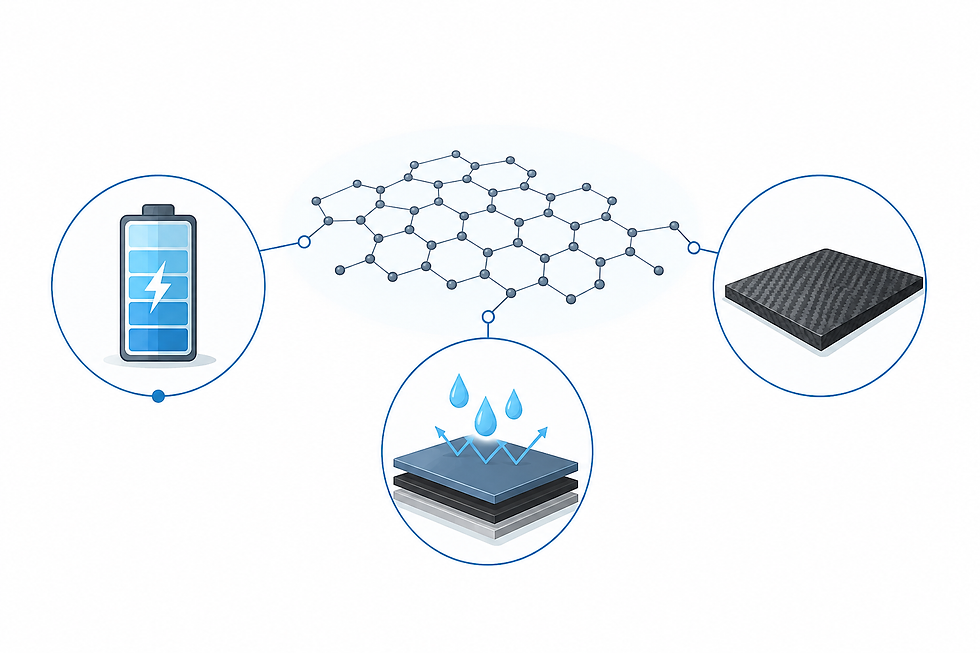
Graphene's potential as a battery conductive additive, coating enhancer, and structural composite filler has been discussed for over a decade, but commercial adoption has been held back specifically by production cost and yield limitations at scale. As process research continues closing that yield gap — moving from single-digit to near-complete graphite-to-graphene conversion in controlled studies — the wet milling equipment behind that process becomes a more central part of making graphene commercially viable, not just academically interesting.
Conclusion
Graphene exfoliation asks a bead mill to do something almost opposite to most of its other applications — not to break particles down, but to peel layers apart while keeping them intact. Getting that balance right is what separates commercially viable graphene production from a low-yield lab curiosity. Contact Sanxing Feirong Machinery to discuss bead mill configuration for graphene exfoliation and dispersion.
Frequently Asked Questions
Why can't graphene just be produced by grinding graphite harder?
Because graphene exfoliation requires separating layered sheets from each other via shear, not fracturing particles through impact — grinding too aggressively tends to fracture and damage the graphene sheets rather than simply peeling more layers apart.
What has historically limited graphene production yield from wet milling?
Early processes converted only a small fraction of graphite into usable graphene per batch; more recent process designs using microbead-driven shear friction have demonstrated dramatic yield improvements, up to full conversion in controlled studies.
Does wet milling introduce oxidative damage like graphene oxide reduction methods do?
Not necessarily some wet milling studies have shown exfoliated graphene retaining the same carbon-to-oxygen atomic ratio as the starting graphite, indicating the mechanical process itself doesn't introduce the oxidative defects associated with chemical exfoliation routes.
What is graphene produced this way typically used for?
Common applications include conductive additives for lithium-ion battery electrodes, polymer nanocomposite reinforcement, and coatings — applications where electrical conductivity and mechanical reinforcement both matter.


Comments