

Bead Mill for Inkjet Ink: How to Achieve Fine Pigment Dispersion

Author: Moeez Ullah Company: Shenzhen Sanxing Feirong Machinery Co., Ltd.
Published: September 23, 2026
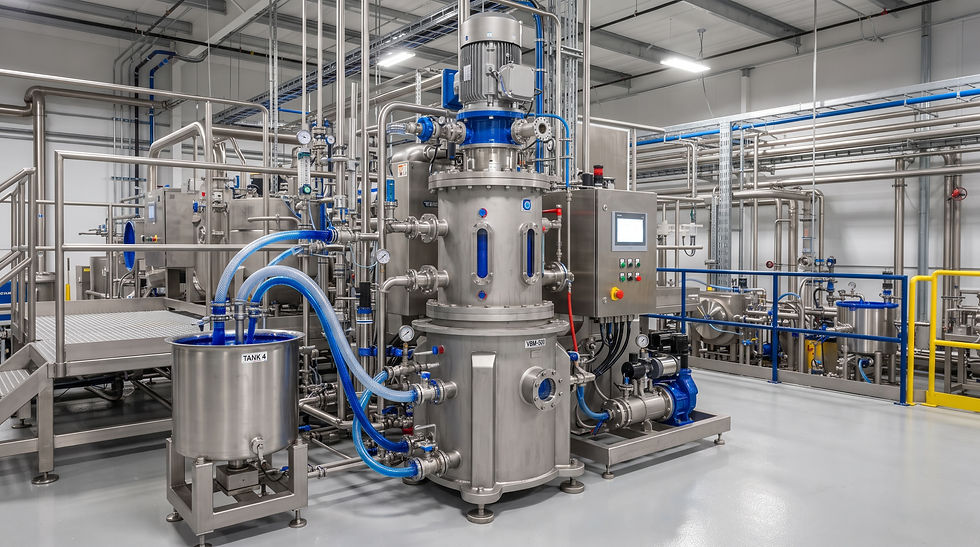
Why Inkjet Ink Requires Precision Grinding
Inkjet ink production is much less forgiving than ordinary pigment processing. A manufacturer may have a carefully developed formulation, high-quality pigments and suitable additives, yet still experience inconsistent printing if the pigment dispersion is not properly controlled. This is why a bead mill for inkjet ink plays an important role in modern digital printing production. Inkjet systems require controlled particle size and stable dispersion so that the finished formulation can pass through the printing system consistently while maintaining color quality.
Current industry solutions show how closely inkjet manufacturing is connected with fine grinding and particle-size control. WAB describes bead milling for inkjet as a process for controlling particle-size distribution and improving printing precision, durability and consistency. NETZSCH similarly identifies nanometer-scale pigment particles as important for pigmented inkjet inks and promotes specialized milling systems for stable pigment dispersions.
The Role of Particle Size

Pigment particles naturally tend to form agglomerates. Simply mixing pigment into a liquid carrier does not guarantee the fine and uniform dispersion required for digital printing. A properly selected inkjet pigment grinding machine uses mechanical energy and grinding media to break down agglomerates and create a more controlled particle-size distribution.
The target should not simply be “the smallest possible particle.” The better objective is a controlled particle-size distribution that matches the formulation, printhead requirements, viscosity, pigment chemistry and production process. Bühler's published work on inkjet applications demonstrates how fine grinding can involve very small grinding media and tightly controlled processing conditions.
Why Oversized Particles Create Printing Problems
When dispersion is poorly controlled, manufacturers can face problems such as inconsistent color, sedimentation, poor print quality and potential nozzle-related issues. The risk becomes particularly important in applications using very fine printhead openings, where unwanted large particles can interfere with reliable ink delivery.
For this reason, inkjet pigment dispersion should be treated as a process-engineering challenge rather than simply a grinding step. The equipment, grinding media, circulation method, cooling system and formulation all need to work together.
What Is a Bead Mill for Inkjet Ink?
A bead mill for inkjet ink is a wet-grinding machine designed to reduce and disperse solid particles suspended in a liquid. During operation, the product passes through a grinding chamber containing small grinding media. Mechanical forces generated between the moving media and pigment agglomerates progressively reduce particle size while distributing the pigment through the liquid phase.
Sanxing's current product portfolio includes vertical bead mills, dual-power models, laboratory sand mills and horizontal bead mills, with applications extending across inks, coatings, pigments and advanced materials. Its solutions page also identifies printing inks, water-based paints, solvent-based coatings, decorative paints and automotive coatings as applications for its grinding and dispersion equipment.
How Wet Grinding Works
The basic process can be viewed as a controlled sequence. First, the pigment-containing formulation enters the grinding system. The grinding media then interact with pigment agglomerates under controlled mechanical conditions, and the processed material exits with a finer and more uniform dispersion.
The actual result depends on much more than machine size. Media diameter, rotor speed, residence time, viscosity, solids loading, temperature and formulation chemistry can all influence the final result. That is why manufacturers should evaluate an ink dispersion machine according to the complete process rather than choosing equipment only from its rated capacity.
Choosing the Right Grinding Media
Grinding media are one of the most important variables in fine pigment dispersion. Larger media can be useful for particular grinding requirements, while finer media can provide more contact opportunities for demanding fine-grinding applications. The appropriate selection depends on the raw material, target particle size, viscosity and machine configuration.
For high-performance inkjet applications, manufacturers commonly investigate ceramic or zirconia-based media because the process may require fine grinding with controlled contamination. NETZSCH and WAB both position specialized bead-milling technologies around fine pigment dispersion, while Bühler has documented the use of very small media for demanding inkjet grinding applications.
Why Zirconia Beads Matter

Zirconia grinding media are frequently considered for applications where hardness, wear resistance and fine grinding performance are important. Sanxing's published equipment information also identifies zirconia media across its bead-milling systems, including very fine media options for ultra-fine grinding applications.
However, the correct media should always be selected according to the formulation and process trial rather than assuming that the smallest bead is automatically the best choice.
Bead Mill for Inkjet Ink vs. Conventional Grinding
Traditional mixing or coarse grinding may distribute pigment through a formulation, but it does not necessarily create the particle-size distribution required for advanced digital inks. A specialized bead mill for inkjet ink is designed around fine wet grinding and dispersion, making it more suitable when manufacturers need tighter control over pigment particles.
This difference becomes particularly important when the product must combine color strength, storage stability, controlled viscosity and reliable printing behavior. Competitors such as WAB, Bühler and NETZSCH all connect their grinding technology with specific inkjet or printing applications rather than treating milling as an isolated mechanical operation.
Controlling Dispersion and Heat
Fine grinding generates heat, so temperature management becomes an important part of process design. Excessive temperature can influence formulation behavior and may affect sensitive ingredients. Cooling capacity should therefore be evaluated together with grinding speed, production capacity and formulation characteristics.
This is one reason why manufacturers should look beyond a machine's headline capacity. A machine that appears suitable on paper may require different cooling, media, chamber or circulation conditions to achieve the desired result consistently.
How Pigment Dispersion Affects Inkjet Performance
Good inkjet pigment dispersion contributes to a more consistent formulation. Uniformly dispersed pigment can support stable color development, controlled flow behavior and better storage characteristics. In digital printing, these factors directly influence the quality and consistency expected from the finished ink.
WAB specifically links controlled particle-size distribution with printing precision, accuracy, durability and consistency, while NETZSCH highlights stable pigment dispersions and nanometer-scale pigments for inkjet applications.
Color, Stability and Print Quality
Color performance is not determined by pigment selection alone. If pigment particles are poorly dispersed, the final ink may behave differently from batch to batch. A controlled grinding process can therefore become an important part of maintaining reproducible product quality.
For manufacturers producing water-based, solvent-based, UV or specialty digital inks, the correct milling approach should be developed around the actual formulation. This makes laboratory testing and scale-up particularly valuable before investing in full production equipment.
Choosing an Inkjet Pigment Grinding Machine

When evaluating an inkjet pigment grinding machine, buyers should consider several variables together:
Required final particle size and distribution
Pigment type and concentration
Ink viscosity
Production capacity
Grinding-media size and material
Cooling requirements
Separation technology
Batch or continuous operation
Required level of automation
Ease of maintenance and cleaning
Laboratory testing and scale-up support
Sanxing's current portfolio includes laboratory and industrial bead-milling equipment, while its broader EPC offering covers process design, equipment integration, installation, commissioning and automation. This creates an opportunity to position the company not simply as a machine supplier but as a complete grinding and dispersion solution provider.
Why Testing and Process Engineering Matter
There is no universal bead mill setting that works perfectly for every ink formulation. Two pigments with similar visual characteristics can behave very differently during dispersion because their surface chemistry, hardness, agglomeration behavior and interaction with the liquid phase may differ.
A practical approach is therefore to test the formulation first, measure particle-size distribution and evaluate the resulting ink before selecting the production configuration. This approach is also reflected in competitor offerings: Bühler promotes test and R&D facilities, while WAB lists trials and expert advice among its services.
For manufacturers looking to scale digital ink production, the objective is simple: achieve the required dispersion quality reliably, repeatedly and economically. The right bead mill for inkjet ink should therefore be selected as part of the complete process rather than as a standalone piece of machinery.
Conclusion
Inkjet manufacturing demands precise control because the final ink must combine stable pigment dispersion, suitable particle size, consistent color and reliable processing characteristics. A properly specified bead mill for inkjet ink can become a central part of that process by providing controlled wet grinding and dispersion.
For manufacturers evaluating equipment, the most important question is not simply how fine a machine can grind. It is whether the complete system can consistently achieve the required particle-size distribution, throughput, temperature control and product quality for the specific ink formulation.
Sanxing Machinery's combination of bead mills, laboratory equipment, grinding technology and EPC production-line capabilities provides a foundation for addressing these requirements from laboratory development through industrial production.
Frequently Asked Questions
What is a bead mill for inkjet ink?
A bead mill for inkjet ink is a wet-grinding machine used to reduce pigment agglomerates and produce a controlled dispersion within a liquid ink formulation.
Why is particle size important in inkjet ink?
Particle size affects dispersion stability and printing performance. Highly demanding digital inks require tightly controlled particle-size distributions to support consistent ink delivery and print quality.
Which grinding media are used for inkjet pigment dispersion?
Fine ceramic or zirconia grinding media are commonly evaluated for demanding pigment-dispersion applications. The correct size depends on the formulation, target particle size and milling system.
Can a vertical bead mill be used for inkjet ink?
Yes. Vertical bead mills can be used for fine grinding and dispersion applications, but the appropriate configuration should be determined from the formulation, required particle size, capacity and process conditions.
How should manufacturers choose an inkjet grinding machine?
Manufacturers should evaluate particle-size requirements, pigment characteristics, viscosity, solids concentration, capacity, grinding media, cooling, separation and automation. Laboratory testing can help determine the appropriate production configuration.


Comments