

Conductive Carbon Slurry Production: How Better CNT Dispersion Improves Battery Manufacturing

Author: Moeez Ullah Published Date: September 16, 2026

Why Conductive Slurry Has Become a Critical Battery Processing Step
Battery manufacturers spend enormous effort optimizing active materials, binders, coatings and electrode structures, but one comparatively small component can have a major influence on the final electrode: the conductive additive network. Carbon black, carbon nanotubes and other conductive materials are incorporated into electrode formulations to create pathways that help electrons move through the electrode. The challenge is that these materials do not naturally disperse themselves into a perfectly uniform network. They form agglomerates, interact strongly with binders and solvents, and can behave very differently depending on concentration, surface chemistry, mixing energy and processing conditions. As battery manufacturing moves toward higher-performance electrodes and more demanding production requirements, manufacturers increasingly need reliable conductive carbon slurry production rather than simply conventional mixing.
The market is also moving beyond basic carbon-black dispersion. CNT and SWCNT materials are attracting increasing attention because they can create conductive networks at relatively low additive loading, but achieving that benefit requires controlled dispersion. Current industrial equipment suppliers are already positioning conductive-slurry preparation as a dedicated battery-material application, with solutions covering carbon nanotubes, conductive carbon and slurry preparation. Sanxing's current website similarly lists conductive carbon slurries under its new-energy and lithium-battery processing applications. That creates a valuable content opportunity: instead of publishing another general battery grinding article, Sanxing can establish topical authority around the specific engineering problems involved in conductive additive dispersion.
What Conductive Additives Actually Do
A conductive additive is not simply "another powder" added to the electrode mixture. Its job is to form an electrically conductive network around and between active-material particles. If the conductive additive is poorly distributed, some regions of the electrode may have insufficient conductive pathways while other regions contain excessive concentrations of additive. That imbalance can affect electrical resistance, coating uniformity, material utilization and ultimately electrode performance.
The processing objective therefore isn't necessarily to make every particle as small as possible. It is to create a stable and sufficiently uniform dispersion while preserving the characteristics needed by the final electrode formulation. This distinction is particularly important when processing CNTs, because aggressive mechanical treatment can change the structure of nanotube networks rather than simply improving them.
Carbon Black, CNTs and Other Conductive Materials
Carbon black and CNTs present different dispersion challenges. Carbon black commonly forms agglomerates that need to be broken down and distributed through the liquid phase, whereas CNTs can form entangled networks and may be sensitive to excessive shear or unsuitable processing conditions. A production system should therefore be designed around the material rather than assuming that one mixing strategy will work for every conductive additive.
This is why conductive slurry mixing equipment should be evaluated according to viscosity, solids loading, additive morphology, binder system, solvent or liquid carrier, required throughput and dispersion specification.
What Is Conductive Carbon Slurry?
Conductive carbon slurry is a liquid-based dispersion containing conductive materials such as carbon black or carbon nanotubes together with a carrier system and, depending on the formulation, binders or other additives. It may subsequently be combined with active electrode materials or used as part of a larger electrode-slurry preparation process. The purpose of preparing a conductive slurry separately can be to achieve better control over additive wetting, deagglomeration and distribution before the material enters later production stages.
The terminology can vary between manufacturers. Some processes use a concentrated conductive additive dispersion that is later diluted or incorporated into the final electrode slurry, while others integrate conductive materials directly into the electrode mixing process. The right approach depends on the formulation and production architecture.
Understanding Dispersion Before Electrode Coating
Imagine trying to distribute a handful of flour evenly into a thick bowl of batter. Throwing it in and stirring for another five minutes does not necessarily produce the same result as properly wetting and dispersing it from the beginning. Conductive additives behave similarly: if large agglomerates survive the early processing stages, downstream mixing may not completely eliminate them.
That is why conductive carbon slurry dispersion should be considered a controlled process rather than a simple mixing operation. Manufacturers need repeatable energy input, controlled temperature, appropriate residence time and a system capable of handling the formulation's viscosity.
Why CNT Dispersion Is Difficult

Carbon nanotubes have an unusual morphology. Instead of behaving like conventional spherical particles, CNTs are elongated structures capable of forming bundles and entangled networks. Their high aspect ratio is one of the reasons they can be attractive as conductive additives, but it also makes dispersion technically challenging.
The manufacturer therefore has to balance two competing objectives. On one side, the process must break down unwanted CNT agglomerates and distribute the nanotubes throughout the carrier. On the other side, excessive mechanical treatment can damage or shorten structures that contribute to the desired conductive network. The best process is consequently not necessarily the one delivering the greatest apparent shear; it is the one delivering controlled dispersion without unnecessarily damaging the conductive architecture.
For this reason, CNT processing is a strong subject for an engineering-focused Sanxing article. It moves beyond the simple "grind finer" message and addresses the actual process-design questions that technical buyers care about.
Carbon Black vs CNT Dispersion
Although carbon black and CNTs can both be used as conductive additives, they should not automatically be processed in the same way.
Factor | Carbon Black | CNT / SWCNT |
Particle structure | Aggregated particulate material | High-aspect-ratio tubular structure |
Main challenge | Agglomerate breakdown | Bundle and network dispersion |
Key process concern | Uniform deagglomeration | Dispersion without excessive structural damage |
Viscosity impact | Depends strongly on loading and formulation | Can increase significantly with network formation |
Equipment priority | Efficient wetting and dispersion | Controlled shear and dispersion |
Quality focus | Uniform conductive distribution | Stable nanotube network and dispersion |
Typical processing strategy | Mixing + deagglomeration/dispersion | Controlled mixing + high-shear dispersion |

This comparison is also useful from an SEO perspective because it naturally introduces several related search terms without forcing them into the text. Carbon black dispersion machine, CNT dispersion equipment, and SWCNT slurry preparation can all become supporting keywords around the main topic.
What Happens When Conductive Additives Are Poorly Dispersed
Poor dispersion can create problems long before a finished battery reaches testing. Large agglomerates may remain in the slurry, causing local variations in composition and potentially affecting coating quality. Viscosity can become inconsistent between batches, making pumping and coating more difficult. Sedimentation or re-agglomeration can also create instability during storage or processing.
For a battery manufacturer, the commercial consequence is even more important than the technical symptom. A process that produces variable slurry may create inconsistent electrode coatings, increase material waste and require more frequent process adjustments. As production scales, small variations become expensive because the same issue is repeated across large quantities of material.
The answer is not simply to increase mixing time. Longer processing can increase energy consumption and, depending on the formulation, may introduce unnecessary heat or structural changes. A properly engineered battery conductive additive dispersion system instead focuses on controlled processing from the beginning.
Conductive Carbon Slurry Production Process
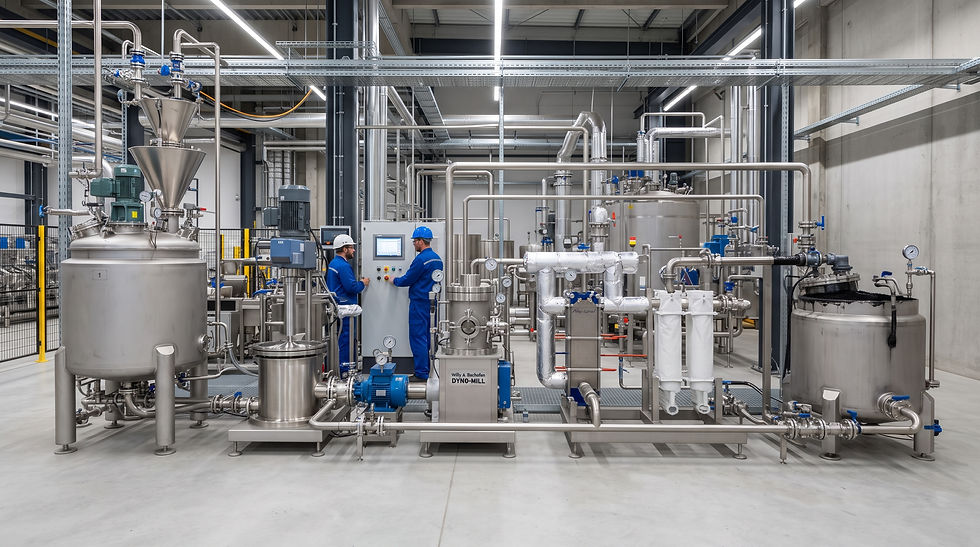
A typical conductive-slurry process can involve raw-material preparation, liquid charging, wetting, premixing, deagglomeration, fine dispersion, temperature management, filtration and final quality control. The exact sequence changes according to formulation and whether the system is designed for carbon black, CNTs, SWCNTs or a combination of conductive additives.
The key is to treat the process as a connected chain. If wetting is incomplete, the dispersion stage has to compensate. If viscosity is uncontrolled, pumping becomes difficult. If temperature rises excessively, the formulation can behave differently. If the slurry is stored too long without adequate stability, the dispersion achieved during production may not remain intact.
Mixing, Deagglomeration, Dispersion and Quality Control
A robust process should establish measurable quality checkpoints. These can include viscosity, solids content, particle or agglomerate distribution, temperature, electrical characteristics where appropriate, and stability over a defined storage period.
Sanxing can position its equipment around this process-engineering approach rather than selling a machine in isolation. That message is particularly relevant for customers planning a new production line because they are buying repeatability, not merely mechanical equipment.
Choosing Equipment for Conductive Slurry Production
Selecting CNT dispersion equipment requires more than comparing motor power. The first question should be the formulation: What conductive additive is being processed? What is its concentration? What liquid system is used? What viscosity does the slurry reach? Is the customer producing a concentrated conductive dispersion or a final electrode slurry?
The second question concerns production capacity. Laboratory equipment may be appropriate for formulation development and process validation, while pilot systems help establish scale-up parameters. Industrial production requires equipment capable of maintaining consistent processing conditions over long operating periods.
The third question is contamination. Battery materials can have strict purity requirements, so wetted components, grinding media and wear surfaces should be selected carefully. A process that achieves excellent dispersion but introduces unwanted contamination is not a successful process.
Why Particle Distribution Matters More Than Simply Grinding Finer
One of the biggest mistakes in advanced-material processing is treating the smallest particle size as automatically equal to the best result. In conductive slurry production, that approach can be misleading. The objective is a stable and useful conductive network, not a race toward the lowest possible particle-size number.
A controlled distribution can be more valuable than extreme size reduction. The process engineer therefore needs to understand the relationship between dispersion energy, agglomerate size, viscosity, additive structure and final electrode performance.
This principle creates a strong differentiator for Sanxing's content. Instead of saying that its equipment simply "grinds finer," the website can explain how process conditions are engineered around the customer's material and performance requirements.
How Temperature Control Protects Slurry Quality
Temperature is another variable that can easily be overlooked. Mechanical mixing and dispersion introduce energy into the formulation, and that energy can appear as heat. As slurry viscosity, concentration and processing intensity increase, temperature management becomes more important.
A controlled cooling system can help maintain more stable process conditions during extended production. It can also make process results more repeatable because the material is being processed within a narrower operating window.
For industrial buyers, this is an important equipment-selection criterion. A machine should not be evaluated only by whether it can process a formulation for ten minutes in a laboratory. The real question is whether the complete system can maintain the required conditions during continuous commercial production.
How to Reduce Agglomeration During CNT Processing
CNT agglomeration begins with the material's natural tendency to form bundles. The solution therefore starts before the main dispersion stage. Proper wetting, suitable carrier selection, controlled addition rates and formulation chemistry can all influence the quality of the dispersion.
Mechanical equipment then needs to deliver enough energy to distribute the CNTs without unnecessarily damaging the desired structure. Recirculation can be useful when a narrow dispersion specification requires progressive processing rather than a single aggressive treatment.
This is why a CNT conductive slurry production line should ideally be developed through testing. A formulation that performs well in one machine at laboratory scale may require different residence time, circulation strategy or equipment configuration when scaled to industrial capacity.
Wet Grinding vs Conventional Mixing for Conductive Slurries
Conventional mixing remains useful for many formulations, especially where the objective is simply to combine materials or achieve preliminary wetting. However, stubborn agglomerates can require more controlled dispersion energy than a conventional mixer can provide.
Wet grinding or media-based dispersion introduces another mechanism for breaking down agglomerates. Whether it is necessary depends on the material and target specification. Manufacturers should therefore avoid automatically selecting a bead mill simply because the word "nano" appears in a product specification.
The correct question is: What process mechanism is required to reach the required dispersion quality efficiently and consistently?
This approach protects the customer from over-specifying equipment and gives Sanxing an opportunity to demonstrate engineering expertise rather than simply presenting a catalog.
When a Complete Conductive Slurry Production Line Makes Sense
A complete line becomes increasingly attractive when production volume, quality requirements and process complexity increase. Instead of separately purchasing mixers, tanks, pumps, controls and dispersion equipment, the customer can develop a coordinated process architecture.
Competitors are already marketing dedicated conductive-slurry and SWCNT preparation lines. Boyee, for example, currently presents SWCNT slurry preparation as a dedicated production-line application and highlights dispersion, viscosity control, scale-up and consistency.
Sanxing's own homepage positions its broader offering around turnkey process design, equipment engineering, automated integration, installation and commissioning for advanced materials, including battery materials. This makes the complete-line approach a natural extension of the existing brand proposition.
Laboratory Testing Before Industrial Scale-U

Laboratory testing is one of the most valuable steps in conductive slurry development. It allows manufacturers to evaluate a real formulation before committing to industrial equipment. The test should examine not only initial dispersion but also viscosity, stability, temperature behavior and the ability to reproduce the desired result.
The laboratory stage can also reveal whether the formulation needs a single dispersion stage or a multi-stage process. This reduces the risk of purchasing an industrial system based solely on theoretical calculations.
Sanxing already promotes laboratory and scale-up capabilities across its advanced-material processing positioning, so this can become an important conversion message: test the material first, then engineer the production line around verified process conditions.
Automation and Process Control for Battery Slurry

As production volumes increase, manual control becomes increasingly difficult. Operators need to manage addition rates, mixing speed, temperature, residence time and discharge conditions while maintaining batch-to-batch consistency.
Automation can turn these variables into repeatable recipes. Sensors and PLC-based controls can help monitor critical process parameters and provide alarms when operating conditions move outside defined limits.
For a modern battery slurry production line, automation should therefore be considered part of the process architecture rather than an optional decorative feature. The goal is simple: reduce avoidable variation and make the process easier to reproduce.
How Sanxing Machinery Fits Into Conductive Slurry Processing
Sanxing Machinery's current positioning covers ultra-fine grinding and dispersion for advanced materials, with its website specifically identifying lithium-battery components, conductive carbon slurries, silicon-carbon anodes and solid electrolytes among its target applications.
That gives Sanxing a strong opportunity to build a dedicated conductive slurry processing content cluster. Instead of relying on one generic battery page, the site can create separate resources for carbon black dispersion, CNT dispersion, SWCNT slurry preparation, conductive-agent mixing and complete battery-material production lines.
The commercial path should then be straightforward:
Application problem → laboratory testing → equipment selection → process design → pilot validation → automated production line → installation and commissioning.
That journey mirrors how industrial buyers actually evaluate complex machinery.
Developing a conductive carbon, CNT or SWCNT slurry? Send Sanxing your material type, concentration, target viscosity, required dispersion quality and production capacity. Our engineering team can evaluate the processing requirements and recommend a suitable laboratory, pilot or industrial-scale configuration.
Conclusion
Conductive carbon slurry production is a strong new content opportunity for Sanxing because it connects advanced battery manufacturing with the company's existing expertise in grinding, dispersion and process engineering without repeating the subjects already heavily covered on the blog.
Frequently Asked Questions
What is conductive carbon slurry?
Conductive carbon slurry is a liquid dispersion containing conductive materials such as carbon black or carbon nanotubes. It is processed to distribute the conductive additive uniformly before or during electrode-slurry manufacturing.
Why is CNT dispersion difficult?
CNTs have a high-aspect-ratio structure and naturally form bundles or entangled networks. The processing system needs enough energy to disperse these structures while avoiding unnecessarily damaging the nanotube network.
What equipment is used for CNT conductive slurry production?
Depending on the formulation, a production system may include mixing tanks, high-shear dispersers, wet-grinding or fine-dispersion equipment, pumps, cooling systems, filtration and automated process controls. The correct configuration depends on the material and production requirements.
Is wet grinding always required for conductive slurry?
No. The appropriate technology depends on the conductive additive, formulation, agglomerate size, viscosity and required dispersion quality. Laboratory trials should be used to determine whether conventional mixing, high-shear dispersion, wet grinding or a combination is appropriate.
Can conductive slurry equipment be scaled from laboratory to industrial production?
Yes, provided the process is properly characterized. Laboratory testing can establish dispersion behavior and operating conditions that can then guide pilot and industrial equipment selection. Sanxing's broader advanced-material positioning includes laboratory testing and turnkey engineering for scale-up applications.


Comments