

Pigment Dispersion Machine for Ink and Paint: How to Reduce Agglomeration and Improve Color Consistency

Updated: Sep 19
Author: Moeez Ullah Published: September 18, 2026

Pigment Dispersion Machine for Ink and Paint: How to Reduce Agglomeration and Improve Color Consistency
Producing consistent ink and paint requires more than simply mixing pigment into a liquid carrier. Pigment particles often form agglomerates that must be properly wetted, dispersed and reduced to the required particle-size range.
This is where a pigment dispersion machine for ink and paint becomes an important part of the manufacturing process.
A properly selected grinding and dispersion system can help manufacturers improve color consistency, dispersion stability, gloss, printing performance and production efficiency while reducing problems associated with oversized particles and pigment settling.
For inkjet applications, the requirements can be even more demanding because the finished formulation must maintain stable particle distribution and reliable flow through very small printhead nozzles.
Why Pigment Dispersion Matters in Ink and Paint Manufacturing
Pigments provide the color and many of the optical properties required by inks, paints and coatings. However, pigment performance depends heavily on how effectively those particles are distributed throughout the liquid formulation.
Poor dispersion can contribute to:
inconsistent color strength;
pigment agglomeration;
poor gloss;
sedimentation;
unstable viscosity;
reduced transparency;
filtration problems;
inconsistent coating quality; and
printing problems in demanding inkjet applications.
Industrial wet grinding is therefore not simply a particle-size reduction operation. It is part of a broader process designed to achieve a stable and uniform pigment dispersion.
Research and technical literature on pigment systems also shows that particle size and dispersion have an important influence on final ink and coating performance.
What Is a Pigment Dispersion Machine?
A pigment dispersion machine is industrial equipment designed to break down pigment agglomerates and distribute solid particles uniformly within a liquid medium.
Depending on the formulation and required fineness, manufacturers may use high-speed dispersers, bead mills, sand mills, basket mills or combinations of equipment.
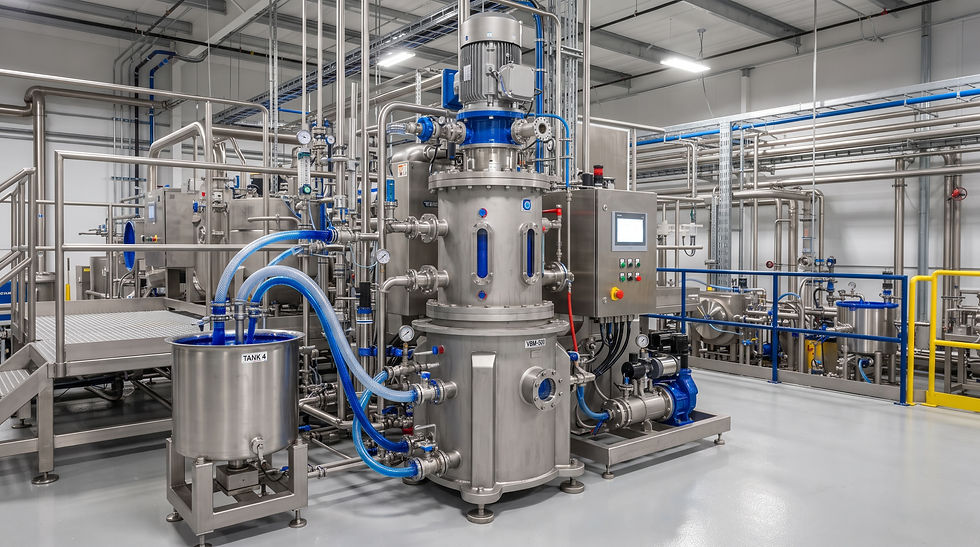
For finer applications, a bead mill for ink and paint can provide intensive wet grinding by repeatedly exposing pigment particles and agglomerates to mechanical forces generated between grinding media and the product.
The objective is to produce a controlled particle-size distribution rather than simply making the pigment "as small as possible."
This distinction is important.
A good process must balance:
target particle size;
particle-size distribution;
production capacity;
temperature control;
viscosity;
energy consumption;
grinding-media selection; and
formulation stability.
How a Bead Mill Helps Improve Pigment Dispersion
A bead mill contains a grinding chamber filled with suitable grinding media. The product passes through the chamber while mechanical energy causes repeated interactions between the grinding media and pigment agglomerates.
These interactions help reduce larger agglomerates and create a more uniform dispersion.
For manufacturers, the objective is often to improve the consistency of the finished product rather than relying on excessive processing time.
A properly engineered pigment grinding machine can help control the process by adjusting variables such as:
grinding-media size;
rotor or agitator speed;
flow rate;
residence time;
chamber design;
cooling conditions; and
number of passes.
The optimum settings depend on the pigment, liquid carrier, dispersant, viscosity and desired final specification.

Inkjet Ink Requires More Precise Pigment Dispersion
Inkjet ink is one of the more demanding applications for pigment dispersion.
Unlike many conventional paint applications, inkjet formulations must be engineered for reliable jetting and consistent print quality. Oversized particles or unstable agglomerates can create filtration and nozzle-related problems.
A suitable inkjet ink grinding machine should therefore support:
fine and controlled particle-size distribution;
stable pigment dispersion;
consistent viscosity;
efficient heat management;
low contamination;
reliable circulation; and
repeatable production.
The chemistry of the formulation also matters. Wetting and dispersing additives are commonly used to stabilize pigments and improve properties such as color strength, gloss, viscosity and long-term stability.
This means the grinding machine and formulation should be considered together rather than as completely separate parts of the manufacturing process.

Pigment Dispersion for Paints and Coatings
Paint manufacturers have different requirements depending on the final product.
Architectural paints, industrial coatings, automotive coatings and specialty coatings can require different pigment types, viscosities and particle-size targets.
A paint grinding machine should therefore be selected according to the actual formulation and production requirements.

Effective pigment dispersion can contribute to:
Better Color Development
Uniform pigment distribution helps manufacturers achieve more consistent color from batch to batch.
Improved Gloss and Appearance
Well-dispersed pigments can contribute to better surface appearance and optical properties.
Better Stability
A stable dispersion can reduce unwanted settling and agglomeration during storage.
More Consistent Application
Controlled particle distribution helps maintain predictable behavior during application and finishing. Modern coating technology also emphasizes the relationship between pigment dispersion, rheology, opacity and final coating performance.
Inkjet Ink vs. Paint: What Should the Grinding Process Prioritize?

Although both applications depend on pigment dispersion, the process priorities are not identical.
Parameter | Inkjet Ink | Paint & Coatings |
Particle control | Extremely important | Very important |
Nozzle protection | Critical | Usually not applicable |
Color consistency | Critical | Critical |
Viscosity control | Very important | Important |
Sedimentation control | Important | Very important |
Gloss | Important | Often critical |
Throughput | Important | Important |
Fine dispersion | Extremely important | Application-dependent |
Contamination control | Very important | Important |
This is why simply purchasing a generic industrial bead mill is not always the best approach.
The equipment should be matched to the formulation and the final product specification.
How to Choose the Right Pigment Grinding Machine
When selecting a pigment grinding machine, manufacturers should evaluate the complete process rather than looking only at machine capacity.

1. Define the Target Particle Size
Start with the required final particle size and distribution.
Inkjet applications can require substantially tighter particle control than many conventional paint products.
2. Evaluate Product Viscosity
High-viscosity paint, pigment concentrates and specialty formulations may require different equipment configurations from low-viscosity ink systems.
3. Select Suitable Grinding Media
Grinding-media size, material and wear characteristics can influence grinding efficiency, contamination and final product quality.
4. Consider Temperature Control
Wet grinding generates heat. Excessive temperature can affect formulation stability and product quality, so cooling capacity should be considered during equipment selection.
5. Match Capacity to Production Requirements
A laboratory machine may be suitable for formulation development, while production-scale manufacturers require equipment capable of continuous or batch processing at the required throughput.
6. Consider Maintenance and Cleaning
For manufacturers producing multiple colors or formulations, cleaning time can have a significant effect on overall production efficiency.
Vertical or Horizontal Bead Mill for Ink and Paint?
Both vertical and horizontal configurations can be used for wet grinding applications.
The correct choice depends on:
formulation characteristics;
required fineness;
throughput;
grinding-media requirements;
operating method;
cleaning requirements;
temperature control; and
production scale.
A vertical bead mill can be attractive for certain pigment and dispersion applications, while horizontal systems are also widely used for continuous wet grinding of inks, paints and coatings.
Competitors in this market commonly position both horizontal and vertical bead mills around ink, paint and pigment applications, so the stronger SEO approach is to cover the application problem first and the machine configuration second.
How to Reduce Pigment Agglomeration
Reducing agglomeration is not the responsibility of the grinding machine alone.
A reliable process normally considers the entire dispersion workflow:
Raw material preparation → Wetting → Premixing → Dispersion → Wet grinding → Cooling → Filtration → Quality control
Manufacturers should monitor:
pigment loading;
dispersant selection;
premixing quality;
grinding conditions;
temperature;
viscosity;
particle-size distribution;
filtration; and
storage stability.
This approach can be more effective than simply increasing machine speed or extending grinding time.
The formulation itself is also critical. Technical information from pigment and additive suppliers shows that dispersing agents can influence pigment wetting, viscosity, optical properties and dispersion stability.
How a Complete Grinding Solution Can Meet Different Customer Needs
Customers do not always need the same machine.

An ink manufacturer may need an ink grinding machine optimized for fine pigment dispersion, while a paint producer may prioritize throughput and viscosity handling.
A strong equipment supplier should therefore offer more than a standard machine.
Depending on customer requirements, a complete solution can include:
laboratory testing;
pilot-scale grinding;
machine selection;
customized grinding chambers;
grinding-media recommendations;
cooling systems;
circulation systems;
automation;
process integration;
production-line engineering;
installation; and
after-sales support.
This solution-based approach is particularly valuable for customers moving from laboratory formulation to commercial production.
Quality Control After Pigment Grinding
A successful grinding process should be validated through measurable product characteristics.
Common quality-control parameters include:
Particle Size
Check whether the product meets the specified particle-size range.
Particle-Size Distribution
A narrow and controlled distribution may be important for demanding applications.
Viscosity
Monitor whether grinding and formulation conditions produce the required rheological behavior.
Color Strength
Compare finished batches against a controlled standard.
Gloss and Appearance
Especially important for coatings and high-quality paint products.
Storage Stability
Evaluate whether pigments remain dispersed over the required storage period.
For inkjet formulations, filtration behavior and reliable jetting performance are also important considerations.
Why Equipment Selection Should Start With the Customer's Application
The cheapest machine is not necessarily the most economical solution.
If the equipment cannot achieve the required particle-size distribution, the manufacturer may experience:
longer processing cycles;
repeated grinding;
excessive energy consumption;
poor batch consistency;
increased filtration requirements;
product rejection; or
reduced production capacity.
A better approach is to define the customer's formulation and target specification first and then select the appropriate grinding technology.
That is particularly important for manufacturers working with inkjet ink, high-value pigments, specialty coatings and advanced materials.
Final Takeaway
A modern pigment dispersion machine for ink and paint should be selected around the finished product, not simply the machine's nominal capacity.
For paint manufacturers, the priority may be stable pigment dispersion, color consistency, gloss, opacity and production throughput.
For inkjet ink manufacturers, tighter particle control, stable viscosity, filtration performance and reliable jetting can become even more important.
The most effective solution combines the right grinding technology with appropriate process parameters, formulation chemistry, cooling, media selection and quality control.
If your production process is experiencing pigment agglomeration, inconsistent color, poor stability or inefficient grinding, the first step should be to evaluate the complete dispersion process and define the target particle-size specification.
The right pigment grinding machine can become more than a piece of equipment—it can be a key part of improving product consistency, production efficiency and customer satisfaction.
Frequently Asked Questions
What is a pigment dispersion machine?
A pigment dispersion machine is equipment used to distribute pigment particles uniformly in a liquid formulation and, depending on the machine, reduce pigment agglomerates to the required particle-size range.
What machine is used for ink pigment grinding?
Bead mills and other wet-grinding systems are commonly used for fine pigment processing. The appropriate configuration depends on the ink formulation, target particle size, viscosity and production capacity.
What is the best grinding machine for paint pigments?
There is no universal best machine. The correct paint grinding machine depends on pigment type, formulation viscosity, target fineness, throughput, temperature sensitivity and other process requirements.
Can a bead mill be used for inkjet ink?
Yes, bead mills are used for demanding fine-dispersion applications, including inkjet materials. The equipment and grinding conditions must be selected according to the formulation and particle-size requirements.
How can pigment dispersion be improved?
Improve the complete process by optimizing wetting, premixing, dispersant selection, grinding-media size, machine settings, temperature, residence time and quality-control procedures.


Comments