

Pigment Dispersion Problems in Ink and Paint: A Production Troubleshooting Guide for Manufacturers

Author: Moeez Ullah Published: September 19, 2026

Pigment Dispersion Problems in Ink and Paint: A Production Troubleshooting Guide for Manufacturers
Production Problem | Possible Cause | Area to Investigate |
Weak color strength | Incomplete pigment dispersion | Grinding and formulation |
Grainy paint surface | Large agglomerates | Grinding conditions |
Inkjet nozzle problems | Oversized particles or unstable dispersion | Fine grinding and filtration |
Pigment settling | Poor stabilization or particle distribution | Formulation + dispersion |
Excessive heat | High energy input or unsuitable process conditions | Mill + cooling |
Long grinding time | Inefficient grinding conditions | Media, flow and machine parameters |
Batch-to-batch variation | Inconsistent process control | Grinding and QC |
High operating cost | Rework, long cycles or inefficient energy use | Complete process |
Poor gloss | Incomplete dispersion | Pigment processing |
Production downtime | Separation, maintenance or process instability | Equipment and process |
Introduction: When the Formula Is Not the Real Problem
A paint or ink batch can fail even when the formulation appears correct.
The pigment may be correct. The resin may be correct. The additives may be correct. The viscosity may even appear to be within specification.
Yet the final product can still show:
weak color strength;
inconsistent shade;
poor gloss;
sedimentation;
graininess;
unstable viscosity;
filtration problems;
long production cycles; or
poor inkjet printing performance.
In many cases, manufacturers immediately look for a formulation problem.
But there is another question worth asking:
Is the pigment actually dispersed properly?
This is where pigment dispersion problems become a manufacturing issue rather than simply a formulation issue.
The grinding and dispersion stage determines how effectively pigment agglomerates are broken down and distributed throughout the liquid system. A problem at this stage can create additional processing time, rejected batches, rework and inconsistent product quality.
For manufacturers producing printing inks, inkjet inks, paints and coatings, understanding the relationship between dispersion quality and production performance can help identify problems earlier.
What Are Pigment Dispersion Problems?
Pigment dispersion problems occur when pigment particles are not adequately wetted, deagglomerated or distributed throughout the liquid formulation.
Pigments can naturally form clusters or agglomerates. The purpose of the dispersion process is to break down these structures and achieve the particle-size distribution required by the final product.
A dispersion problem does not always appear as an obvious grinding failure.
Instead, it may appear later as:
unexpected color variation;
poor tinting strength;
reduced gloss;
sedimentation;
poor transparency;
increased viscosity;
inconsistent filtration;
print defects; or
excessive grinding time.
This makes troubleshooting particularly important.
A manufacturer should not simply ask:
“Is the mill running?”
The more useful question is:
“Is the complete grinding process producing the particle-size distribution and dispersion stability that the formulation requires?”
The Hidden Cost of Poor Pigment Dispersion

Poor dispersion can affect more than the quality of one batch.
It can create a chain reaction throughout the production process.
For example:
Poor premixing → inefficient grinding → extended processing → higher energy consumption → temperature increase → formulation instability → filtration/rework → delayed delivery
That means a dispersion problem can become a production-efficiency problem.
For high-value ink and coating formulations, the cost of reprocessing can be significant.
Manufacturers should therefore evaluate grinding efficiency not only by final particle size but also by:
processing time;
energy consumption;
temperature stability;
batch consistency;
equipment utilization;
rework rate;
cleaning frequency; and
finished-product quality.
This broader approach can reveal opportunities that are invisible when operators look only at the final grind result.
7 Common Pigment Dispersion Problems and What They Can Indicate
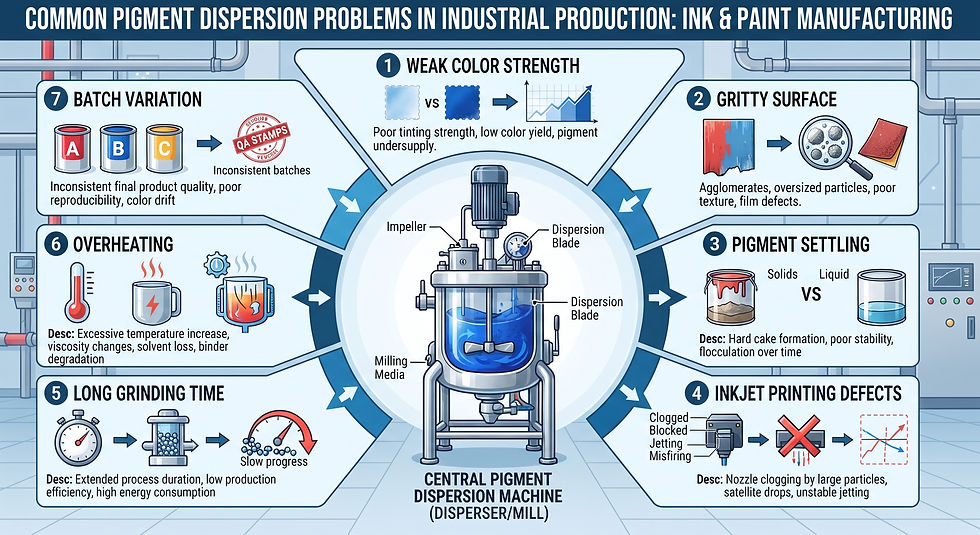
1. Weak Color Strength
If a pigment does not develop the expected color strength, incomplete dispersion can be one area worth investigating.
Large agglomerates can prevent the pigment from achieving the desired effective surface area and distribution.
Possible contributing factors include:
insufficient grinding;
unsuitable grinding conditions;
incorrect media selection;
inadequate premixing;
poor wetting;
excessive viscosity; or
unsuitable dispersant concentration.
Instead of automatically increasing grinding time, manufacturers should determine why the current process is failing to achieve the required dispersion.
2. Grainy or Gritty Paint
A rough or gritty finished coating can indicate that larger particles or agglomerates remain in the formulation.
This may become particularly noticeable after application.
Potential causes include:
Incomplete Deagglomeration
The grinding stage may not be providing enough effective particle-particle interaction.
Incorrect Grinding Conditions
Rotor speed, flow rate, media loading and residence time can all influence the process.
Poor Premixing
If large pigment clusters enter the grinding stage without adequate premixing, the mill may require significantly more processing time.
Contamination
Unexpected particles introduced through equipment wear or raw materials can also affect finished-product quality.
3. Pigment Settling During Storage
A product can leave the production line looking acceptable and still develop problems later.
Sedimentation can occur when particles are not adequately stabilized within the formulation.
However, grinding alone is not always the complete solution.
The final stability depends on the interaction between:
particle size;
particle-size distribution;
pigment density;
formulation viscosity;
dispersants;
surface chemistry; and
storage conditions.
This is why simply grinding for longer does not necessarily eliminate sedimentation.
A better strategy is to investigate both dispersion quality and formulation stability.
4. Inkjet Ink Shows Printing Problems

Inkjet applications create another level of sensitivity.
The finished ink must maintain a highly controlled particle system so that it can flow and jet consistently through the printing system.
If the dispersion contains problematic oversized particles or unstable agglomerates, manufacturers may encounter:
inconsistent print density;
streaking;
filtration difficulties;
nozzle-related problems;
poor storage stability; or
inconsistent color output.
For this reason, inkjet ink dispersion should be evaluated using more than a visual inspection.
Particle-size measurement, filtration performance, viscosity and storage stability should be considered together.
A suitable ink grinding machine should therefore be matched to the formulation rather than selected solely by nominal production capacity.
5. Grinding Takes Too Long
Long grinding cycles are one of the easiest production problems to notice.
But the solution is not necessarily to increase machine speed.
If grinding takes longer than expected, investigate:
Feed Characteristics
Is the premix entering the mill with excessive agglomeration?
Viscosity
Is the product too viscous for the selected process conditions?
Grinding Media
Is the media appropriate for the required particle-size reduction?
Flow Rate
Is the material moving through the grinding chamber at the appropriate rate?
Cooling
Is temperature increasing enough to affect formulation behavior?
Target Specification
Is the process attempting to achieve a finer particle size than the finished product actually requires?
The final question is particularly important.
Over-processing is still inefficient processing.
6. The Product Gets Too Hot During Grinding
Wet grinding generates mechanical energy and heat.
For some ink and paint formulations, excessive temperature can affect:
resin behavior;
dispersant performance;
viscosity;
solvent characteristics;
chemical stability; and
final product quality.
When a process becomes too hot, manufacturers sometimes reduce machine speed immediately.
That may reduce heat generation—but it can also increase processing time.
A better troubleshooting approach is to evaluate the complete energy balance.
Consider:
cooling capacity;
product flow rate;
grinding-media loading;
rotor speed;
viscosity;
chamber configuration; and
number of passes.
The objective is not simply lower temperature.
The objective is:
efficient grinding at a controlled temperature.
7. Batch-to-Batch Color Variation
One of the most frustrating production problems is when two batches made from apparently identical raw materials produce different color strength or shade.
This can indicate inconsistency in the dispersion process.
Manufacturers should compare:
Process Variable | Batch A | Batch B |
Premixing time | — | — |
Feed viscosity | — | — |
Grinding time | — | — |
Flow rate | — | — |
Temperature | — | — |
Grinding media | — | — |
Particle size | — | — |
Particle-size distribution | — | — |
Final viscosity | — | — |
This type of process record can help identify whether the problem originates from raw materials, formulation or grinding conditions.
A Better Way to Troubleshoot Pigment Dispersion

Instead of changing several variables simultaneously, manufacturers can use a structured troubleshooting sequence.
Step 1: Confirm the Raw Materials
Check pigment characteristics, moisture, particle condition and batch consistency.
Step 2: Check Premixing
Determine whether the pigment is adequately wetted and distributed before fine grinding.
Step 3: Measure Viscosity
Record viscosity at the relevant process temperature.
Step 4: Measure Particle Size
Do not rely only on visual inspection or a grind gauge when the application requires tighter particle control.
Step 5: Check Particle-Size Distribution
Two batches can have similar average particle sizes while having different distributions.
Step 6: Review Grinding Conditions
Compare:
speed;
flow;
media;
temperature;
residence time; and
number of passes.
Step 7: Check Final Stability
Evaluate settling, viscosity change and other relevant storage characteristics.
This creates a much more useful troubleshooting process than simply increasing grinding time.
Why Particle Size Alone Does Not Tell the Whole Story

Particle size is important—but average particle size is not the entire picture.
Imagine two pigment dispersions with a similar average particle size.
One has a narrow distribution.
The other contains a large population of fine particles plus a small number of oversized agglomerates.
For some applications, those oversized particles can cause disproportionate problems.
This is particularly important for demanding inkjet applications.
Therefore, manufacturers should consider:
Average particle size + particle-size distribution + dispersion stability
rather than relying on one measurement.
This is one reason modern pigment-processing systems need to be evaluated as complete processes rather than simple grinding machines.
How the Grinding Machine Can Affect Dispersion Quality
The equipment itself can influence the process through:
grinding chamber design;
agitator or rotor configuration;
media separation;
cooling performance;
circulation characteristics;
material flow;
wear resistance;
sealing;
operating speed; and
process control.
A pigment dispersion machine should therefore be evaluated against the actual material and production requirements.
For example, an inkjet pigment concentrate may require very different conditions from a high-viscosity industrial coating.
There is no single machine setting that is optimal for every formulation.
From “Machine Problem” to “Process Problem”
One of the most useful changes a manufacturer can make is to stop viewing dispersion failures as isolated machine problems.
The real system is:
Raw materials → Premixing → Wetting → Dispersion → Grinding → Cooling → Separation → Filtration → Quality Control → Finished Product
A failure anywhere in this chain can influence the final result.
This is why equipment suppliers that can support testing, process development, machine selection and production-scale implementation can provide more value than suppliers focused only on selling a machine.
How Manufacturers Can Reduce Rework
Reducing rework starts with identifying problems before a batch reaches final production.
Useful controls include:
Incoming Material Testing
Verify pigment and liquid raw materials before processing.
Process Monitoring
Track temperature, viscosity, flow and grinding conditions.
Particle-Size Testing
Measure particle size at appropriate stages rather than only at final inspection.
Batch Documentation
Record process parameters for every production batch.
Equipment Maintenance
Inspect wear components and separation systems regularly.
Standardized Operating Procedures
Keep important process conditions consistent between batches.
These measures can turn dispersion from a reactive problem into a controlled manufacturing process.
When Should You Consider New Pigment Dispersion Equipment?
Replacing a grinding system should not be the first response to every dispersion problem.
However, equipment evaluation becomes worthwhile when manufacturers repeatedly experience:
long grinding cycles;
poor particle-size control;
excessive heat;
frequent maintenance;
inconsistent batches;
high rework;
inadequate production capacity;
contamination concerns; or
inability to achieve the required fineness.
Before purchasing new equipment, conduct a material trial whenever possible.
The most useful question is not:
“What is the most powerful grinding machine?”
It is:
“Which grinding system can consistently achieve our required product specification at an acceptable production cost?”
Building a Customer-Focused Grinding Solution

Different customers have different problems.
An inkjet manufacturer may prioritize particle-size distribution and filtration.
A decorative paint manufacturer may prioritize throughput and color consistency.
An automotive coating producer may focus on appearance, gloss and repeatability.
A specialty pigment producer may require extremely fine dispersion and tight process control.
Therefore, a professional supplier should be able to discuss:
material properties;
target particle size;
production capacity;
formulation viscosity;
grinding media;
temperature control;
equipment configuration;
automation;
quality control; and
scale-up requirements.
This application-first approach can help customers select equipment based on their actual manufacturing needs rather than simply comparing machine specifications.
A Practical Pigment Dispersion Troubleshooting Checklist
Before changing your formulation or purchasing a new machine, ask:
Material
Is the pigment consistent between batches?
Is the pigment adequately wetted?
Has the raw material condition changed?
Formulation
Has viscosity changed?
Is the dispersant appropriate?
Is pigment loading consistent?
Grinding
Is the grinding media suitable?
Is the process reaching the required particle size?
Is the particle-size distribution controlled?
Is the grinding time reasonable?
Temperature
Is the product overheating?
Is cooling capacity sufficient?
Does viscosity change significantly with temperature?
Equipment
Is the mill properly maintained?
Is the separation system operating correctly?
Is there evidence of equipment wear?
Is the machine appropriate for the formulation?
Quality
Are color strength and shade consistent?
Is the product stable during storage?
Are filtration and application tests consistent?
This checklist can help narrow the source of a dispersion problem before costly process changes are made.
Conclusion
Pigment dispersion problems are rarely just a single-machine issue.
They can originate from raw materials, formulation, premixing, grinding conditions, temperature, grinding media, equipment configuration or quality-control procedures.
For ink and paint manufacturers, the goal should therefore not be to grind for the longest possible time or select the largest machine available.
The goal is to create a repeatable dispersion process that achieves the required particle-size distribution, stability, color performance and production efficiency.
For demanding products such as inkjet inks, specialty pigments and advanced coatings, this becomes even more important.
A properly selected pigment grinding machine, combined with controlled formulation and process parameters, can help manufacturers reduce rework, improve batch consistency and make production more predictable.
When dispersion problems continue despite formulation adjustments, it may be time to evaluate the grinding process itself—and determine whether the current equipment is truly matched to the application.
Frequently Asked Questions
What are the most common pigment dispersion problems?
Common problems include pigment agglomeration, weak color strength, poor gloss, sedimentation, inconsistent particle size, excessive grinding time, high temperature and batch-to-batch variation.
Why does pigment dispersion become inconsistent between batches?
Inconsistency can result from changes in raw materials, premixing, viscosity, grinding-media conditions, flow rate, temperature, residence time or other process variables.
How can pigment agglomeration be reduced?
Agglomeration can be addressed through appropriate wetting, premixing, dispersant selection and controlled wet grinding. The exact process depends on the pigment and formulation.
Why does my pigment grinding process take too long?
Long grinding cycles can result from unsuitable grinding media, excessive viscosity, inefficient flow, inadequate premixing, inappropriate machine settings or an overly demanding target specification.
Why does inkjet ink require fine pigment dispersion?
Inkjet formulations require controlled particle size and dispersion stability to support consistent flow, filtration and reliable printing performance. Oversized or unstable particles can create application problems.
Can a bead mill solve every pigment dispersion problem?
No. A bead mill is one part of the overall process. Raw materials, formulation chemistry, premixing, grinding conditions, cooling and quality control all influence dispersion quality.
How do I know whether I need a new pigment grinding machine?
Consider equipment evaluation when repeated problems such as excessive processing time, poor particle-size control, overheating, contamination, frequent maintenance or inconsistent batches cannot be resolved through process optimization.


Comments