

Prevent Contamination: Choosing the Right Grinding Chamber Materials for High-Purity Wet Milling

Author: Moeez Ullah Published: October 12, 2026

Prevent Contamination: Choosing the Right Grinding Chamber Materials for High-Purity Wet Milling
In high-purity sectors like lithium-ion battery slurries (LFP/silicon-carbon), MLCC dielectrics, and digital inks, even <5 ppm of metallic wear debris (Fe, Cr, Ni) can cause battery short-circuits, dielectric breakdown, or color shifts.
Selection of grinding chamber materials for bead mill units requires balancing three competing physical properties: hardness/wear resistance, thermal conductivity (κ), and chemical/solvent compatibility.
Silicon Carbide (SiC) stands out as the premium ceramic liner for heat-sensitive, high-throughput processes due to its exceptional thermal conductivity (>120 W/(m⋅K))—roughly six to seven times higher than Yttria-Stabilized Zirconia.
Polyurethane (PU) and engineered polymers provide an economical, metal-free, and impact-resistant solution for abrasive water-based mineral slurries, but suffer from poor thermal dissipation and vulnerability to aggressive organic solvents.
Pairing the chamber material with matching grinding media (e.g., ZrO2 liners with YSZ beads, or SiC liners with silicon carbide/zirconia media) prevents differential hardness abrasion, extending equipment lifespan while eliminating foreign particulate pickup.
Quick Overview
Does simply using ceramic grinding beads prevent contamination in high-energy wet milling? No. Grinding beads collide continuously against the inner chamber walls, agitation pins, and separation components at tip speeds between 8 and 14 m/s. If the chamber walls are constructed from standard stainless steel or an incompatible liner, severe abrasive scuffing releases metallic ions directly into the process fluid. Choosing the correct grinding chamber materials for bead mill hardware is the single most critical engineering decision for protecting product purity and ensuring process repeatability.
The Hidden Cost of Chamber Wear: Why Material Purity Dictates Product Performance
In standard industrial milling (such as agricultural chemicals or construction coatings), minor wear of alloy steel is considered an acceptable maintenance cost. However, in advanced functional materials, chamber wear acts as a direct chemical contaminant:
Battery Slurries (Cathodes & Anodes): Free iron (Fe), copper (Cu), or chromium (Cr) particles shed from metal liners dissolve electrochemically during initial charging, plating onto the anode as conductive dendrites that puncture the separator and cause catastrophic thermal runaway.
Electronic Ceramics (MLCC & Thermistors): Multi-layer ceramic capacitors operating under intense electric fields (>10 kV/mm) experience localized electrical conduction around metallic trace impurities, leading to insulation resistance (IR) breakdown.
Digital Inks & Transparent Coatings: Microscopic metallic flaking oxidizes rapidly, shifting delicate CMYK color profiles, degrading transparency, and altering the electrostatic surface charge (ζ-potential) of suspended nanoparticles, triggering flocculation.

Detailed Evaluation: The 4 Core Grinding Chamber Materials
To prevent contamination, bead mill engineering relies on four primary chamber liner and rotor materials. Each exhibits distinct mechanical, thermal, and chemical tradeoffs.

1. Silicon Carbide (SiC) — The Thermal & Wear Benchmark
Sintered Silicon Carbide is widely recognized as the gold-standard engineering ceramic for ultra-fine nano grinding and continuous high-viscosity production.
Mohs Hardness: ∼9.5 (Vickers Hardness ≈2200–2600 HV).
Thermal Conductivity (κ): 120–150 W/(m⋅K).
Key Strengths: Because wet milling converts up to 90% of kinetic motor energy into heat, temperature-sensitive formulations (such as UV monomers, biologic slurries, and battery binders) can easily overheat. SiC conducts heat out to the mill's cooling jacket at nearly five times the rate of stainless steel and seven times that of zirconia, preventing thermal gelation and binder scorching.
Limitations: Lower fracture toughness (KIc≈3.5–4.5 MPa⋅m1/2) compared to zirconia, requiring precision manufacturing to prevent mechanical shock during assembly or sudden thermal shock during CIP cycles.
2. Yttria-Stabilized Zirconia (ZrO₂ / YSZ) — The Toughness Champion
Zirconium oxide stabilized with 3 mol% yttrium oxide exhibits a unique "transformation toughening" mechanism that resists mechanical chipping and cracking.
Mohs Hardness: ∼8.5–9.0 (Vickers Hardness ≈1200–1300 HV).
Thermal Conductivity (κ): 2–3 W/(m⋅K) (Low).
Key Strengths: Exceptional fracture toughness (KIc≈6.0–10.0 MPa⋅m1/2). When using high-density YSZ micro-grinding media (0.05–0.3 mm), matching the chamber lining with ZrO2 ensures identical hardness, virtually eliminating dissimilar-material scuffing. It is chemically inert across both strongly acidic and basic formulations.
Limitations: Poor thermal conductivity. Heat generated in high-energy pin-type chambers dissipates slowly, requiring lower agitator tip speeds or chilled cooling water systems.
3. Polyurethane (PU) & Engineered Polymers — The Impact-Absorbing Workhorse
High-grade cast polyurethane liners provide a metal-free, non-ceramic alternative tailored for specific lower-temperature applications.
Hardness: Shore 90A – 75D.
Key Strengths: Elastic deformation allows polyurethane to absorb bead impacts without chipping. It provides superior erosion resistance against highly abrasive, irregular mineral particles (e.g., quartz, titanium dioxide, calcium carbonate) and is more cost-effective to replace than monolithic ceramic sleeves.
Limitations: Susceptible to degradation and swelling when exposed to aggressive organic solvents (ketones, esters, aromatic hydrocarbons). Additionally, polyurethane is a thermal insulator (κ≈0.2 W/(m⋅K)), restricting its use to water-based, heat-tolerant slurries.
4. Hardened Alloy & Tungsten Carbide Steels — Traditional Heavy-Duty Option
Specialized tool steels, hardened chromium alloys, and tungsten carbide liners represent the conventional industrial standard.
Key Strengths: Unmatched structural rigidity, simple machining of complex geometries, and tolerance to rapid temperature shifts.
Limitations: Metallic contamination is inevitable. Even hardened alloy steels release sub-micron iron, chromium, and tungsten particles under constant bead abrasion, disqualifying them from electronic-grade and clean battery chemistries.
Technical Material Matrix: Side-by-Side Comparison
Engineering Property | Silicon Carbide (SiC) | Zirconia (ZrO2) | Polyurethane (PU) | Hardened Alloy Steel |
Vickers Hardness (HV) | 2200–2600 | 1200–1300 | Shore 70D (∼20 HV) | 600–800 |
Fracture Toughness (KIc) | 3.5–4.5 MPa⋅m1/2 | 8.0–10.0 MPa⋅m1/2 | Extremely High (Ductile) | 20–30 MPa⋅m1/2 |
Thermal Conductivity (κ) | 120–150 W/(m⋅K) | 2.5–3.0 W/(m⋅K) | 0.2 W/(m⋅K) | 30–45 W/(m⋅K) |
Metallic Contamination Risk | Zero (<1 ppm) | Zero (<1 ppm) | Zero (Metal-free) | High (Fe, Cr Spikes) |
Solvent Resistance | Universal (pH 0–14) | Universal (pH 1–13) | Poor (Water-based only) | Good (Prone to acid etch) |
Relative Material Cost | High | High | Moderate | Low to Moderate |
Best Process Fit | Heat-sensitive nano inks, LFP | MLCC, electronic ceramics | Mining, abrasive pigments | Heavy industrial paint |
The Critical Synergy: Pairing Chamber Materials with Media Hardness
A frequent error in wet milling configuration is mismatching the grinding chamber liner with the grinding media:

ΔH=∣Hbeads−Hliner∣
When media hardness significantly exceeds chamber hardness (ΔH≫0), the beads rapidly abrade the chamber walls, leading to liner grooving, increased clearance gaps, and slurry contamination. Conversely, if an excessively hard chamber surface faces lower-durability media, the beads will shatter, causing media fragmentation and separator screen blinding.
Ideal Pairing 1 (Electronic Ceramics): Sintered YSZ grinding beads (0.05–0.1 mm) paired with a monolithic ZrO2 or SiC grinding chamber liner.
Ideal Pairing 2 (Lithium Battery Slurries): High-density YSZ beads paired with a Silicon Carbide (SiC) chamber liner to achieve optimal cooling and zero metal contamination.
Ideal Pairing 3 (Water-Based Industrial Minerals): Toughened glass or silicate beads paired with a Polyurethane (PU) liner.
Sanxing Feirong’s Integrated Zero-Contamination Engineering
Selecting the right material is only half the equation; equipment architecture determines whether that material can perform without mechanical failure. Shenzhen Sanxing Feirong Machinery engineers specialized vertical bead mills to eliminate contamination at its source:
1. Monolithic Sintered Ceramic Liners & Rotors
Rather than relying on thin plasma-sprayed ceramic coatings—which can peel or delaminate under localized shear stress—Sanxing's vertical bead mills feature solid, isostatically pressed and sintered Silicon Carbide and Zirconia liners, agitator pins, and dynamic separation rings. This provides true long-term wear protection down to the nanoscale.
2. Elimination of Dynamic Mechanical Seals
Traditional horizontal bead mills incorporate mechanical face seals that require barrier fluids. If a seal leaks, hydrocarbons or glycols instantly contaminate the slurry. Sanxing’s vertical seal-free design uses fluid dynamic sealing, eliminating mechanical seals, O-rings in the grinding zone, and cooling oil leakage entirely.
3. Dynamic Centrifugal Separation Systems

Static metal wire screens easily clog and suffer severe abrasive wear when running micro media. Sanxing employs dynamic ceramic centrifugal separation rotors that push media outward while allowing smooth, screen-free liquid discharge. This setup reliably supports 0.05 mm micro beads without screen blinding.
Step-by-Step Selection Guide: Choosing Your Mill Chamber Material
Audit Contamination Tolerance: Quantify your slurry's allowable parts-per-million (ppm) threshold for metallic ions (Fe,Ni,Cr). If allowable Fe<10 ppm, disqualify all metal alloys immediately.
Evaluate Slurry Solvent Chemistry: Inspect your formulation's liquid phase. If using ketones, toluene, esters, or UV monomers, avoid polyurethane and organic elastomers; specify solid ceramics (SiC or ZrO2).
Calculate Thermal Load: Determine whether your product is temperature-sensitive (Tmax<40∘C). If temperature limits are tight, Silicon Carbide (SiC) is mandatory to ensure rapid heat dissipation through the cooling jacket.
Match Media Hardness: Choose your grinding media size and composition first based on the required final D99 particle size, then match the chamber material to provide equivalent or superior wear resistance.
Inspect Separation Mechanism: Ensure separator components use the same ceramic materials as the chamber to avoid localized wear points.
External Industry References & Material Science Standards
Comprehensive material properties and wear characteristics of advanced technical ceramics: Ceramic Source & Advanced Technical Ceramics (NIST).
Chemical and mechanical testing standards for wear in wet milling equipment: ASTM G99: Standard Test Method for Wear Testing with a Pin-on-Disk Apparatus.
Impact of metal particle impurities on lithium-ion battery safety and short-circuits: Metallic Contaminant Dendrite Growth in Lithium-Ion Cells (ScienceDirect).
Thermal conductivity standards and laser flash measurement in technical ceramics: ISO 22007-4: Plastics and Ceramics — Determination of Thermal Conductivity.
Conclusion
Preventing contamination in ultra-fine wet milling requires matching your chamber material to your formulation's chemical, thermal, and mechanical profile. By pairing solid sintered Silicon Carbide or Zirconia liners with micro YSZ grinding media inside a seal-free vertical bead mill, processing plants eliminate metal pickup, maintain thermal stability, and achieve consistent sub-100nm dispersions.
Explore Sanxing Feirong Machinery’s Equipment:
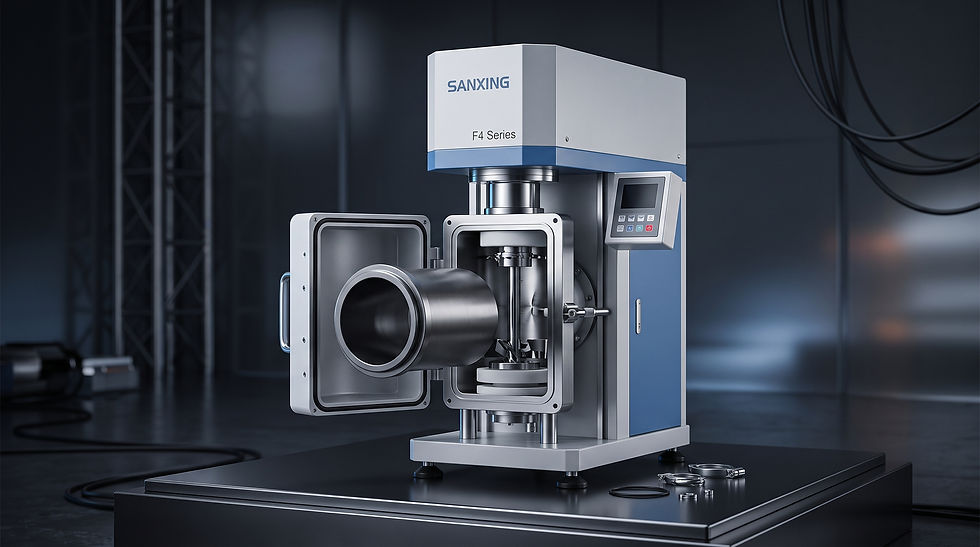
Discover our SP Series Vertical Bead Mill (Seal-Free) equipped with all-ceramic chambers for industrial production.
Review the W Series & F4 Series Laboratory Bead Mills for R&D trials with interchangeable SiC, ZrO2, and PU liners.
Contact Sanxing Feirong Machinery to consult on chamber material selection and arrange pilot grinding trials.
Frequently Asked Questions
Why not use stainless steel if my product isn't white?
Contamination is not just an aesthetic issue. Even if discoloration is not visible, metallic debris catalyzes decomposition in battery electrolytes, degrades dielectric resistance in ceramics, and causes flocculation in sensitive colloidal suspensions.
Is Silicon Carbide or Zirconia better for nano bead mills?
It depends on your thermal dissipation needs. Silicon Carbide is the clear winner for heat-sensitive, high-energy operations due to its outstanding thermal conductivity (120–150 W/(m⋅K)). Zirconia offers higher fracture toughness (KIc) and resistance to mechanical impact, but its lower thermal conductivity can cause slurry temperatures to rise faster.
Can ceramic chamber liners crack during operation?
Monolithic ceramic liners can crack if subjected to severe mechanical shock or sudden thermal shock (e.g., pumping freezing solvent into a hot 80∘C chamber). Sanxing Feirong protects ceramic components with precision-engineered cushioned jacket sleeves and automated temperature interlocks to prevent thermal shock damage.
How does a seal-free vertical bead mill prevent contamination compared to a horizontal mill?
Horizontal mills require mechanical seals running directly against the slurry path, creating wear surfaces and risking cooling oil leakage into the product. Sanxing’s vertical seal-free architecture removes dynamic mechanical seals completely, preventing liquid contamination and seal-related maintenance downtime.


Comments