

Vertical Bead Mill for Lithium Battery Materials: The Complete Guide for Engineers & R&D Professionals

Updated: Sep 2
By Khan | Foreign Trade Manager, Shenzhen Sanxing Feirong Machinery Co., Ltd. Published: July 2026 | Reading Time: 6 minutes
Introduction
As the global demand for lithium-ion batteries continues to surge — driven by electric vehicles, energy storage systems, and consumer electronics — the pressure on engineers and R&D teams to achieve ultra-fine, consistent particle sizes in battery material processing has never been greater.
One piece of equipment sits at the heart of this challenge: the Vertical Bead Mill.
In this guide, we break down everything R&D engineers and production professionals need to know about vertical bead mills for lithium battery material processing — including how they work, why they outperform alternatives, and what to look for when selecting one.
What Is a Vertical Bead Mill?
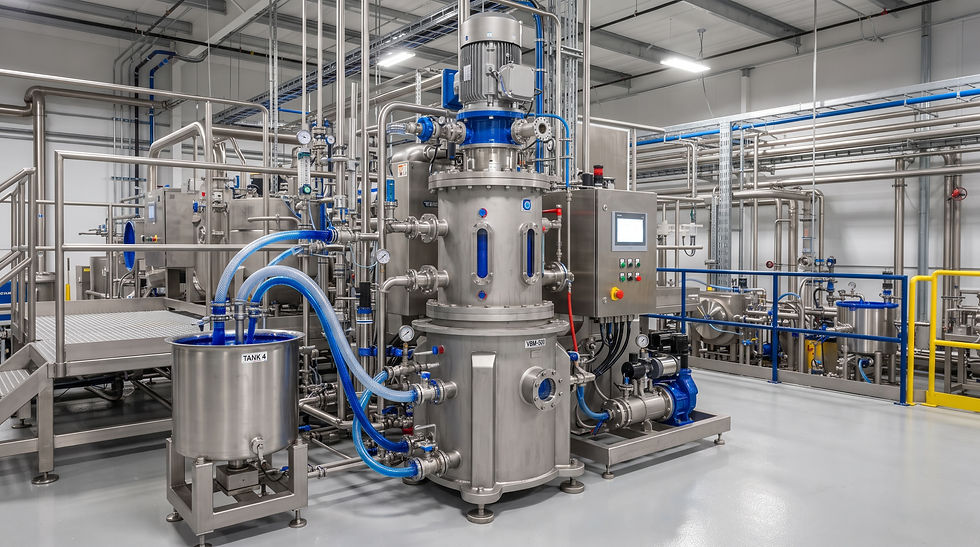
A vertical bead mill (also known as a vertical stirred bead mill or vertical sand mill) is a wet grinding and dispersion machine used to reduce particle sizes of solid materials suspended in a liquid medium.
In lithium battery manufacturing, vertical bead mills are used to process critical materials including:
Cathode materials — LFP (Lithium Iron Phosphate), NMC, NCA
Anode materials — graphite, silicon carbon composites
Solid electrolyte materials
Conductive carbon slurries — carbon black, carbon nanotubes
Separator coatings — alumina, boehmite
How Does a Vertical Bead Mill Work?
Understanding the working principle is essential for R&D engineers who need to optimize grinding parameters.
Here is the step-by-step process:
Material Feed — Slurry enters through the feed inlet at the top of the grinding chamber
High-Speed Agitation — The agitator rotor spins at high speed, creating intense shear forces between the grinding beads
Dual Zone Grinding — Material passes through both the inner grinding zone and outer grinding zone, maximizing contact between beads and particles
Separator Turbine — A built-in separator turbine retains grinding beads inside the chamber while allowing only finished, fine-ground product to pass through
Top Discharge — Processed slurry exits cleanly through the top discharge outlet
Integrated Cooling — A cooling water jacket maintains temperature stability throughout the process — critical for heat-sensitive battery materials
The result is uniform, ultra-fine particle size distribution — a non-negotiable requirement for high-performance lithium battery materials.
Why Vertical Bead Mill Is Ideal for Lithium Battery R&D
1. Superior Particle Size Control
Vertical bead mills achieve D50 particle sizes as fine as 100nm or below, which is essential for improving ionic conductivity, electrochemical performance, and battery cycle life.
2. Flexible Bead Size Range
Vertical mills support a wider range of bead sizes compared to horizontal mills, giving R&D teams more flexibility when experimenting with different grinding media for different battery chemistries.
3. Excellent Thermal Management
The dual cooling water system (inlet and outlet) prevents thermal degradation of sensitive cathode and anode materials — a critical advantage when processing NMC or silicon-based anodes.
4. Easy Cleaning & Material Switching
In R&D environments where you switch between multiple battery formulations, vertical bead mills offer faster cleaning cycles and lower cross-contamination risk — saving valuable lab time.
5. Scalable from Lab to Production
Start your trials on a laboratory-scale vertical bead mill and scale up to industrial production without changing your core grinding parameters — ensuring R&D results translate directly to production.
6. Low Energy Consumption
Gravity-assisted bead movement in vertical mills reduces unnecessary energy waste, delivering lower kWh per kg of processed material compared to horizontal alternatives.

Key Parameters Engineers Should Optimize
When running a vertical bead mill for lithium battery materials, these are the critical parameters to control:
Parameter | Recommended Range | Impact |
Bead Size | 0.3mm – 1.0mm | Particle fineness |
Bead Fill Rate | 70% – 85% | Grinding efficiency |
Rotor Speed (tip speed) | 8 – 14 m/s | Shear intensity |
Slurry Viscosity | 500 – 5000 mPa·s | Flow behavior |
Solid Content | 30% – 60% | Throughput vs fineness |
Cooling Water Temp | 10°C – 25°C | Thermal control |
Flow Rate | Application-specific | Residence time |
Fine-tuning these parameters allows R&D teams to achieve optimal D50/D90 distribution for their specific battery chemistry.
Common Applications in Lithium Battery Manufacturing
LFP Cathode Slurry Grinding Achieving sub-micron LFP particle size dramatically improves rate capability and cycle stability. Vertical bead mills deliver consistent D50 values below 500nm.
Graphite Anode Dispersion Uniform dispersion of graphite particles in slurry ensures homogeneous coating on copper foil — directly impacting energy density and cycle life.
Silicon Carbon Composite Processing Silicon expands during lithiation. Ultra-fine, uniform Si-C composites processed in vertical bead mills help manage volume expansion and improve first-cycle efficiency.
Conductive Carbon Slurry Carbon black and CNT dispersions require intense shear to break agglomerates. Vertical bead mills achieve excellent deagglomeration with minimal contamination.
Solid Electrolyte Grinding Next-generation solid-state batteries require ultra-fine solid electrolyte powders. Vertical bead mills deliver the required fineness with minimal contamination risk.
Sanxing Vertical Bead Mill — Built for Battery Material Excellence
At Shenzhen Sanxing Feirong Machinery Co., Ltd., we have spent 32 years engineering precision grinding solutions for the most demanding applications in advanced materials manufacturing.
Our vertical bead mills are specifically designed to meet the exacting requirements of lithium battery R&D and production:
Dual grinding zone design — inner + outer zones for maximum efficiency
Full cooling water jacket — top and bottom temperature control
Precision separator turbine — zero bead contamination in product
Available in lab, pilot, and industrial scale
25 patents in grinding and dispersion technology
Exported to 50+ countries — trusted by global battery manufacturers
Frequently Asked Questions
Q: What bead material is best for lithium battery applications? A: Zirconia (ZrO₂) beads are the most recommended — high density, low wear, and minimal contamination risk for battery-grade materials.
Q: Can a vertical bead mill handle high-viscosity battery slurries? A: Yes. Sanxing vertical bead mills are engineered to handle slurries up to 5000 mPa·s with stable, consistent performance.
Q: What is the minimum particle size achievable? A: Our vertical bead mills can achieve D50 values below 100nm depending on material, bead size, and process parameters.
Q: Is the equipment suitable for laboratory R&D scale? A: Absolutely. We offer lab-scale vertical bead mills starting from 0.3L chamber volume — ideal for small batch R&D trials.
Conclusion
For engineers and R&D professionals working on lithium battery materials, the vertical bead mill is one of the most versatile, efficient, and cost-effective grinding solutions available today.
Whether you are processing LFP cathode slurries, graphite anodes, or next-generation solid electrolytes — the right vertical bead mill delivers the particle size consistency, thermal stability, and process flexibility your R&D demands.
Ready to Discuss Your Application?
At Sanxing Feirong Machinery, we work directly with R&D engineers and production teams to recommend the right grinding solution for your specific battery material and production requirements.
Email: info@sanxing-machinery.com
Let's talk about your application — no sales pressure, just engineering expertise.
Tags: vertical bead mill, lithium battery materials, bead mill for LFP, cathode slurry grinding, battery material processing, ultra-fine grinding, sand mill for battery, NMC grinding, anode slurry dispersion, Sanxing bead mill, powder processing equipment, wet grinding machine
© 2026 Shenzhen Sanxing Feirong Machinery Co., Ltd. All rights reserved.


Comments