

Vertical Bead Mill for Rare Earth Materials Processing: A Complete Guide to Ultra-Fine Grinding

Updated: Aug 5
Author: Mr,Sanxing | Shenzhen Sanxing Feirong Machinery Co., Ltd.
Published: July 2026 | Reading Time: 8 minutes
Category: Bead Mill Technology | Rare Earth Materials | Grinding & Dispersion.
Introduction
Rare earth materials — including neodymium, praseodymium, dysprosium, cerium, and lanthanum compounds — are essential to permanent magnets, catalysts, phosphors, and polishing powders used across electronics, automotive, and clean energy industries. Processing these materials to the precise, ultra-fine particle sizes required for high-performance applications demands specialized grinding technology.
This guide covers everything engineers and production teams need to know about using a vertical bead mill for rare earth materials processing — how it works, why it outperforms alternative grinding methods, and what to consider when selecting equipment for your application.

What Makes Rare Earth Material Grinding Different
Rare earth materials present unique processing challenges that make equipment selection especially important:
High value per kilogram — grinding losses or contamination carry a much higher cost impact than with commodity minerals
Magnetic material sensitivity — rare earth magnet powders (NdFeB) can be sensitive to oxidation and require careful atmosphere and moisture control during processing
Strict particle size requirements — magnet powders, phosphors, and polishing compounds each require tightly controlled, application-specific particle size distributions
Purity requirements — even trace contamination from grinding media can compromise magnetic, optical, or catalytic performance.
A vertical bead mill for rare earth materials processing addresses each of these challenges through precise mechanical design and process control.

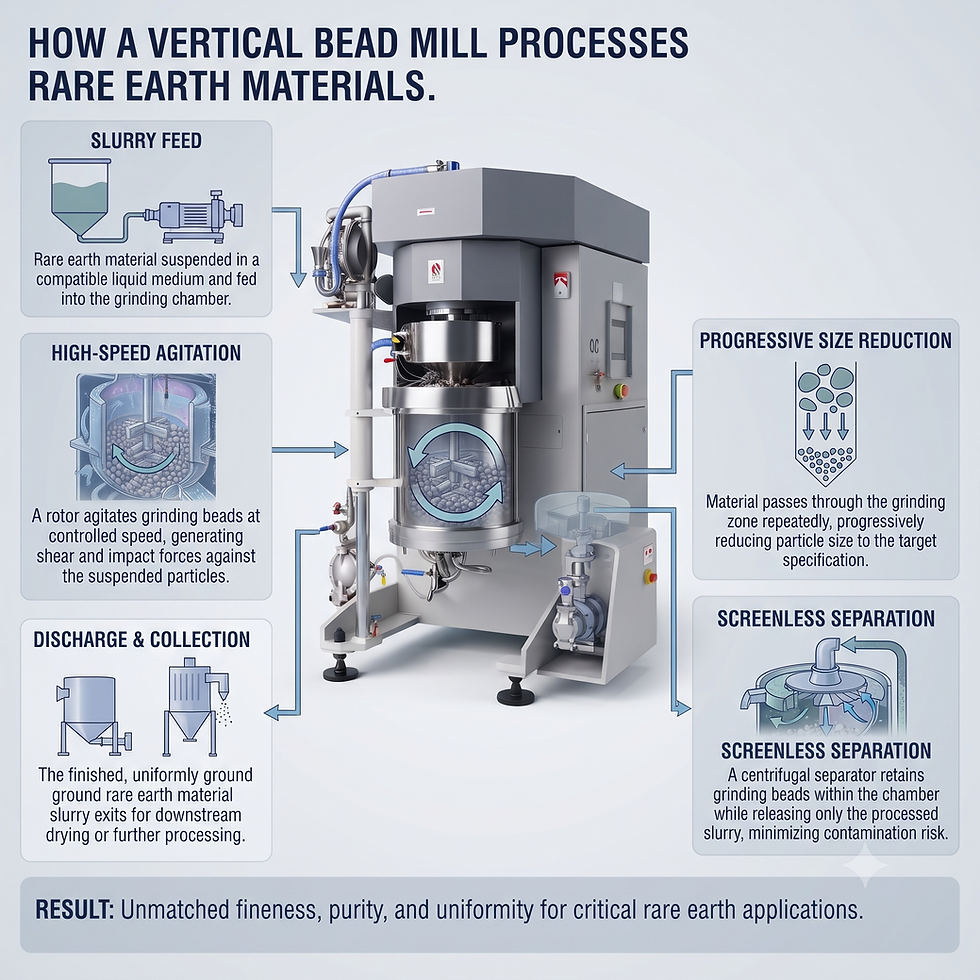
How a Vertical Bead Mill Processes Rare Earth Materials
Slurry Feed — Rare earth material is suspended in a compatible liquid medium and fed into the grinding chamber
High-Speed Agitation — A rotor agitates grinding beads at controlled speed, generating shear and impact forces against the suspended particles
Progressive Size Reduction — Material passes through the grinding zone repeatedly, progressively reducing particle size to the target specification
Screenless Separation — A centrifugal separator retains grinding beads within the chamber while releasing only the processed slurry, minimizing contamination risk
Discharge & Collection — The finished, uniformly ground rare earth material slurry exits for downstream drying or further processing.
Vertical Bead Mill vs. Traditional Grinding Methods for Rare Earth Materials
Factor | Traditional Ball Mill | Vertical Bead Mill |
Achievable particle size | 1–10 μm | 50nm – 500nm |
Contamination risk | Higher (steel media) | Lower (zirconia media) |
Particle size distribution | Broad | Narrow |
Energy efficiency | Lower | Higher per unit fineness |
Scalability lab-to-production | Difficult | Linear, predictable |
Batch-to-batch consistency | Moderate | High |
For rare earth applications requiring fine, consistent, high-purity output — such as sintered NdFeB magnet powder or fine rare earth polishing compounds — a vertical bead mill consistently outperforms traditional ball milling.

Key Rare Earth Materials Processed with Vertical Bead Mills
Neodymium-Iron-Boron (NdFeB) — magnet powder for permanent magnets in motors, wind turbines, and electronics
Samarium Cobalt (SmCo) — high-temperature-stable magnet materials
Cerium Oxide (CeO₂) — precision polishing compounds for glass, semiconductors, and optics
Lanthanum Compounds — catalysts and optical glass additives
Yttrium-based Phosphors — used in LED and display technology
Dysprosium & Praseodymium Additives — used to enhance magnet performance at high temperatures.

Critical Parameters for Rare Earth Material Grinding
Parameter | Typical Range | Why It Matters |
Bead size | 0.1mm – 1.0mm | Determines minimum achievable particle size |
Bead fill rate | 70% – 85% | Affects grinding efficiency and throughput |
Rotor tip speed | 6 – 16 m/s | Controls shear intensity |
Slurry solids content | 30% – 50% | Balances throughput against fineness |
Cooling water temperature | 10°C – 25°C | Prevents thermal degradation of sensitive compounds |

Why Choose a Vertical Bead Mill for Rare Earth Materials Processing
1. Superior Particle Size Control Vertical bead mills achieve fine, consistent particle sizes essential for magnetic performance and optical clarity in rare earth applications.
2. Minimized Contamination High-purity zirconia grinding beads and screenless separation significantly reduce metallic contamination — critical given the high value and performance sensitivity of rare earth materials.
3. Scalable ProductionProcess parameters developed at lab scale translate reliably to industrial production, reducing costly rework during scale-up.
4. Energy-Efficient OperationGravity-assisted bead movement reduces unnecessary energy consumption — an important cost factor given the energy-intensive nature of rare earth processing overall.

Frequently Asked Questions
What particle size can a vertical bead mill achieve for rare earth materials?Depending on the specific material and bead size used, vertical bead mills can achieve D50 particle sizes as fine as 50–500 nanometers for rare earth compounds such as NdFeB and cerium oxide.
What grinding media is best for rare earth magnet powder processing?High-purity zirconia (ZrO₂) beads are recommended, as they minimize metallic contamination that could compromise magnetic performance.
Can a vertical bead mill handle rare earth materials sensitive to oxidation?Yes, with appropriate sealed system design and controlled atmosphere, vertical bead mills can process oxidation-sensitive rare earth materials safely.
Is vertical bead milling suitable for small-batch rare earth R&D?Yes, lab-scale vertical bead mills allow small-batch formulation and process development before scaling to full production.
Sanxing Vertical Bead Mills for Rare Earth Material Processing
Shenzhen Sanxing Feirong Machinery Co., Ltd. has engineered precision grinding solutions for advanced material industries, including rare earth materials, for over 32 years.
Our vertical bead mills offer:
Screenless centrifugal separation for minimal contamination
Zirconia bead compatibility from 0.01mm to 2.0mm
Integrated cooling system for temperature-sensitive materials
Available from lab scale to full industrial production
25 patents in grinding and dispersion technology
Exported to 50+ countries

Conclusion
Rare earth material processing demands equipment capable of precise, contamination-free, and scalable particle size reduction. A vertical bead mill for rare earth materials processing delivers the fine particle control, purity, and production scalability that magnet manufacturers, phosphor producers, and specialty chemical companies require.
Ready to discuss your rare earth material processing application?Contact Sanxing Feirong Machinery — our engineering team works directly with manufacturers to recommend the right grinding solution for your specific material and production requirements.
Email: info@sanxing-machinery.comPhone: +86 139 2527 6960
Tags: vertical bead mill, rare earth materials, NdFeB magnet powder, cerium oxide grinding, rare earth processing equipment, ultra-fine grinding, Sanxing bead mill, powder processing equipment.
© 2026 Shenzhen Sanxing Feirong Machinery Co., Ltd. All rights reserved.


Comments