

Bead Mill After-Sales Technical Support: What to Expect From a Reliable Manufacturer


Buying a bead mill is a capital decision, but the machine itself is only half the purchase. The other half — the part most buyers underweight until something goes wrong — is after-sales technical support: installation help, operator training, spare parts, and someone who picks up the phone when your fineness readings drift off-spec at 2 a.m. on a production run.
If you're evaluating powder processing or wet-grinding equipment suppliers right now, this is the checklist worth working through before you sign a purchase order, not after.
Why After-Sales Support Matters More Than the Purchase Price
A bead mill is a precision system: grinding chamber tolerances, bead loading ratios, flow rates, and cooling all have to work together to hit a target particle size consistently, batch after batch. Get any one variable wrong during commissioning and you'll either underperform your fineness spec or burn through media and downtime chasing it.
Two suppliers can sell what looks like the same machine on a spec sheet. What actually separates them is what happens in the weeks and years after the crate is opened — and that's the part a spec sheet never tells you.
What Full-Service Bead Mill Technical Support Should Include
Pre-Installation Process Consultation
Support should start before the machine ships. A supplier who understands your material — viscosity, target fineness, batch size, abrasiveness — can flag process risks (media wear rate, wrong disc configuration, undersized motor) while it's still a drawing, not a delivered machine.
Installation and Commissioning
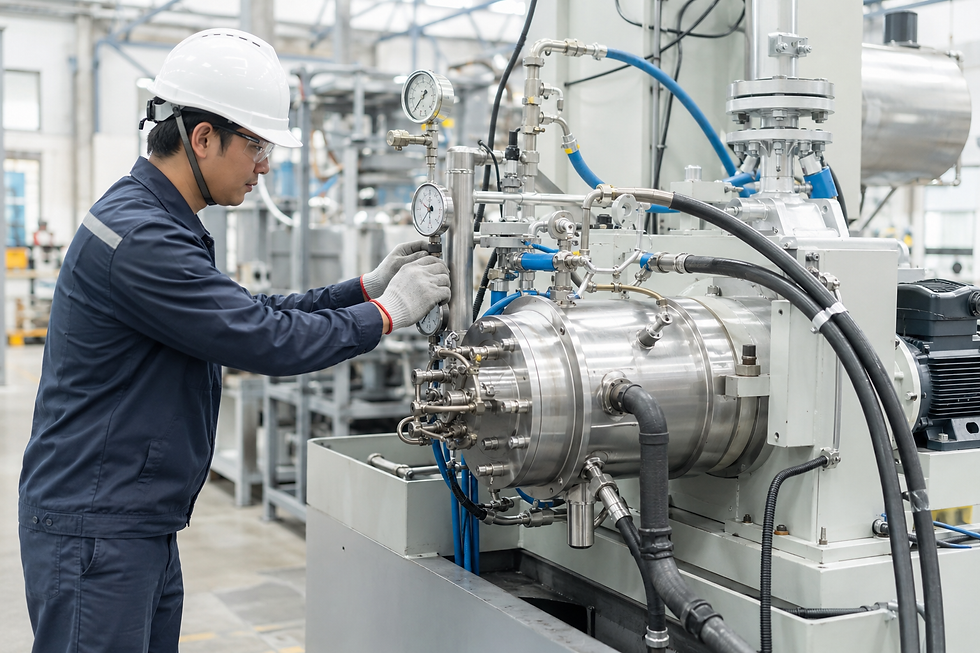
This covers utility hookups, initial bead loading, seal and cooling system checks, and a first production run walked through with your operators. Some suppliers offer this on-site; others run it remotely via video with a local technician on the ground. Either is workable — what matters is that it's included, not billed as a surprise add-on.
Operator Training
Most "machine problems" reported in year one are actually operator error: wrong bead fill ratio, incorrect startup sequence, or seals run dry during cleaning. Structured training at commissioning — not a PDF manual — prevents most of these calls from ever happening.
Spare Parts Availability

Wear parts (seals, liners, screens, grinding discs) fail on a predictable schedule. A supplier who stocks common spares and can ship internationally within days keeps a parts failure a minor event instead of a week of stopped production. Ask specifically about lead times on wear parts, not just whether parts are "available."
Ongoing Troubleshooting and Remote Diagnostics
Fineness drifting, unusual noise, temperature spikes — a responsive technical team should be reachable by call or video and able to walk your operator through first-line diagnostics before escalating to an on-site visit.
Red Flags: Signs a Supplier Won't Support You After the Sale
Support terms aren't written into the contract — only promised verbally
No named technical contact, just a general sales inbox
Vague or evasive answers about spare parts lead time
No documented commissioning or training process
Reviews or case studies mention long response times after purchase
If a supplier hesitates to put support commitments in writing, that hesitation is the answer.
How Sanxing Feirong Machinery Supports Customers From Quotation to Commissioning
Our process is built around the idea that a sale isn't complete until the line is running at spec in your facility. That includes process consultation before manufacturing begins, installation guidance (on-site or remote depending on project scope), operator training at commissioning, and a stocked spare parts program for common wear components. For EPC and turnkey production lines specifically, this support extends across the full system, not just the mill itself — you can read more in our guide to [turnkey powder processing production lines].
The Real Cost of Poor After-Sales Support
Unplanned downtime on a production bead mill isn't just a maintenance cost — it's lost output, missed delivery dates, and in continuous-process lines, potential rework of an entire batch. A support gap that costs a few hours of an engineer's time to fix at the supplier's end can cost days on your production floor. When you're comparing quotes, treat support terms as a cost line item, not a soft factor.
Questions to Ask Before You Buy

What's included in commissioning — and is it in writing?
Who is my named technical contact after the sale?
What's the average lead time on wear parts to my region?
Do you offer remote diagnostics, and what's the typical response time?
Can I speak to an existing customer about their support experience?
Frequently Asked Questions
What does "after-sales technical support" typically cover for a bead mill?
It generally includes installation/commissioning assistance, operator training, spare parts supply, and ongoing troubleshooting for the operating life of the machine.
How long should spare parts take to arrive?
This varies by region and part, but a supplier with a stocked parts program should quote a specific lead time — not "as soon as possible." Ask for a number.
Is remote support as effective as on-site support?
For most fineness, seal, or startup issues, video-based remote diagnostics resolve the problem without a site visit. On-site visits are typically reserved for mechanical failures or full-line commissioning.
Should after-sales support be included in the machine price, or billed separately?
Basic commissioning and training should be included. Extended service contracts, on-site visits beyond an agreed scope, or expedited parts shipping are reasonably billed separately — but this should be clear in the quote, not discovered later.
Comments