

Validate Your Process Before Spending a Single Dollar on Capital Equipment: Inside Sanxing Feirong's Free Pilot Grinding & Analytical Testing Program!

Author: Moeez Ullah Published: November 06, 2026

Validate Your Process Before Spending a Single Dollar on Capital Equipment: Inside Sanxing Feirong's Free Pilot Grinding & Analytical Testing Program!
Zero-Risk Capital Procurement: Procuring industrial-scale wet grinding machinery without empirical testing exposes chemical and battery plants to severe financial risk; Sanxing Feirong’s free pilot program validates particle size targets ($D_{50}$ and $D_{99}$) before a purchase order is ever signed.
End-to-End Rheological & Kinetic Mapping: Using 1 to 5-liter client slurry submissions, our process engineers map non-Newtonian viscosity shifts, screen micro-media sizes ($0.05\text{–}1.0\text{ mm}$), optimize rotor tip speeds ($6\text{–}14\ \text{m/s}$), and track thermal dissipation ($\Delta T$).
Traceable Analytical Verification: Every trial pass is quantified using ISO 13320 laser diffraction particle size analyzers, dynamic rheometers, zeta potential ($\zeta$) electrokinetic meters, and ICP-OES trace metal spectrometry.
Strict Intellectual Property Protection: All international sample evaluations are executed inside access-controlled laboratory bays under legally binding bilateral Non-Disclosure Agreements (NDAs), with full live video streaming available for overseas engineering teams.
Mathematical Scale-Up Certainty: Empirical specific energy consumption ($\text{kWh/ton}$) recorded on our W Series and F4 Series laboratory vertical mills translates directly into guaranteed throughput and motor sizing for our industrial SP Series production lines.
The Pilot Testing Program at a Glance
Program Component | Technical Specification / Testing Protocol |
Testing Facility Location | Sanxing Feirong R&D Application Testing Center, Shenzhen, China |
Required Sample Volume | $1.0\text{ to }5.0\ \text{Liters}$ (Aqueous or organic solvent slurries) |
Test Mill Platforms | W Series & F4 Series Seal-Free Vertical Laboratory Nano Bead Mills |
Available Grinding Media | $0.05\text{ mm}, 0.1\text{ mm}, 0.2\text{ mm}, 0.3\text{ mm}, 0.4\text{ mm}, 0.6\text{ mm}, 0.8\text{ mm}$ ($95\%$ YSZ, $\text{SiC}$) |
Interchangeable Chambers | Solid Sintered Silicon Carbide ($\text{SiC}$), Yttria Zirconia ($\text{ZrO}_2$), Polyurethane, 316L SS |
Analytical Instrumentation | Laser Diffraction PSD ($10\text{ nm–}3,000\ \mu\text{m}$), Rotational Viscometer, ICP-OES, Zeta Sizer |
Turnaround Time & Deliverable | 5–7 Business Days; Full Engineering Dossier + Treated Slurry Sample Return |
The High Cost of Guesswork: Why Theoretical Sizing Fails in Nanoscale Wet Grinding
When engineering teams specify wet milling machinery based solely on vendor catalog capacities or theoretical calculations, costly commissioning failures frequently follow on the factory floor:
Non-Newtonian Dilatancy Traps: As primary particles deagglomerate below $200\text{ nm}$, specific surface area expands exponentially. Free solvent is immobilized on particle surfaces, causing sudden shear-thickening viscosity spikes. A machine sized for low-viscosity fluids will choke, blind its discharge screen, and trip over-pressure relays.
Surface Passivation Stripping & Re-Agglomeration: Applying excessive impact kinetic energy ($E_k = \frac{1}{2}mv^2$) with oversized grinding beads can fracture delicate crystal lattices (such as LFP cathodes or $\text{BaTiO}_3$ dielectrics) or strip polymeric dispersants, triggering irreversible flocculation.
Thermal Degradation: Without measuring the exact frictional heat transfer rate of a specific slurry, facilities routinely undersize cooling chillers, resulting in thermal plasticization of active ingredients or premature monomer curing.
Sanxing Feirong’s free pilot grinding and analytical testing program eliminates these hazards by generating physical proof of performance prior to capital expenditure.
Inside the 6-Stage Laboratory Validation Workflow
Every client sample arriving at our Shenzhen R&D Application Testing Center progresses through a documented, six-stage analytical workflow:
Stage 1: Confidential Intake & Baseline Rheology Audit
Before shipping, Sanxing executes a bilateral Non-Disclosure Agreement (NDA) to protect proprietary client formulations. Upon sample arrival, laboratory chemists measure initial solids concentration, pH, carrier viscosity across varying shear rates ($1\text{ to }1,000\ \text{s}^{-1}$), and baseline particle size distribution ($D_{10}, D_{50}, D_{90}, D_{99}$).
Stage 2: Chamber Metallurgy & Grinding Media Selection
Engineers configure our laboratory W Series or F4 Series vertical seal-free bead mill to match the chemical and thermal demands of the slurry:
Thermal-Sensitive Slurries (e.g., Reactive Diluents, Agrochemical SCs, Battery Cathodes): Fitted with solid sintered Silicon Carbide ($\text{SiC}$) chambers ($\kappa > 120\ \text{W/(m}\cdot\text{K)}$) to maximize heat extraction.
Ultra-Pure Electronic & Optical Slurries (e.g., MLCC Ceramics, CMP Ceria, Nano-$\text{TiO}_2$): Fitted with $95\%$ Yttria-Stabilized Zirconia ($\text{ZrO}_2$) liners and $0.05\text{–}0.1\text{ mm}$ micro-beads to eliminate color contamination and heavy metal pickup.
Stage 3: Instrumented Multi-Pass Grinding Trials
The slurry is processed using simulated plug-flow recirculation or pass-by-pass discrete batching. Throughout the run, automated data loggers record:
Gross motor power ($P_{\text{gross}}$) and no-load idle power ($P_{\text{idle}}$).
Agitator rotor tip speed ($v_t = \pi \cdot d \cdot n / 60$, tested across $6\text{ to }14\ \text{m/s}$).
Slurry inlet temperature, discharge temperature, and cooling jacket $\Delta T$.
Dynamic centrifugal separation stability (confirming zero media carry-over and zero screen blinding).
Stage 4: In-House Analytical Verification
Sub-samples extracted at regular energy intervals (e.g., Pass 1, Pass 3, Pass 5, Pass 8) undergo laboratory testing:
Laser Diffraction PSD (ISO 13320): Plotting the progressive shift of the bell curve, tracking $D_{50}$ reduction, and confirming the elimination of coarse tail particles ($D_{99}$ and $D_{99.9}$).
Colloidal Stability & Zeta Potential ($\zeta$): Verifying that electrostatic or steric stabilization remains intact ($\vert{}\zeta\vert{} > 30\ \text{mV}$) and identifying the exact over-grinding threshold where re-agglomeration begins.
ICP-OES Elemental Purity Check: Confirming that foreign metallic leaching ($\text{Fe, Cr, Ni}$) remains strictly below $<1\text{–}3\text{ ppm}$.
From Lab Bench to Gigafactory: The Specific Energy Scale-Up Law
The primary engineering objective of our pilot program is establishing the Specific Energy Curve—the definitive mathematical bridge between a $1\text{-liter}$ laboratory trial and a $5,000\text{-liter/hour}$ industrial production line.
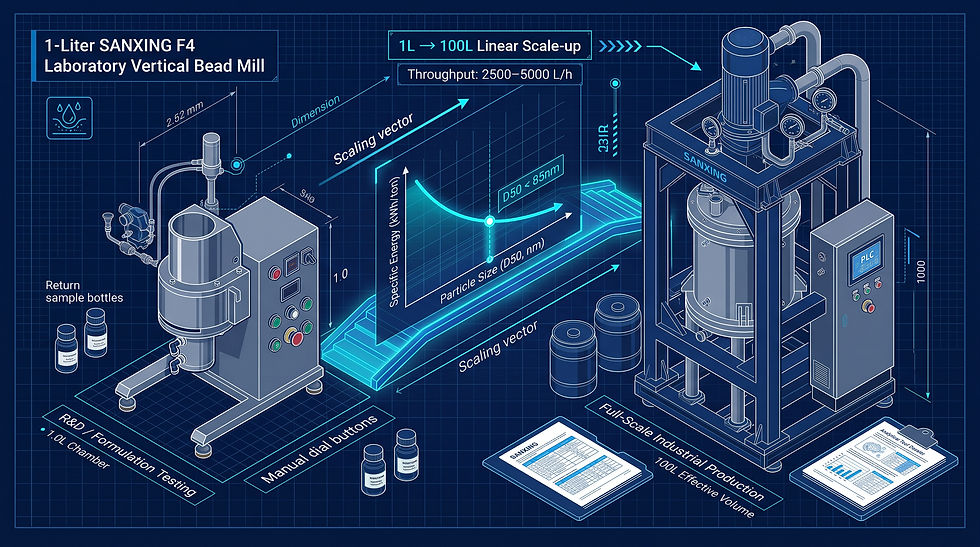
Using the net specific energy ($E_m$) validated during the laboratory trial:
$$E_m = \frac{(P_{\text{gross}} - P_{\text{idle}}) \cdot t}{m_{\text{slurry}}} \quad [\text{kWh/ton}]$$
Once $E_m$ is established (for example, $160\text{ kWh/ton}$ in the log above), scaling up to an industrial Sanxing SP Series Vertical Seal-Free Bead Mill is a direct calculation:
If the client requires a commercial production throughput ($\dot{M}$) of $0.5\text{ tons/hour}$ ($500\text{ kg/h}$), the required net shaft power transferred into the slurry is:
$$P_{\text{net, industrial}} = \dot{M} \cdot E_m = 0.5\ \text{t/h} \times 160\ \text{kWh/t} = 80\ \text{kW}$$
Because Sanxing’s laboratory W/F4 Series and industrial SP Series share identical vertical seal-free fluid dynamics, pin-counter-pin shear geometry, and dynamic centrifugal separation ratios, the industrial machine is guaranteed to reproduce the exact particle size distribution curve achieved in the laboratory trial.
Comparison: Blind Equipment Procurement vs. Sanxing Validated Procurement
Procurement Factor | Standard Blind Equipment Purchase | Sanxing Validated Pilot Program |
Upfront Financial Commitment | High (Purchase order required upfront) | $0 (Free exploratory laboratory trial) |
Particle Size Guarantee ($D_{50}/D_{99}$) | Estimated ("Should reach sub-micron") | Empirically verified via ISO 13320 laser diffraction |
Over-Grinding & Re-Agglomeration | Discovered after commissioning | Identified & mapped in lab energy curves |
Grinding Media Specification | Guessed by sales representative | Optimized across $0.05\text{–}0.8\text{ mm}$ trial screenings |
Chiller & Utility Sizing | Rough rule-of-thumb estimation | Calculated from exact $\Delta T$ calorimetric data |
Post-Trial Product Evaluation | Impossible prior to machine delivery | Milled sample shipped back for client application testing |
Step-by-Step Guide: How Global Clients Participate in the Program
Technical Consultation & NDA Signing: Contact our foreign trade engineering team with your material parameters (carrier liquid, initial particle size, target $D_{50}/D_{99}$, and required hourly production rate). We sign a bilateral NDA immediately.
Sample Preparation & Dispatch: Package $1.5\text{ to }5.0\text{ liters}$ of pre-mixed slurry (or dry active powder plus dispersant recipe) along with the Material Safety Data Sheet (MSDS) and ship via international courier (DHL/FedEx) to our Shenzhen facility.
Live Video or In-Person Trial Execution: Witness the trial in person at our Shenzhen R&D Center, or join our engineers via a live, multi-camera video conference to watch your slurry run through the vertical seal-free bead mill and view laser diffraction readouts in real time.
Receipt of Technical Dossier & Treated Sample: Within 5 to 7 business days, receive your comprehensive PDF Analytical Trial Report—complete with PSD overlay graphs, energy curves, and equipment sizing—alongside a return shipment of the milled nano-slurry so your internal QA team can test coating, sintering, or electrochemical performance in your own lab.
Conclusion & Reserve Your Laboratory Testing Slot Today
Purchasing wet grinding equipment should never be a leap of faith. By taking advantage of Shenzhen Sanxing Feirong Machinery’s Free Pilot Grinding & Analytical Testing Program, you obtain ironclad empirical proof of your formulation’s particle size distribution, purity, and energy consumption before spending a single dollar on capital machinery.
Validate Your Formulation with Our Engineering Team:
Explore our W Series & F4 Series Laboratory Bead Mills used in our pilot testing bays.
Review our industrial SP Series Vertical Bead Mill (Seal-Free) for full-scale commercial production.
Contact Sanxing Feirong Machinery today to request our sample shipping guidelines, sign a confidential NDA, and reserve your free pilot grinding slot!
Frequently Asked Questions
Q: Is the pilot grinding and analytical testing program truly free of charge?
A: Yes. For qualified B2B industrial manufacturers, EPC contractors, and institutional R&D teams evaluating equipment procurement, Sanxing Feirong provides standard pilot wet milling trials and laser diffraction PSD characterization completely free of charge. Clients only cover the courier shipping cost of their material samples.
Q: What if our slurry uses flammable solvents or moisture-sensitive materials?
A: Our Shenzhen Application Center is equipped with explosion-proof (ATEX-compliant) ventilation hoods, closed-loop nitrogen/argon inert gas blanketing lines, and chilled-water loops down to $5^\circ\text{C}$, enabling safe processing of NMP battery slurries, volatile ketones, acrylate monomers, and reactive electrolytes.
Q: Why can we trust that results from a 1-liter lab mill will match a 100-liter industrial mill?
A: Unlike competitors who test on simple benchtop stirrers that bear no resemblance to industrial mills, Sanxing’s laboratory W and F4 Series are miniature structural replicas of our industrial SP Series. Both use top-driven seal-free vertical shafts, solid ceramic chambers, and dynamic centrifugal media separators, ensuring linear scale-up via specific energy ($\text{kWh/ton}$).Conclusion & Reserve Your Laboratory Testing Slot Today
Purchasing wet grinding equipment should never be a leap of faith. By taking advantage of Shenzhen Sanxing Feirong Machinery’s Free Pilot Grinding & Analytical Testing Program, you obtain ironclad empirical proof of your formulation’s particle size distribution, purity, and energy consumption before spending a single dollar on capital machinery.
Validate Your Formulation with Our Engineering Team:
Explore our W Series & F4 Series Laboratory Bead Mills used in our pilot testing bays.
Review our industrial SP Series Vertical Bead Mill (Seal-Free) for full-scale commercial production.
Contact Sanxing Feirong Machinery today to request our sample shipping guidelines, sign a confidential NDA, and reserve your free pilot grinding slot!


Comments