

Bead Mill for WC-Co Hard Metal Powder: Wet Milling for Cemented Carbide Cutting Tools

Author: Moeez Ullah Published: August 29, 2026

Bead Mill for WC-Co Hard Metal Powder: Wet Milling for Cemented Carbide Cutting Tools
At a Glance | Detail |
Focus keyword | Bead mill for WC-Co hard metal powder |
Core material | Tungsten carbide (WC) powder bonded with cobalt (Co) binder phase |
Why it matters | Grain size directly sets the hardness-vs-toughness balance in the finished cutting tool |
Typical starting particle size | 0.5–5 µm WC, 0.5–3 µm Co, reduced further during milling |
Typical milling time | 6–48 hours depending on target grain size and equipment |
Primary applications | Cutting tool inserts, mining/drilling tools, wear-resistant components |
Nearly every modern cutting tool insert, drill bit, and wear-resistant component made from cemented carbide starts the same way: tungsten carbide and cobalt powders wet-milled together until they're homogeneously mixed and reduced to a tightly controlled particle size. Get that step wrong, and no amount of downstream sintering skill fully compensates. Here's what a bead mill for WC-Co hard metal powder processing actually needs to deliver.
What Is WC-Co Powder and Why Does It Need Wet Milling?
WC-Co, commonly called cemented carbide or hard metal, combines the extreme hardness of tungsten carbide with cobalt as a ductile metal binder that holds the carbide grains together and provides fracture toughness. Before sintering, WC and Co powders — along with grain-growth inhibitors like chromium carbide or vanadium carbide in many formulations — have to be intimately mixed and ground to a uniform, fine particle size. This mixing and grinding step is typically done in an organic solvent like ethanol or hexane, using hard-metal grinding media, over an extended milling cycle.
Wet Milling vs Dry Milling for WC-Co
Wet milling in a liquid carrier disperses heat more effectively than dry milling, reduces the risk of oxidation during processing, and allows dispersants to help keep the powder from re-agglomerating between the mixing step and the pressing/sintering stage — which is why wet milling remains the dominant industrial route for WC-Co powder preparation despite dry milling being simpler in principle.
Why Particle Size Determines Cutting Tool Performance
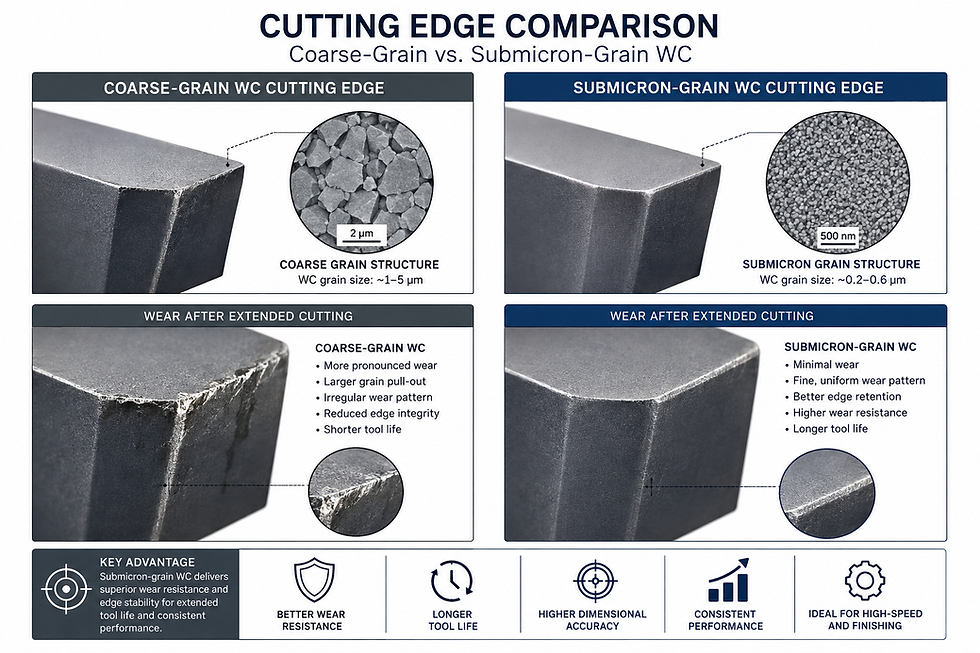
Submicron and Nanoscale WC Grain Size: The Modern Standard
Cutting tool performance research consistently points to finer WC grain size as the path to better tool life: studies on WC-Co cutting tools have found that tools with submicron WC grain sizes in the 0.4–0.8 µm range delivered the longest tool life among the grades tested, with wear occurring primarily through cobalt binder removal followed by grain fracture and mechanical removal (WC-Co cutting tool wear characteristics study, PMC). That's a direct, measurable link between the milling step's output and how long a finished tool actually lasts in service.
Grain Growth Control During Milling
The challenge isn't simply grinding WC-Co powder as fine as possible — it's controlling grain growth so the milled powder's particle size actually translates into the correspondingly fine grain structure after sintering. Patent literature on cemented tungsten carbide production specifies stringent grain size uniformity requirements, achieved through careful starting powder selection and process control, specifically to minimize abnormal grain growth that can create stress concentration points and lead to premature tool failure (tungsten carbide milling cutter manufacturing overview, Patsnap).
The Core Production Challenge: Homogeneous Mixing Without Contamination

Avoiding Iron and Contamination Pickup
WC-Co is extremely abrasive, and if the milling equipment's wetted components aren't built from wear-resistant, chemically compatible materials, the grinding process itself can introduce iron or other metallic contamination into the powder — a defect that directly degrades the finished tool's performance and consistency. This is why hard-metal grinding media (often WC-Co balls or cylinders) and wear-resistant chamber linings are standard practice rather than an optional upgrade for this application.
Long Milling Times and Process Control
Achieving homogeneous WC-Co powder mixing has historically required extended milling cycles — research on submicron WC-Co powders has documented particle size dropping from roughly 20 µm to 2 µm over the first several hours of ball milling before stabilizing around 1 µm with further processing time (submicron WC-12Co planetary ball milling study, ScienceDirect). That extended processing window makes throughput and process consistency a meaningful production planning factor, not just a technical detail.
How Sanxing's Bead Mill Supports WC-Co Powder Production
Wear-Resistant Chamber Linings for Abrasive Hard Metal Powders
Given how abrasive WC-Co powder is on grinding equipment, Sanxing's bead mill chambers are built with wear-resistant lining options suited to demanding hard-metal applications, extending equipment service life and protecting powder purity from contamination pickup.
Precision Particle Size Control for Submicron Targets
Adjustable rotor speed, bead loading, and residence time on Sanxing's vertical bead mill platforms allow processors to target the submicron particle size range that modern cutting tool grades increasingly demand, rather than settling for the coarser output older milling technology was limited to.
From Lab Trials to Production Scale
WC-Co formulations vary by cobalt content, grain-growth inhibitor package, and target application — inserts for finishing versus roughing operations call for different hardness-toughness balances. Validating a specific formulation at lab scale on Sanxing's F4/W Series bead mills before committing to full production batches reduces the risk of costly reformulation downstream.
Bead Mill vs Ball Mill/Attritor Mill for WC-Co Processing

Factor | Ball Mill / Attritor Mill | Bead Mill |
Typical cycle time | Longer (often 12–48 hours) | Shorter with continuous circulation grinding |
Media size flexibility | Larger media typical | Fine media enables submicron targeting |
Continuous production suitability | Batch-oriented | Well-suited to continuous processing |
Contamination control | Depends on media/lining material | Depends on media/lining material |
Common use case | Traditional, well-established for WC-Co | Increasingly used for finer target grain sizes |
Why This Matters Now

Cutting tool manufacturers are under continuous pressure to extend tool life and support higher-speed, higher-temperature machining operations, which keeps pushing WC-Co grain size targets finer. As nanometric and submicron grain cutting tool grades move from specialty products toward broader commercial availability, the wet milling equipment behind that transition becomes a bigger competitive factor for hard metal powder producers, not a smaller one.
Conclusion
Cemented carbide cutting tools are only as good as the WC-Co powder that goes into them — and that starts with a wet milling process capable of hitting a tight, contamination-free particle size target. Contact Sanxing Feirong Machinery to discuss bead mill configuration for WC-Co hard metal powder production.
Frequently asked questions
Why does WC grain size matter so much for cutting tool life?
Finer, submicron WC grain size has been linked directly to longer tool life in cutting performance studies, since it changes how the tool wears — through gradual binder removal and grain fracture rather than larger-scale chipping.
Why is wet milling preferred over dry milling for WC-Co powder?
Wet milling disperses heat more effectively, reduces oxidation risk, and allows dispersants to prevent re-agglomeration between milling and the pressing/sintering stage.
What causes contamination during WC-Co milling, and why does it matter?
Because WC-Co is highly abrasive, milling equipment without wear-resistant wetted components can introduce iron or other metallic contamination, which degrades the finished tool's hardness and consistency.
Can Sanxing's equipment handle the abrasiveness of WC-Co powder processing?
Yes — Sanxing's bead mills offer wear-resistant chamber lining options suited to abrasive hard-metal applications, along with precision particle size control for submicron targets.

Comments