

Ceramic Slurry Bead Mill: How Ultra-Fine Grinding Improves Advanced Ceramic Processing

Author: Moeez Ullah Published: October 7, 2026

Ceramic Slurry Bead Mill: How Ultra-Fine Grinding Improves Advanced Ceramic Processing
Why Does Ceramic Slurry Particle Size Matter?
Ceramic manufacturing is not simply about making a powder smaller.
The way ceramic particles are distributed inside a slurry can influence how that slurry behaves during downstream processing. Large agglomerates, broad particle-size distributions, or unstable dispersion can create problems during forming and may contribute to inconsistencies in the final ceramic.
That is why a ceramic slurry bead mill is more than a particle-size reduction machine. It becomes part of the process used to control dispersion quality before the material reaches the next manufacturing stage.
For advanced ceramic manufacturers, the objective is usually not the smallest possible particle size at any cost. The objective is a controlled and repeatable particle-size distribution that matches the formulation and final application.
What Is a Ceramic Slurry Bead Mill?
A ceramic slurry bead mill is a wet-grinding machine designed to reduce and disperse solid ceramic particles suspended in a liquid medium.
During operation, ceramic slurry enters the grinding chamber, where an agitator drives grinding media through the material. Repeated impact and shear forces break down larger particles and agglomerates.
The processed slurry can then be used in downstream applications such as:
Ceramic tape casting
Advanced ceramic forming
Electronic ceramics
Technical ceramics
Ceramic coatings
Precision ceramic components
Wear-resistant ceramic materials
Super hard material processing
Sanxing identifies ceramic slurry as one of the applications for its sand-milling solutions, alongside battery materials, pigments, inks, coatings, chemical suspensions, and nano materials.
Which Ceramic Materials Can Be Processed?
Advanced ceramics cover a wide range of materials, and each one can create different grinding challenges.
Alumina Slurry
Alumina is widely used where hardness, wear resistance, electrical insulation, and thermal performance are important. A controlled wet-grinding process can help manufacturers produce a more uniform alumina slurry for downstream ceramic processing.
Zirconia Slurry
Zirconia is used in applications requiring high mechanical strength, toughness, wear resistance, or specialized functional properties. Because zirconia is itself a hard ceramic material, the grinding system and media must be selected carefully to balance grinding performance and contamination control.
Silicon Carbide
Silicon carbide is an extremely hard material used in demanding technical and industrial applications. Processing such materials requires equipment capable of handling abrasive feedstocks while maintaining stable particle-size control.
Boron Carbide and Other Super-hard Materials
Boron carbide, cubic boron nitride, and diamond represent another demanding group of materials. Sanxing's SP-Series product information specifically lists alumina, zirconia, silicon carbide, boron carbide, cubic boron nitride, and diamond among suitable advanced and super-hard material applications. This makes equipment selection particularly important where hardness, contamination, media wear, and final particle-size requirements all have to be considered together.
How Does Wet Bead Milling Improve Ceramic Slurry Processing?
1. Breaking Down Agglomerates
Ceramic powders naturally tend to form agglomerates.
Simply mixing powder with a liquid does not necessarily produce a fully dispersed system. Agglomerates can remain even when the primary particles themselves are relatively small.
Bead milling introduces mechanical energy directly into the slurry, helping break down these structures and distribute the particles more uniformly.
2. Controlling Particle-Size Distribution
A ceramic process may require more than a particular average particle size.
The distribution of particle sizes can also matter. Excessively large particles may create defects or inconsistent processing behavior, while excessive fines can change slurry rheology and increase surface-area demand.
A properly configured bead mill allows manufacturers to develop a grinding process around the required particle-size distribution rather than simply operating toward maximum fineness.
3. Improving Dispersion Uniformity
Particle-size reduction and dispersion are closely connected.
A stable ceramic slurry requires the solid phase to remain appropriately distributed throughout the liquid carrier. Better dispersion can support more consistent downstream processing and reduce problems associated with uncontrolled agglomeration.
This is particularly important when the ceramic slurry is used for precision forming or coating.
Why Is a Vertical Bead Mill Useful for Advanced Ceramics?
Not every ceramic application requires the same equipment configuration.
Sanxing's vertical bead mill range includes the SP-Series Seal-Free Vertical Bead Mill, SD-Series Dual-Power Vertical Bead Mill, and SF-Series Mechanical-Seal Vertical Bead Mill, while laboratory-scale F4 and W Series equipment supports formulation and process development.
For ultra-fine ceramic processing, several design factors become especially important.
Fine Grinding Media
The SP-Series supports zirconia grinding beads ranging from 0.01 to 2.0 mm. Smaller media can provide a high number of grinding contacts, which is useful for demanding fine and nano-scale applications.
Screenless Separation
Traditional grinding systems may rely on screens to separate grinding media from the processed slurry. The SP-Series uses a dynamic centrifugal particle-separation system designed to retain grinding media while allowing processed material to exit. Sanxing states that this design helps avoid screen clogging and routine screen cleaning.
Seal-Free Operation
The SP-Series eliminates the conventional mechanical seal arrangement used in many bead mill designs. For applications where seal wear, leakage, contamination, or maintenance are significant concerns, this configuration can offer an alternative approach to equipment design.
Ceramic Grinding Is Not Simply a "Finer Is Better" Process
One of the most important mistakes in ceramic slurry development is assuming that the smallest possible particle size automatically produces the best product.
It does not.
As particles become finer, their total surface area increases. This can change:
Slurry viscosity
Dispersant demand
Binder interaction
Sedimentation behavior
Pumping characteristics
Heat generation
Processing time
Therefore, the optimum grinding condition depends on the complete formulation.
A ceramic manufacturer should consider the relationship between particle size, solids loading, liquid medium, dispersant, viscosity, grinding media, temperature, and production throughput rather than selecting a machine based on fineness alone.
How to Select a Bead Mill for Ceramic Slurry
Before purchasing a ceramic slurry bead mill, manufacturers should evaluate several process parameters.
1. What Is the Starting Particle Size?
A powder entering the process at several microns may require very different conditions from a pre-dispersed nano-scale material.
The starting distribution helps determine the required grinding intensity and residence time.
2. What Is the Target Particle Size?
The target should be defined using the actual application requirements.
For some ceramic formulations, micron-level grinding may be sufficient. Others may require submicron or nanometer-scale processing.
3. How Hard and Abrasive Is the Material?
Alumina, silicon carbide, boron carbide, and diamond can be extremely abrasive.
The grinding chamber, agitator, separator, and grinding media therefore need to be considered as a complete system.
4. Is Contamination a Concern?
For high-purity ceramics, contamination from unsuitable grinding media or machine components can become a major quality issue.
High-purity zirconia media can be considered where minimizing metallic contamination is important, subject to the specific formulation and process requirements.
5. What Is the Required Production Capacity?
A laboratory process and a continuous production line have different requirements.
Production capacity should be evaluated together with the required final particle size rather than looking only at nominal chamber volume.
Laboratory Testing Before Production Scale-Up
Ceramic slurry development often starts with formulation experiments.
This is where laboratory bead mills become valuable.
Sanxing's F4 and W Series laboratory bead mills are positioned for small-volume R&D, formulation testing, and process validation before moving toward larger production equipment.
A practical development workflow can be:
Raw ceramic powder → slurry formulation → laboratory grinding → particle-size analysis → viscosity evaluation → formulation adjustment → repeat testing → production scale-up
This approach gives engineers process data before they commit to a larger production system.
It can also help identify problems such as:
Excessive viscosity
Insufficient dispersion
Unexpected temperature rise
Media wear
Long processing time
Poor particle-size distribution
Ceramic Slurry Bead Mill vs. Conventional Ball Milling
Factor | Conventional Ball Milling | Ceramic Slurry Bead Milling |
Grinding mechanism | Lower-frequency impact | Intensive bead-driven impact and shear |
Fine particle control | Often broader | More suitable for controlled fine dispersion |
Continuous processing | Depends on configuration | Well suited to continuous wet processing |
Nano-scale processing | More challenging | More suitable with appropriate fine media |
Dispersion | Depends strongly on formulation | Grinding and dispersion occur together |
Scale-up | Application dependent | Laboratory-to-production configurations available |
Best use | Coarse/fine grinding applications | Fine, ultra-fine and dispersion-sensitive slurry processing |
The right technology still depends on the ceramic material, formulation, required particle size, throughput, and contamination limits. A bead mill should not be selected solely because it is capable of producing a finer number.
Why the SP-Series Can Be Attractive for Advanced Ceramic Processing
Sanxing's SP-Series combines several features that are relevant to demanding ceramic slurry applications.
Seal-Free Design
The seal-free configuration removes one common maintenance point associated with conventional mechanical-seal systems.
Screenless Separation
The centrifugal separation system is designed to reduce clogging and eliminate conventional screen cleaning requirements.
Fine Zirconia Media Compatibility
The machine supports zirconia beads from 0.01–2.0 mm, providing flexibility across micron, submicron, and nanometer grinding requirements.
Narrow Particle Distribution
Sanxing describes the centrifugal separation principle as allowing fine particles to leave the grinding chamber while larger particles remain longer for additional grinding, supporting a more uniform final particle distribution.
High-Efficiency Grinding
Sanxing states that the SP-Series can provide more than 50% higher efficiency compared with traditional sand mills under its specified operating concept. Actual performance, however, depends on material and process conditions and should be validated through application testing.
From Laboratory Ceramic Slurry to Industrial Production
A successful ceramic grinding process should be scalable.
The laboratory stage establishes the relationship between:
Powder characteristics
Grinding media
Rotor speed
Solids concentration
Liquid formulation
Grinding time
Temperature
Final particle-size distribution
Once these variables are understood, the data can guide the selection of production-scale equipment.
Sanxing provides both laboratory equipment and industrial bead mill configurations, allowing customers to approach scale-up as a process-development exercise rather than simply purchasing a larger machine.
For manufacturers developing a complete facility, Sanxing also offers EPC production-line solutions that integrate equipment into a broader manufacturing system.
Why Advanced Ceramic Manufacturers Need Better Grinding Control
The market for advanced ceramics continues to expand into applications where conventional materials cannot provide the required combination of hardness, thermal performance, electrical properties, wear resistance, or chemical stability.
But advanced material performance begins with consistent material processing.
A ceramic slurry containing uncontrolled agglomerates can create problems long before the final component reaches its application.
That is why wet grinding and dispersion deserve to be treated as a critical part of the manufacturing process rather than simply a preliminary powder-processing step.
The right ceramic slurry bead mill can help manufacturers establish tighter control over particle-size distribution, dispersion, and process repeatability.
Conclusion
Advanced ceramic manufacturing requires more than high-quality raw powder. The slurry must be processed with sufficient control to achieve the particle-size distribution and dispersion required by the final application.
A ceramic slurry bead mill provides a practical route for controlled wet grinding of demanding materials such as alumina, zirconia, silicon carbide, boron carbide, and other advanced ceramics.
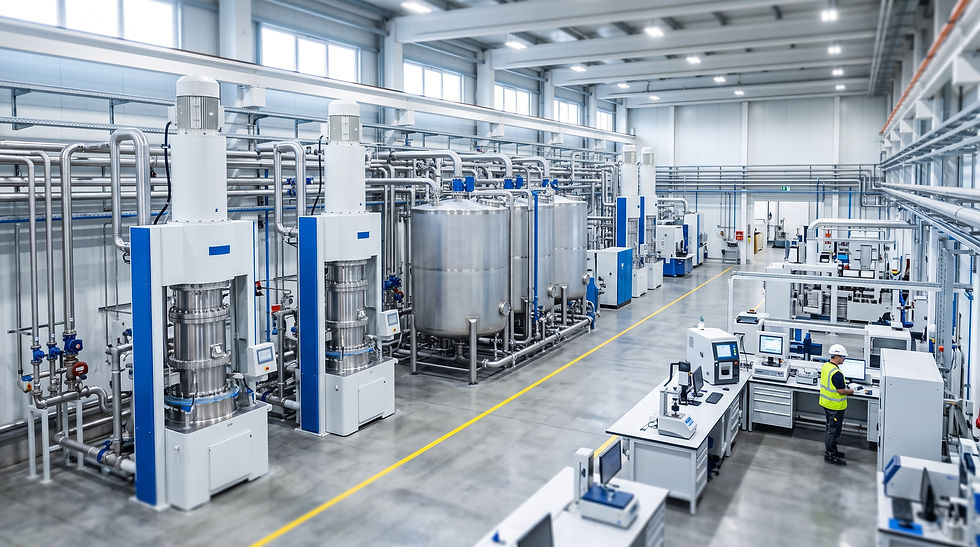
For applications requiring ultra-fine processing, Sanxing's SP-Series combines seal-free operation, screenless centrifugal separation, and compatibility with fine zirconia grinding media from 0.01–2.0 mm.
The most reliable approach is to develop the process around the material rather than choosing equipment based only on nominal capacity or maximum fineness.
Contact Sanxing Feirong Machinery to discuss ceramic slurry grinding, laboratory testing, production-scale bead mill configuration, and complete grinding solutions for advanced ceramic manufacturing.
Frequently Asked Questions
What is a ceramic slurry bead mill?
A ceramic slurry bead mill is a wet-grinding and dispersion machine that uses grinding media to reduce ceramic particles and agglomerates while they are suspended in a liquid medium.
What ceramic materials can be processed with a bead mill?
Depending on the machine configuration and formulation, bead mills can process advanced materials including alumina, zirconia, silicon carbide, boron carbide, cubic boron nitride, and diamond. Sanxing specifically lists these materials among applications for its SP-Series.
Can a bead mill produce nano-scale ceramic particles?
Yes, appropriately configured bead mills can be used for submicron and nanometer-level grinding. Sanxing's SP-Series supports zirconia beads from 0.01–2.0 mm and is designed for micron-, submicron-, and nanometer-level processing.
Why use zirconia beads for ceramic grinding?
Zirconia beads provide high hardness and are commonly considered for demanding fine-grinding applications where wear resistance and contamination control are important. The appropriate media should still be selected according to the specific ceramic formulation.
Is a vertical bead mill suitable for abrasive ceramics?
Yes, vertical bead mills can be configured for abrasive ceramic materials. However, equipment materials, grinding media, cooling, and process parameters should be evaluated according to the hardness and abrasiveness of the feed material.
Should ceramic slurry be tested in a laboratory bead mill first?
For new formulations, laboratory testing can be valuable before production-scale investment. Sanxing's F4 and W Series laboratory bead mills are designed for formulation development and process validation.
What particle size can a ceramic bead mill achieve?
The achievable particle size depends on the material, initial particle size, grinding media, formulation, machine configuration, and operating conditions. Sanxing's SP-Series is designed for micron-, submicron-, and nanometer-level grinding.
How do I choose the right bead mill for ceramic slurry?
Start with the ceramic material, initial and target particle size, slurry viscosity, solids concentration, required production capacity, contamination limits, grinding media, temperature requirements, and desired process configuration. Laboratory trials can help establish the appropriate production setup.


Comments