

Grinding Media Guide: Choosing the Right Beads for Ink and Paint Pigment Dispersion

Category: Grinding Technology Author: Moeez Ullah
(Grinding Technology Content Specialist, Sanxing Feirong Machinery)
Published Date: August 10, 2026 Estimated Read Time: 6 min read

The bead mill machine gets most of the attention, but the grinding media inside it is often the bigger lever on final ink and paint quality. Two identical machines running different grinding media can produce noticeably different color strength, gloss, and particle size distribution. If you've already read our guide on how to choose a bead mill machine, this article picks up where that one leaves off — matching the right beads to your pigment dispersion process.
Why Grinding Media Selection Affects Product Quality
Grinding media works by colliding with pigment particles at high velocity inside the mill chamber, breaking agglomerates down to the fine, uniform size that determines how ink jets or how paint lays down and reflects light. Get the media wrong, and you'll see it directly in the finished product: dull color, poor jetting reliability, gritty texture, or premature settling in storage.
Comparing the Main Grinding Media Types
Zirconia (Yttrium-Stabilized Zirconium Oxide) Beads
Zirconia beads are the standard choice for high-performance inkjet ink and premium paint dispersion. Their high density delivers strong grinding impact even at small bead diameters, and their excellent wear resistance minimizes contamination — critical for inks where even trace impurities affect color purity and jetting nozzle life.
Best for: digital inkjet ink, high-end architectural and automotive paint, nano-scale pigment dispersion.
Zirconium Silicate Beads
A more cost-effective mid-tier option, zirconium silicate beads offer solid grinding performance for less demanding applications where nano-scale fineness isn't required. They wear faster than pure zirconia but cost significantly less per kilogram.
Best for: general industrial coatings, mid-range decorative paint, larger-batch production where cost control matters more than ultra-fine particle size.
Glass Beads
Glass beads are the budget option — low cost and adequate for coarser dispersion work, but they wear quickly and can introduce contamination into sensitive formulations. Generally not recommended for inkjet ink production, where nozzle clogging from bead fragments is a real risk.
Best for: low-viscosity, low-cost coatings and preliminary/pre-dispersion passes before finer grinding.

Grinding Media Comparison Table
Media Type | Density | Wear Resistance | Typical Use Case | Relative Cost |
Zirconia beads | High | Excellent | Inkjet ink, premium/nano-dispersion paint | High |
Zirconium silicate beads | Medium-high | Good | General industrial & decorative coatings | Medium |
Glass beads | Low-medium | Fair | Low-cost coatings, pre-dispersion | Low |
How Bead Size Affects Pigment Dispersion
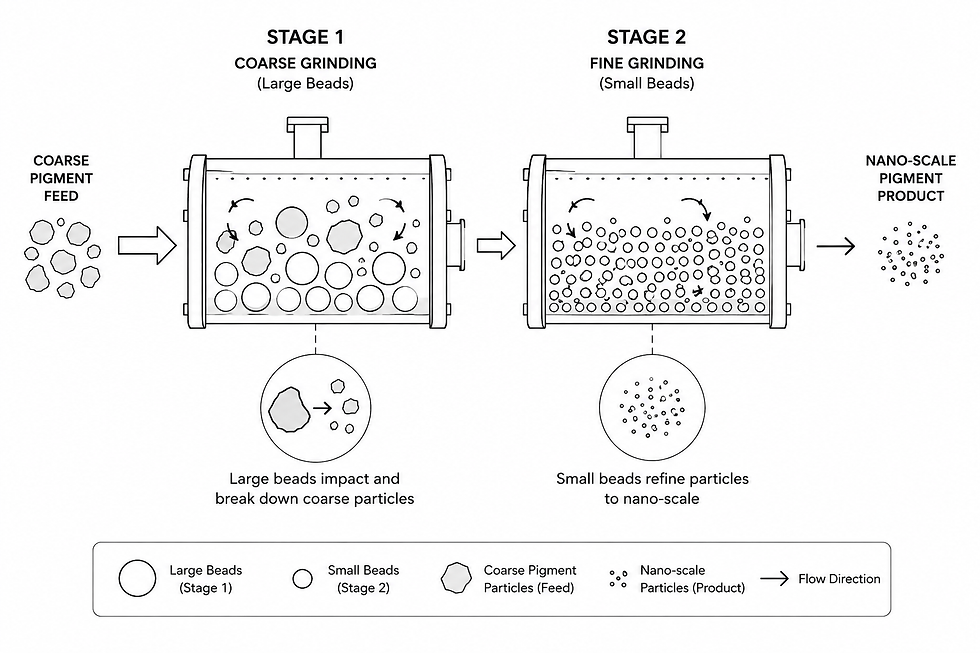
Bead diameter matters as much as material. Smaller beads (0.3–0.8mm) create more contact points per pass, driving particles toward nano-scale fineness — essential for inkjet ink where nozzle apertures are extremely small. Larger beads (1–2mm) grind faster on coarser material but plateau earlier in fineness. Many production lines use a two-stage approach: larger beads for initial breakdown, then smaller beads for final polishing to target particle size distribution measured to ASTM standards.
This is exactly the kind of process tuning our SP Series and SD Series Dual-Power Vertical Bead Mill are engineered to support, since their seal-free and dual-power configurations allow flexible bead loading without cross-contamination risk.
Common Grinding Media Mistakes
Using glass beads for inkjet ink to cut costs, then dealing with recurring nozzle clogging.
Running one bead size for the entire process instead of staging coarse-to-fine passes.
Ignoring bead wear rate and not budgeting for periodic replenishment, which silently degrades dispersion quality over time.
Mismatching bead hardness to pigment hardness — harder pigments need harder, denser media to achieve target fineness efficiently.
Get the Full System Right
Grinding media is only as effective as the machine running it. For a complete breakdown of specifications, seal types, and selection criteria, read our companion guide: How to Choose a Bead Mill Machine. For process-specific media and equipment recommendations for your ink or paint formulation, contact our engineering team.

External Sources
Frequently Asked Questions
What's the best grinding media for inkjet ink production?
Zirconia beads are the industry standard for inkjet ink due to their high density, low wear, and minimal contamination risk — all critical for reliable nozzle performance and color consistency.
Can I use the same beads for paint and ink production?
Not ideally. While zirconia beads work well for both, ink production typically demands smaller bead diameters and finer particle size targets than most paint formulations.
How often should grinding media be replaced?
This depends on bead material and throughput volume — zirconia beads last significantly longer than glass or zirconium silicate, but all media wears over time and should be monitored for size reduction and contamination.


Comments