

Industries We Serve: Advanced Wet Grinding & Nano-Dispersion Solutions Across Global Sectors

Author: Moeez Ullah Published: November 02, 2026

Industries We Serve: Advanced Wet Grinding & Nano-Dispersion Solutions Across Global Sectors
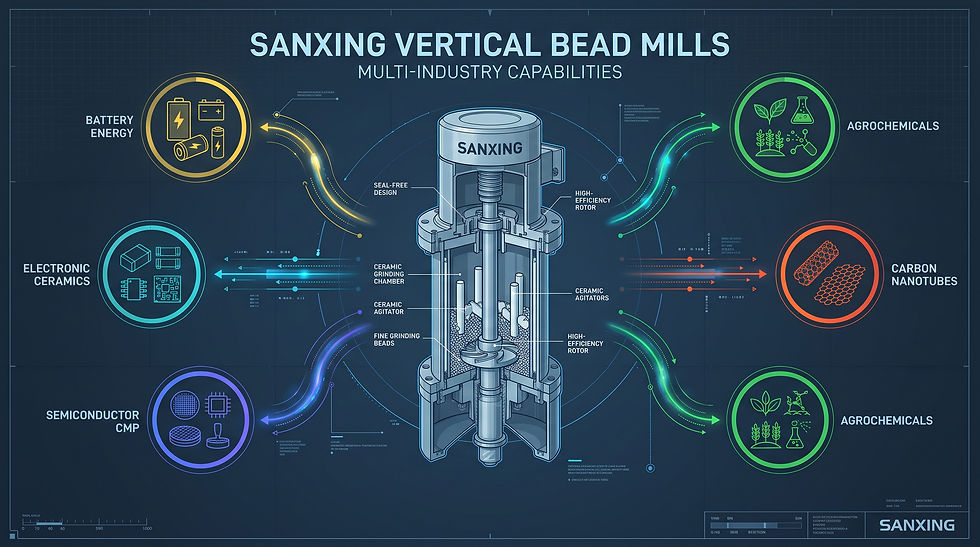
Cross-Sector Precision: Modern advanced material industries require tight particle size distribution (D50<100–300 nmD_{50} < 100\text{–}300\text{ nm}D50<100–300 nm) without coarse particle tails (D99D_{99}D99) that cause pinholes, nozzle blockages, or electrical shorts.
Zero Metallic Contamination: From EV battery cathode/anode slurries to dielectric ceramics, trace metal contamination (Fe, Cr, Ni<2–3 ppm\text{Fe, Cr, Ni} < 2\text{–}3\text{ ppm}Fe, Cr, Ni<2–3 ppm) is non-negotiable; Sanxing replaces metal wetted paths with solid sintered Silicon Carbide (SiC\text{SiC}SiC) and Zirconia (ZrO2\text{ZrO}_2ZrO2) ceramics.
Seal-Free Reliability: Submerged mechanical seals in conventional horizontal mills leak barrier cooling fluids and degrade under abrasive contact; Sanxing’s top-driven seal-free vertical architecture eliminates mechanical contact seals and barrier fluid contamination entirely across all served industries.
Micro-Media Fluidization: Incorporating dynamic centrifugal separation rotors allows high-flow multi-pass recirculation of 0.05–0.3 mm0.05\text{–}0.3\text{ mm}0.05–0.3 mm micro-media without static screen blinding.
Turnkey Engineering Scope: Beyond standalone bead mills, Sanxing delivers integrated EPC production systems—combining dust-free vacuum powder induction, sanitary premixing tanks, and digital PLC supervisory automation.
1. New Energy & Battery Materials
The ongoing transition toward high-energy-density and fast-charging energy storage demands uniform nanoscale control across both cathode and anode slurries:
Cathode Slurries (LFP / LMFP): Inherently low electronic conductivity requires reducing primary particle sizes down to D50=200–350 nmD_{50} = 200\text{–}350\text{ nm}D50=200–350 nm to shorten lithium-ion diffusion path lengths. Sanxing’s solid SiC\text{SiC}SiC ceramic chambers prevent foreign metallic iron and chromium leaching (<2 ppm<2\text{ ppm}<2 ppm), avoiding dendrite-induced separator punctures.
Silicon-Carbon & Hard Carbon Anodes: Controlled grinding prevents the excessive creation of ultra-fine dust, which balloons specific surface area (SSA) and reduces initial coulombic efficiency (ICE).
Solid-State Battery Electrolytes: Sulfide argyrodites (Li6PS5Cl\text{Li}_6\text{PS}_5\text{Cl}Li6PS5Cl) and garnet oxides (LLZO\text{LLZO}LLZO) require moisture-free, hermetic processing. Our seal-free vertical bead mills integrate with closed-loop argon/nitrogen atmospheres, enabling sub-300nm dispersion without hydrogen sulfide (H2S\text{H}_2\text{S}H2S) release.
2. Advanced Technical & Electronic Ceramics
In electronic and functional ceramics, component miniaturization mandates defect-free particle consolidation:
MLCC Dielectrics (BaTiO3\text{BaTiO}_3BaTiO3): Multi-layer ceramic capacitors require dielectric sheets below 1 μm1\ \mu\text{m}1 μm thickness. Agglomerates larger than 200 nm200\text{ nm}200 nm trigger localized electrical breakdown. Sanxing’s vertical mills deliver gentle, high-density hydrodynamic shear using 0.05–0.1 mm0.05\text{–}0.1\text{ mm}0.05–0.1 mm YSZ beads, achieving sub-100nm deagglomeration without destroying the crystalline tetragonality required for high dielectric permittivity.
Structural Ceramics (SiC,ZrO2,Al2O3\text{SiC}, \text{ZrO}_2, \text{Al}_2\text{O}_3SiC,ZrO2,Al2O3): Sintering high-hardness ceramic structural parts without residual micro-voids requires narrow grain distribution. Our ceramic-lined chambers eliminate cross-material contamination, maximizing green-body density.
3. Semiconductor & Electronic Chemicals (CMP Slurries)
Chemical Mechanical Planarization (CMP) dictates semiconductor device yield across advanced sub-10nm fabrication nodes:
The Killer Scratch Threshold: A single abrasive agglomerate exceeding 0.5 μm0.5\ \mu\text{m}0.5 μm creates micro-scratches across transistor gate oxide layers under downward pad pressure.
Sanxing Cleanroom Solution: We configure dedicated vertical bead mills with high-purity Silicon Carbide liners and dynamic centrifugal separation of 0.05 mm0.05\text{ mm}0.05 mm micro-media. The system gently breaks clustered ceria and silica aggregates down to D50≈60 nmD_{50} \approx 60\text{ nm}D50≈60 nm while maintaining D99.9<150 nmD_{99.9} < 150\text{ nm}D99.9<150 nm—completely cutting off the coarse Large Particle Count (LPC) tail.
4. Digital Printing Inks & High-Performance Coatings
Industrial drop-on-demand (DOD) printing requires stable, sub-micron colloidal fluids:
Digital Inkjet Inks (Ceramic, UV-Curable, Textile): Piezoelectric printhead orifices (10–20 μm10\text{–}20\ \mu\text{m}10–20 μm) clog immediately if coarse particles exceed 200–300 nm200\text{–}300\text{ nm}200–300 nm. Our vertical seal-free mills eliminate static discharge screens, allowing 0.05–0.1 mm0.05\text{–}0.1\text{ mm}0.05–0.1 mm beads to run at high recirculation rates to yield narrow particle envelopes (D99<150 nmD_{99} < 150\text{ nm}D99<150 nm) with zero nozzle dropouts.
Automotive & Transparent Coatings: Over-milling fractures primary organic pigment lattices, causing dull haze and re-agglomeration. Sanxing pin-rotor systems provide soft shear fields, maximizing optical transparency, chroma, and gloss.
5. Carbon Nanomaterials & Conductive Pastes
Conductive pastes require preserving particle morphology rather than crushing it:
Carbon Nanotubes (SWCNTs / MWCNTs): High-aspect-ratio (L/D>1,000L/D > 1,000L/D>1,000) nanotubes establish electrical percolation networks in battery electrodes at low loadings (0.1 wt%0.1\text{ wt}\%0.1 wt%). Brute-force milling fractures tubes into inactive soot. Sanxing vertical bead mills employ viscous micro-media shear to peel entangled bundles apart without shortening longitudinal tube length.
Graphene Exfoliation: Multi-pass liquid-phase shear in a seal-free vertical chamber cleanly exfoliates graphite into few-layer graphene nanosheets with high lateral dimension retention.
6. Agrochemicals & Crop Protection (SC Formulations)
Modern sustainable crop protection relies heavily on water-based Suspension Concentrates (SC):
Preventing Ostwald Ripening: By narrowing particle size distributions (D50=1.2–2.2 μm,D98<4.5 μmD_{50} = 1.2\text{–}2.2\ \mu\text{m}, D_{98} < 4.5\ \mu\text{m}D50=1.2–2.2 μm,D98<4.5 μm), Sanxing bead mills eliminate the chemical potential gradient that causes crystal growth and container sedimentation over 2-year storage periods.
Low-Melting Active Ingredients: Thermal-sensitive fungicides and insecticides (e.g., Pyraclostrobin, Tebuconazole) melt and jam conventional mills. Multi-zone spiral-baffled cooling jackets remove heat instantly, maintaining slurry temperatures safely below 28–30∘C28\text{–}30^\circ\text{C}28–30∘C.
Industry Comparison: Why Manufacturers Migrate to Sanxing Feirong
Engineering Factor | Traditional Horizontal Bead Mill | Sanxing Vertical Seal-Free Bead Mill |
Shaft Sealing | Double mechanical seal + barrier fluid loop | Patented seal-free fluid dynamic design ($0 barrier oil) |
Minimum Usable Media | 0.2–0.4 mm0.2\text{–}0.4\text{ mm}0.2–0.4 mm (Screens blind below this) | 0.05–0.1 mm0.05\text{–}0.1\text{ mm}0.05–0.1 mm (Dynamic centrifugal non-screen rotor) |
Contamination Tolerance | Leaches Fe, Cr, Ni\text{Fe, Cr, Ni}Fe, Cr, Ni from worn metal walls | Solid sintered SiC\text{SiC}SiC or ZrO2\text{ZrO}_2ZrO2 ceramics (<2 ppm<2\text{ ppm}<2 ppm) |
Thermal Dissipation | Single outer jacket; slow heat removal | High-conductivity SiC\text{SiC}SiC liners with multi-zone jackets |
Footprint Efficiency | Large horizontal footprint with motor slide rail | Compact vertical tower layout (Saves 40–60% floor space) |
System Scope | Standalone units requiring manual plumbing | Complete turnkey EPC lines with integrated PLC automation |
Conclusion & Partnering with Sanxing Feirong
Across every modern processing sector—from energy storage and technical ceramics to electronics and crop protection—sub-micron particle distribution and absolute contamination control define market leadership. By pairing patented seal-free vertical architectures with high-conductivity ceramic grinding chambers and automated turnkey systems, Shenzhen Sanxing Feirong Machinery Co., Ltd. provides global manufacturers with reliable tools to scale advanced materials.
Connect with Our Industry Application Specialists:
Explore our SP Series Vertical Bead Mill (Seal-Free) for high-output industrial manufacturing.
Review our W Series & F4 Series Laboratory Bead Mills for pilot trials and R&D formulation screening.
Contact Sanxing Feirong Machinery to consult with our engineering team, discuss your industry-specific requirements, or arrange a pilot grinding trial today.
Frequently Asked Questions
Which industries benefit most from Sanxing’s seal-free vertical bead mill design?
Industries with zero tolerance for contamination or seal downtime benefit most: lithium/sodium battery slurries (where metal causes short circuits), electronic ceramics (where metal ruins insulation resistance), digital printing inks (where seal oil causes nozzle clogging), and agrochemicals (where abrasive solids wear down mechanical seals).
Can Sanxing accommodate specialized cleanroom or explosion-proof requirements?
Yes. All industrial SP Series and laboratory W/F4 Series bead mills can be custom-engineered to meet Class 100/1000 cleanroom standards, sanitary cGMP requirements, or ATEX/IECEx explosion-proof ratings for flammable solvent systems (e.g., NMP, toluene, xylene, alcohols).
How does Sanxing support process optimization for new, proprietary materials?
Through our Shenzhen R&D Application Testing Center, clients can submit 1–5 L of raw slurry for comprehensive pilot grinding trials. Our process engineers map grinding kinetics, screen media sizes (0.05–1.0 mm0.05\text{–}1.0\text{ mm}0.05–1.0 mm), evaluate rheology, and provide verified scale-up calculations for full industrial production lines.


Comments