

Are You Looking for an Industrial Wet Milling Solution That Permanently Eliminates Screen Clogging, Slurry Leaks, and Metal Contamination?

Author: Moeez Ullah Published: November 9, 2026

Are You Looking for an Industrial Wet Milling Solution That Permanently Eliminates Screen Clogging, Slurry Leaks, and Metal Contamination?
End Static Screen Blinding Forever: In conventional horizontal mills, shear-thickening slurries and hydraulic drag force micro-beads ($<0.3\text{ mm}$) against static discharge sieves, causing media compaction and high-pressure shutdowns. Sanxing Feirong replaces static wire screens with a non-screen dynamic centrifugal ceramic separator that propels media radially back into the grinding zone while slurry discharges freely through the open center axis.
Eliminate Mechanical Seal Blowouts & Oil Ingress: Horizontal bead mills rely on submerged mechanical seals that wear out within $1,000\text{ to }2,000\ \text{operating hours}$, leaking cooling fluids (glycols or white oils) into expensive batches. Our patented seal-free vertical architecture mounts the drive shaft and bearings entirely above the liquid level, operating with zero mechanical contact seals and zero barrier fluids.
Guarantee Zero Metallic Contamination ($\text{Fe} < 3\text{ ppm}$): Abrasive particles scouring stainless steel chambers shed metallic $\text{Fe, Cr, and Ni}$ into the product, triggering short-circuit dendrites in batteries and accelerated self-discharge in supercapacitors. Sanxing replaces all metal wetted parts with solid sintered Silicon Carbide ($\text{SiC}$) and Zirconia ($\text{ZrO}_2$) ceramics, keeping foreign metal pickup strictly below $3\text{ ppm}$.
Superior Thermal Control for Heat-Sensitive Materials: Sintered alpha-$\text{SiC}$ liners deliver ultra-high thermal conductivity ($>120\ \text{W/(m}\cdot\text{K)}$) paired with multi-zone spiral-baffled cooling jackets, maintaining bulk slurry temperatures safely below $28\text{–}38^\circ\text{C}$.
Uninterrupted High-Flow Multi-Pass Recirculation: Removing static screen resistance enables continuous high-flow recirculation ($15\text{–}25\ \text{passes/hour}$), compressing particle size distribution spans ($\text{Span} < 0.85\text{–}1.0$) and eliminating oversized coarse tails ($D_{98}/D_{99}$).
Conventional Horizontal Mill vs. Sanxing Vertical Solution
Operational Challenge | Conventional Horizontal Sand Mill | Sanxing SP Series Vertical Seal-Free Solution |
Focus Keyword | Industrial wet milling solution | Industrial wet milling solution |
Media Separation Design | Static slotted wire mesh sieve | Non-screen dynamic centrifugal ceramic rotor |
Screen Clogging & Pressure Spikes | Frequent blinding with $<0.3\text{ mm}$ beads or dilatant slurries | Zero screen blinding; unobstructed axial discharge |
Shaft Sealing Architecture | Submerged mechanical seal + pressurized glycol/oil loop | Top-driven seal-free fluid dynamic containment |
Seal Maintenance & Leak Risk | Seal blowout every $1,000\text{–}2,000\ \text{hrs}$; batch spoilage risk | $0\text{ hours}$ seal downtime; zero barrier fluid ingress |
Wetted Chamber Metallurgy | Stainless steel, alloy steel, or polymer linings | Solid sintered $\text{SiC}$ (Mohs $9.5$) & $\text{ZrO}_2$ ceramics |
Metallic Impurity Leaching | High shedding of $\text{Fe, Cr, Ni, Cu}$ under abrasive wear | $<3\text{ ppm}$ cumulative foreign metal pickup |
Usable Grinding Media Range | Restricted to $>0.4\text{ mm}$ to avoid sieve plugging | $0.1\text{–}0.8\text{ mm}$ high-density YSZ micro-beads |
Detailed Breakdown of the 3 Chronic Wet Milling Bottlenecks
When processing high-solids, high-value suspensions—such as Lithium Iron Phosphate ($\text{LiFePO}_4$ / LFP) cathodes, Electric Double-Layer Capacitor (EDLC) activated carbons, or agrochemical Suspension Concentrates (SC)—traditional horizontal bead mills introduce three severe operational bottlenecks:

1. Why Discharge Screens Blind Under High-Solids Recirculation
High-solids slurries ($50\text{–}65\text{ wt}\%$ in battery cathodes or $300\text{–}600\text{ g/L}$ in agrochemical SCs) and porous activated carbon suspensions (which absorb $2\text{–}3\text{ times}$ their weight in liquid) exhibit strong thixotropic and shear-thickening dilatant behavior. When running micro-beads ($<0.3\text{ mm}$) at high recirculation velocities in a horizontal mill, hydrodynamic drag sweeps the grinding media directly against the static exit sieve. The narrow screen slots blind rapidly, causing media packing, flow choking, and emergency high-pressure trips.
2. Why Submerged Mechanical Seals Inevitably Fail
In horizontal mills, the main drive shaft enters below the slurry line, requiring a dynamic mechanical seal submerged directly under high chamber pressure. Hard, sub-micron particles work their way between the rotating silicon carbide seal faces, carving micro-grooves and triggering seal blowout within $1,000\text{ to }2,000\ \text{operating hours}$. Worse still, pressurized barrier cooling fluids (glycols or white oils) leak past worn seal faces into the process chamber—permanently blocking micropores ($0.8\text{–}2\text{ nm}$) in supercapacitor carbon or spoiling expensive battery and agrochemical batches.
3. How Metal Abrasion Destroys Electrochemical & Chemical Performance
Any contact between abrasive particles and stainless steel rotors or chamber walls scuffs metallic $\text{Fe, Cr, Ni, and Cu}$ into the slurry:
In Lithium-Ion Batteries (LFP/LMFP): A single metallic particle ($>1\ \mu\text{m}$) dissolves into the electrolyte during cycling, migrates to the graphite anode, and plates as a metallic dendrite that pierces the separator—causing localized micro-shorts, self-discharge, and catastrophic thermal runaway.
In EDLC Supercapacitors: Trace metallic impurities ($>5\text{ ppm}$) catalyze parasitic Faradaic redox reactions, accelerating self-discharge under floating voltage conditions and degrading operational life.
Sanxing Feirong’s Seal-Free Vertical Engineering: The Permanent Cure
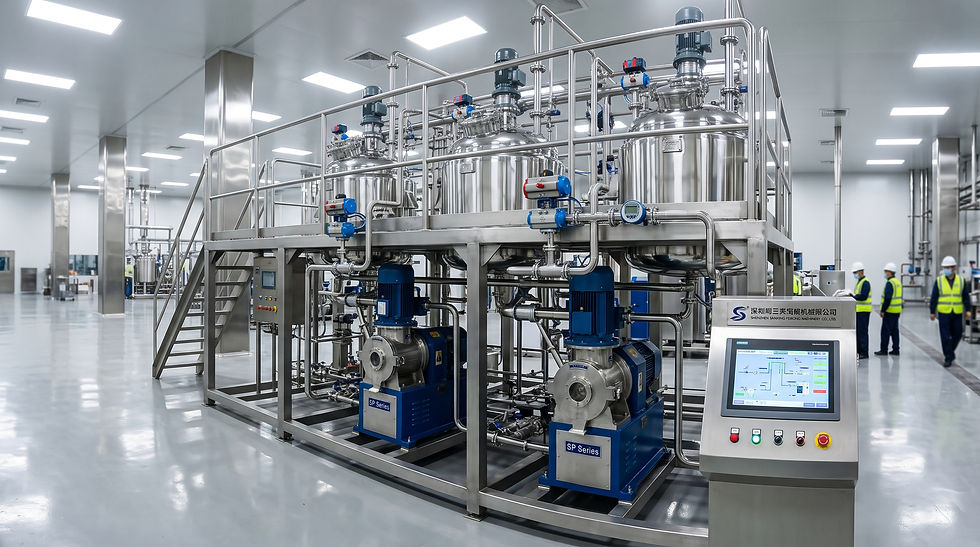
To eliminate these three failure modes simultaneously, Shenzhen Sanxing Feirong Machinery Co., Ltd. engineered the SP Series Vertical Seal-Free Nano Bead Mill:
1. Non-Screen Dynamic Centrifugal Media Separation (Zero Screen Blinding)
Replacing static wire mesh screens with a dynamic centrifugal ceramic separator, Sanxing vertical mills utilize rotational G-forces to separate media from the product stream. Dense Yttria-Stabilized Zirconia (YSZ) beads ($0.1\text{–}0.8\text{ mm}$) are accelerated radially outward back into the high-shear pin grinding zone, while the lighter finished slurry discharges smoothly along the central axial low-pressure channel. This enables continuous high-flow multi-pass recirculation ($15\text{–}25\ \text{passes/hour}$) without screen blinding or pressure spikes.
2. Patented Seal-Free Fluid Dynamic Architecture (Zero Slurry or Oil Leaks)
In the Sanxing SP Series, the main drive shaft and bearings are mounted entirely above the liquid level. Slurry is contained within the vertical chamber using dynamic fluid deflectors and centrifugal exclusion zones. Because there are no submerged mechanical contact seals, no elastomer O-rings in abrasive contact, and no barrier fluid circuits, the risks of seal face wear downtime, cooling oil ingress, and cross-batch contamination are completely eliminated.
3. Solid Sintered Ceramic Internals & Multi-Zone Cooling (Zero Metal Pickup)
All wetted components inside the active grinding zone—the chamber cylinder liner, pin-type agitators, and discharge separation rotors—are fabricated from solid sintered alpha-Silicon Carbide ($\text{SiC}$) or Zirconia ($\text{ZrO}_2$):
Zero Metal Leaching: With a Mohs hardness of $9.5$, sintered $\text{SiC}$ resists abrasive erosion completely, holding cumulative foreign $\text{Fe, Cr, and Ni}$ impurities strictly below $3\text{ ppm}$.
Rapid Heat Extraction: Pairing $\text{SiC}$’s ultra-high thermal conductivity ($>120\ \text{W/(m}\cdot\text{K)}$) with high-flow spiral-baffled cooling jackets removes frictional heat instantly. Chilled water ($5\text{–}8^\circ\text{C}$) maintains bulk slurry temperatures below $28\text{–}38^\circ\text{C}$, preventing low-melting agrochemical active ingredients (such as Pyraclostrobin at $63.7^\circ\text{C}$ or Pendimethalin at $58^\circ\text{C}$) from softening into sticky pastes that jam the mill.
Application Matrix: Proven Results Across High-Spec Sectors
Industry Application | Target Particle Distribution | Media Size & Tip Speed | Critical Defect Eliminated |
LFP / LMFP Battery Cathodes | $D_{50}: 200\text{–}350\text{ nm}$; $D_{99} < 800\text{ nm}$ ($\text{Span} < 0.85$) | $0.1\text{–}0.3\text{ mm}$ YSZ at $10\text{–}12\ \text{m/s}$ | Eliminates $>1\ \mu\text{m}$ coarse tails, $\text{Fe} < 3\text{ ppm}$ dendrites, and glycol seal leaks |
Supercapacitor Carbon (EDLC) | $D_{50}: 2.5\text{–}4.5\ \mu\text{m}$; $D_{99} < 12\ \mu\text{m}$ ($>92\%$ SSA retained) | $0.2\text{–}0.4\text{ mm}$ YSZ at $7\text{–}9\ \text{m/s}$ | Prevents nanopore collapse ($0.8\text{–}4\text{ nm}$), seal oil pore blocking, and sieve choking |
Pesticide SC Formulations | $D_{50}: 1.2\text{–}2.2\ \mu\text{m}$; $D_{98} < 4.5\ \mu\text{m}$ ($\text{Span} < 1.0$) | $0.4\text{–}0.8\text{ mm}$ YSZ keeps temp $<28\text{–}30^\circ\text{C}$ | Stops Ostwald ripening crystal growth, hard-caking, and thermal paste softening |
Step-by-Step Production Protocol: Implementing Zero-Defect Wet Grinding
High-Shear Pre-Dispersion Stage: Pre-mix raw powders, wetting agents, and dispersants in deionized water or organic solvent using a high-shear disperser or dual-planetary vacuum mixer until macroscopic clusters are reduced ($D_{50} < 3\text{–}25\ \mu\text{m}$ depending on raw feed).
Primary Coarse Wet Milling: Route the premix through a primary Sanxing vertical bead mill charged with $0.4\text{–}1.2\text{ mm}$ ceramic media to break down coarse crystalline lumps into a uniform sub-micron or fine-micron feed.
Finishing Seal-Free Nano/Micro Milling: Pump the slurry into the Sanxing SP Series Seal-Free Vertical Bead Mill loaded with $0.1\text{–}0.6\text{ mm}$ high-density YSZ beads. Operate under continuous high-flow multi-pass recirculation ($80\text{–}140\text{ kWh/ton}$ specific energy target for LFP), regulating spiral-baffled cooling jackets to keep slurry temperatures strictly within safe limits ($<28\text{–}38^\circ\text{C}$).
In-Line Quality & Distribution Verification: Monitor batch samples via laser diffraction (ISO 13320) to verify $D_{50}$ and upper cutoff ($D_{98}/D_{99}$) targets before transferring directly to downstream spray drying, roll-to-roll electrode coating, or finishing tanks.
Conclusion & Schedule Your Pilot Grinding Trial
If your facility is losing production hours to blinded discharge screens, spending thousands on replacement mechanical seals, or battling trace metal contamination, upgrading to Shenzhen Sanxing Feirong Machinery’s SP Series Vertical Seal-Free Bead Mill provides a permanent engineering cure.
Eliminate Your Wet Milling Bottlenecks Today:
Explore our flagship SP Series Vertical Bead Mill (Seal-Free) for zero-contamination, non-clogging industrial production.
Visit www.sanxing-machinery.com or Contact Sanxing Feirong Machinery to consult with our engineering specialists and schedule pilot grinding trials on your formulations!
Frequently Asked Questions
Q: How does the Sanxing vertical bead mill prevent micro-beads from escaping without a physical mesh screen?
A: Sanxing replaces static wire screens with a dynamic centrifugal ceramic separation rotor. High-speed rotation generates centrifugal acceleration that propels dense YSZ beads ($0.1\text{–}0.8\text{ mm}$) radially back into the grinding chamber, while the lower-density liquid slurry exits smoothly through the central low-pressure axial channel without screen blinding.
Q: Why is eliminating mechanical seals so important for battery, carbon, and agrochemical plants?
A: In horizontal mills, abrasive particles wear down submerged mechanical seal faces within $1,000\text{–}2,000\ \text{hours}$, leaking cooling oils into the batch. In supercapacitors, leaked oil adsorbs into carbon micropores and increases internal resistance (ESR); in battery slurries, it ruins batch stability; in agrochemical plants that frequently switch active ingredients, Sanxing's seal-free design eliminates cross-batch contamination and enables rapid CIP cleaning cycles.
Q: How does the mill prevent both metallic contamination and thermal overheating?
A: All wetted contact components are constructed from solid sintered Silicon Carbide ($\text{SiC}$) or Zirconia ($\text{ZrO}_2$) ceramics, keeping foreign $\text{Fe, Cr, and Ni}$ pickup strictly below $3\text{ ppm}$. Furthermore, $\text{SiC}$'s high thermal conductivity ($>120\ \text{W/(m}\cdot\text{K)}$) paired with multi-zone spiral-baffled cooling jackets extracts frictional heat rapidly, keeping slurries below $28\text{–}38^\circ\text{C}$.


Comments