

Predictive Intelligence, Effortless Control, and Maximum Operational Uptime: Meet Sanxing Feirong's NextGen PLC Touchscreen Control Suite

Author: Moeez Ullah Published: November 05, 2026

Predictive Intelligence, Effortless Control, and Maximum Operational Uptime: Meet Sanxing Feirong's NextGen PLC Touchscreen Control Suite
From Reactive to Predictive Operations: Sanxing Feirong’s NextGen PLC Touchscreen Control Suite replaces manual valve adjustments with predictive intelligence, utilizing multi-point sensors to detect mechanical unbalance, hydraulic choking, and bearing wear before equipment downtime occurs.
Closed-Loop Specific Energy Control ($\text{kWh/ton}$): Operators program precise net specific energy targets rather than arbitrary grinding runtimes, guaranteeing consistent batch-to-batch particle size distributions ($D_{50}$ and $D_{99}$) regardless of initial feed viscosity variations.
Sub-Second Thermal Regulation: Real-time monitoring of chamber inlet, outlet, and multi-zone cooling jacket temperature differentials ($\Delta T$) automatically trims agitator speeds and modulates proportional coolant valves to prevent thermal degradation in heat-sensitive formulations.
Zero-Downtime Telemetry Integration: Standardized industrial communication protocols (Profinet, Modbus TCP, Ethernet/IP, OPC-UA) enable direct, encrypted data streaming into plant-wide Distributed Control Systems (DCS), Manufacturing Execution Systems (MES), and SCADA architectures.
Effortless Recipe Management: An intuitive, multi-level access interface stores up to 500 distinct multi-stage grinding recipes, complete with automated soft-start ramping, dynamic flow synchronization, and automated Clean-In-Place (CIP) flushing cycles.
NextGen Control Architecture
System Metric | Engineering Specification / Capability |
Processor Platform | Industrial Siemens S7-1500 / Allen-Bradley CompactLogix PLC |
Operator Interface (HMI) | 12-inch to 15.6-inch high-resolution, IP65-rated industrial capacitive touchscreen |
Control Modes | Constant Specific Energy ($\text{kWh/ton}$), Constant Pressure, Constant Tip Speed, Multi-Stage Auto Profile |
Sensor Telemetry Network | Tri-axial vibration accelerometers, PT100 platinum RTDs, dynamic torque transducers, digital pressure transmitters |
Cooling Automation | Proportional PID coolant valve modulation based on real-time chamber $\Delta T$ tracking |
Network Protocols | OPC-UA, Profinet, Modbus TCP, MQTT (Industrial IoT cloud-gateway ready) |
Security & Compliance | Multi-tiered user access control, FDA 21 CFR Part 11 audit trails, emergency safety interlocks |
The Automation Deficit: Why Legacy Wet Grinding Costs Facilities Millions
In conventional nanomaterial processing facilities, wet-milling machines are frequently operated via legacy pushbuttons, analog pressure dials, and manual operator valve adjustments. In high-value manufacturing—including EV battery cathode slurries, electronic ceramic MLCC slips, and digital printing inks—this disconnected approach introduces systemic operational vulnerabilities:
Batch-to-Batch Particle Drift: Runtimes dictated by simple timers ignore shifting slurry rheology, ambient plant temperature fluctuations, and raw material variations. One production batch exits at $D_{50} = 220\text{ nm}$, while the next batch drifts to $380\text{ nm}$, destabilizing downstream coating lines.
Thermal Gelation and Product Degradation: When processing temperature-sensitive active materials—such as low-melting pesticides, UV monomers, or battery binders—delayed manual valve intervention allows localized friction hotspots to exceed critical thresholds ($>35^\circ\text{C}$), causing immediate product gelation inside the grinding chamber.
Catastrophic Unplanned Breakdowns: Legacy machines offer no early warnings for internal media packing or rotor unbalance. Operators only discover mechanical issues when an emergency breaker trips or a bearing housing overheats, halting production lines for days.
Sanxing Feirong’s NextGen PLC Touchscreen Control Suite resolves these vulnerabilities by replacing guesswork with closed-loop predictive intelligence.
The Core Pillars of NextGen Control Architecture
Our NextGen automation suite is engineered around three foundational operational requirements: predictive machine protection, precision closed-loop control, and effortless user interaction.
1. Predictive Intelligence for Maximum Operational Uptime
Rather than reacting to mechanical component failures after damage has occurred, the NextGen control architecture monitors the physical health of the vertical bead mill continuously:
Tri-Axial Bearing Vibration Telemetry: Industrial accelerometers mounted on the upper and lower spindle bearing blocks monitor high-frequency harmonic vibrations. If micro-vibrations exceed ISO 1940 Grade G1.0 thresholds ($>0.5\ \text{mm/s}$), the system flags minor mechanical misalignments long before bearing failure.
Dynamic Drive Torque Analysis: The system tracks instantaneous motor torque draw. If micro-grinding media begins to compact or abnormal hydraulic drag occurs, the PLC detects the localized torque spike and modulates the feed pump rate to clear the chamber dynamically.
Bearing Temperature Trend Tracking: Precision PT100 temperature sensors monitor spindle bearing performance continuously, alerting maintenance teams to inadequate lubrication or abnormal friction before thermal damage occurs.
2. Closed-Loop Specific Energy Control ($\text{kWh/ton}$)
True batch repeatability in wet milling is governed by net specific energy input—the exact electrical energy transferred through the rotor pins into the slurry volume. The NextGen PLC calculates this in real time:
$$E_{\text{specific}} = \frac{\int (P_{\text{gross}} - P_{\text{idle}})\, dt}{m_{\text{batch}}}$$
Operators enter the target specific energy (e.g., $125\text{ kWh/ton}$) required to achieve the desired sub-micron particle size distribution.
The system dynamically modulates the variable frequency drive (VFD) controlling the rotor shaft and the progressive cavity feed pump, delivering uniform kinetic shear to every liter of slurry.
When the target energy is achieved, the PLC completes the run, transitions the system to a clean product flush, or signals automated transfer valves, preventing over-grinding and unnecessary power consumption.
3. Sub-Second Thermal Shield Regulation
Frictional heat generated by micro-media collisions can rapidly degrade delicate polymers and active chemical ingredients:
The NextGen suite monitors the temperature differential ($\Delta T$) across the chamber inlet, chamber outlet, and internal cooling jacket lines.
Proportional PID control loops dynamically modulate the chilled-water flow valve to maintain internal process fluid within $\pm 0.5^\circ\text{C}$ of the setpoint.
If cooling water supply fails or slurry temperatures approach pre-programmed safety thresholds, the controller executes a soft speed trim or initiates an automated safety purge cycle to protect the formulation.
Inside the Operator Experience: Intuitive Industrial Touchscreen Interface
Designed for high-paced factory environments, the NextGen operator interface provides clear visual management across all process stages:

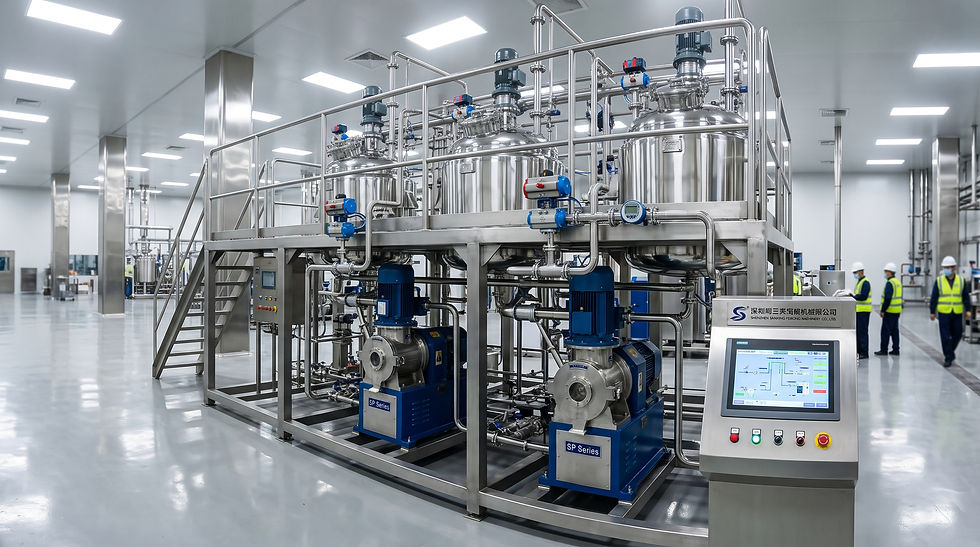
Interactive P&ID Graphic Overview: An interactive digital process and instrumentation diagram (P&ID) illustrates live valve positions, pump states, slurry temperatures, and fluid pressures in real time.
One-Touch Recipe Selection: Operators select pre-programmed recipes using multi-tiered, password-protected authorization levels (Operator, Process Engineer, Administrator), preventing unauthorized recipe changes.
Automated Clean-In-Place (CIP) Sequences: With a single touch, the system runs through multi-stage automated washing cycles, sequencing wash fluid valves, pulsing agitator speeds, and draining the chamber to minimize manual cleaning labor and solvent waste.
Comprehensive Data Export & Audit Logging: All process variables—including rotor speeds, thermal trends, delivered energy, and alarm events—are logged at 100-millisecond intervals. Data exports directly via USB or streams over industrial Ethernet into plant MES databases in standard CSV/SQL formats.
Performance Comparison: Manual Operation vs. NextGen PLC Control
Operational Metric | Conventional Manual Bead Mill | Sanxing NextGen PLC Automated Suite |
Batch Fineness Consistency | $\pm 15\text{–}25\%$ variation between shifts | $<\pm 2.5\%$ batch-to-batch variation ($D_{50} / D_{99}$) |
Response to Thermal Spikes | Dependent on manual operator intervention | Automated sub-second PID throttling and cooling modulation |
Process End-Point Accuracy | Estimated by run-time (Risk of over-grinding) | Exact shutoff based on net specific energy ($\text{kWh/ton}$) |
Equipment Health Monitoring | Reactive (Failures discovered post-breakdown) | Predictive (Tri-axial vibration and torque alarms) |
Clean-In-Place (CIP) Efficiency | 2–4 hours manual flushing; high solvent waste | Automated 20–35 minute pulsed sequence; 40% less solvent |
Plant Network Integration | Standalone; manual paper logsheets | Profinet, Modbus TCP, OPC-UA, and cloud SCADA ready |
Operator Training Curve | Weeks of empirical apprenticeship | Intuitive interface; operators trained within 1 shift |
Step-by-Step Production Protocol: Running an Automated Batch
Recipe Initialization: From the main HMI dashboard, the operator selects the target product profile (e.g., "Nanoscale Inkjet Pigment Dispersion") and confirms batch volume. The PLC loads calibrated parameters for tip speed, target specific energy ($\text{kWh/ton}$), and thermal safety limits.
Automated Pre-Fill & Line Priming: The system engages the progressive cavity feed pump at low speed, monitoring chamber pressure transducers to confirm that the vertical grinding chamber is fully primed with liquid before starting the main motor.
Soft-Start Rotor Acceleration: The VFD accelerates the vertical agitator shaft along a controlled S-curve ramp, eliminating high-current starting spikes and preventing mechanical torque shock on the ceramic rotor pins and drive belts.
Closed-Loop Grinding Execution: The bead mill enters active high-flow recirculation. The PLC balances pump flow rates, rotor tip speeds, and cooling water valves, keeping slurry within the target processing window while tracking delivered kilowatt-hours.
Target Energy Termination & Automatic Flush: Upon delivering the exact pre-programmed specific energy target, the PLC sounds an audible notification, shifts automated diverter valves to route product to final storage, and initiates a closed-loop flush cycle.
Conclusion & Upgrading Your Plant's Operational Capabilities
In modern chemical and nanomaterial processing, achieving consistent sub-micron particle distributions requires advanced process control. Sanxing Feirong’s NextGen PLC Touchscreen Control Suite equips plant managers and process engineers with the predictive intelligence, operational safeguards, and automation precision necessary to eliminate downtime and maximize production yields.
Modernize Your Wet Grinding Operations:
Explore our flagship SP Series Vertical Bead Mill (Seal-Free) equipped with the NextGen automation suite.
Review our complete Turnkey Automated Wet Grinding Systems integrating mixing tanks, pumping skids, and PLC automation.
Contact Sanxing Feirong Machinery today to schedule a live virtual demonstration of our NextGen PLC interface and discuss custom automation configurations for your production facility.
Frequently Asked Questions
Can the NextGen PLC Control Suite be retrofitted onto existing Sanxing bead mills?
Yes. Sanxing Feirong offers standardized modular automation upgrade packages. Our engineering team can retrofit existing SP Series vertical bead mills in the field by installing modernized IP65 touchscreen consoles, high-resolution sensor arrays, and modern variable frequency drives with minimal installation downtime.
How does controlling for specific energy ($\text{kWh/ton}$) improve product quality?
Grinding for a fixed duration produces inconsistent particle distributions because raw materials, initial particle sizes, and slurry viscosities fluctuate between batches. Specific energy measures the true work performed on the suspension. Stopping the process based on energy input guarantees that every batch receives identical grinding exposure, eliminating under-milled agglomerates and over-milled fines.
What industrial communication standards are supported for factory SCADA integration?
The NextGen platform includes native industrial Ethernet hardware supporting Profinet, Modbus TCP, Ethernet/IP, and OPC-UA. This enables direct integration into plant-wide SCADA systems, centralized control rooms, and cloud-based industrial IoT monitoring platforms without requiring third-party protocol converters.
How does the system protect against operator error?
The interface incorporates multi-level password protection (Operator, Maintenance, Supervisor, Administrator). Critical engineering setpoints—such as maximum chamber pressure cutoffs, thermal shutdown limits, and motor overload trip points—are locked behind administrative credentials, ensuring operators run verified production recipes safely.


Comments