

Meet the Complete Automated Wet Grinding Solution from Shenzhen Sanxing Feirong Machinery!

Author: Moeez Ullah Published: November 07, 2026
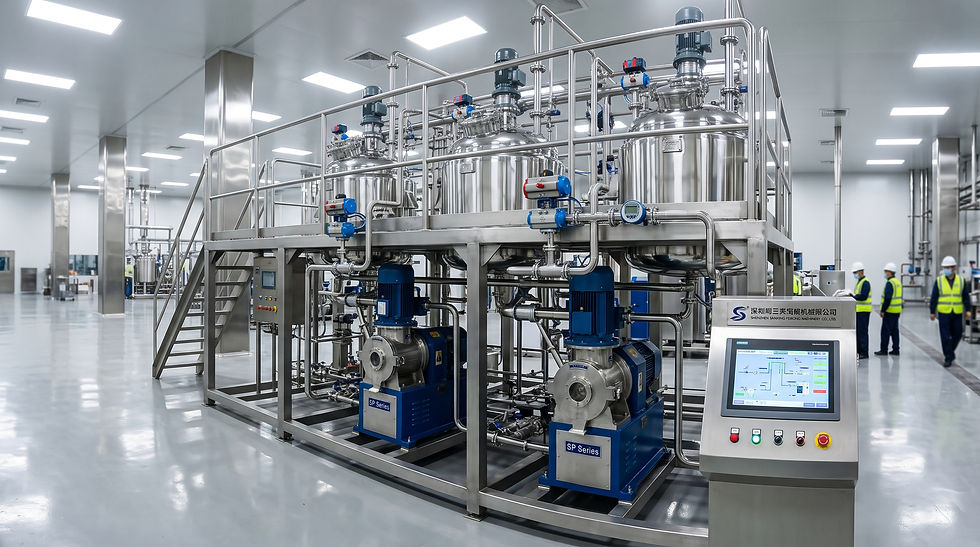
Meet the Complete Automated Wet Grinding Solution from Shenzhen Sanxing Feirong Machinery!
Single-Source Turnkey Responsibility: Sourcing premixers, transfer pumps, bead mills, and control panels from separate vendors leads to hydraulic mismatches and communication bottlenecks; Sanxing Feirong engineers, fabricates, and tests the entire wet grinding line under one roof.
Enclosed Dust-Free Material Handling: Automated subsurface vacuum powder induction draws dry nanopowders directly into the liquid vortex, preventing airborne dust contamination and eliminating un-wetted "fish-eye" agglomerates.
Patented Seal-Free Milling Core: At the center of the line sits the SP Series Vertical Seal-Free Bead Mill, which eliminates submerged mechanical seals and pressurized barrier oils, guaranteeing zero batch cross-contamination and zero seal-related downtime.
All-Ceramic Purity Circuit: By pairing electropolished 316L stainless steel mixing vessels (Ra≤0.4 μm\text{Ra} \le 0.4\ \mu\text{m}Ra≤0.4 μm) with solid sintered Silicon Carbide (SiC\text{SiC}SiC) and Zirconia (ZrO2\text{ZrO}_2ZrO2) milling chambers, foreign metallic iron pickup is held strictly below <2 ppm<2\text{ ppm}<2 ppm.
Closed-Loop Specific Energy Automation: The NextGen PLC Touchscreen Control Suite synchronizes pump flow rates, chiller valves, and rotor tip speeds in real time, terminating the cycle precisely when the target net specific energy (kWh/ton\text{kWh/ton}kWh/ton) is delivered.
Quick Overview: System Architecture at a Glance
Module / Subsystem | Integrated Sanxing Equipment | Technical Specification / Performance Metric |
Focus Keyword | Complete automated wet grinding solution | Complete automated wet grinding solution |
1. Powder & Liquid Dosing | Vacuum Subsurface Inductor + Coriolis Flow Meters | Automated gravimetric/mass dosing (±0.2% accuracy); zero airborne dust |
2. Slurry Pre-Dispersion | Jacketed High-Shear Dissolver / Planetary Premixer | Mirror-polished 316L SS (Ra≤0.4 μm); reduces clusters to D50<20 μm |
3. Fluid Transfer Skid | VFD Progressive Cavity / Sanitary Diaphragm Pump | Low-pulsation positive displacement synchronized with mill pressure |
4. Primary & Fine Milling | SP Series Seal-Free Vertical Nano Bead Mills | Dynamic centrifugal separation; 0.05–0.3 mm YSZ micro-media |
5. Thermal Management | Multi-Zone Chilled Water PID Loop + SiC Liner | High thermal conductivity (κ>120 W/(m⋅K)); keeps slurry <30∘C |
6. Filtration & De-Airing | Duplex Bag/Cartridge Filters + Vacuum Degasser | Continuous online filter switching; removes micro-bubbles prior to coating |
7. Supervisory Control | NextGen Siemens / Allen-Bradley PLC Touchscreen | Closed-loop kWh/ton energy targeting, recipe storage, and auto-CIP |
The Hidden Cost of "Frankenstein" Production Lines
When chemical, battery, and ceramic manufacturers expand capacity, a common pitfall is assembling a "Frankenstein" line—buying mixing tanks from one fabricator, pumps from a catalog distributor, horizontal bead mills from another vendor, and hiring a local contractor to wire the controls. In high-spec manufacturing, fragmented lines fail in three predictable ways:
Hydraulic & Rheological Bottlenecks: If the pre-disperser fails to break macroscopic agglomerates below 25 μm25\ \mu\text{m}25 μm, or if transfer piping contains stagnant deadlegs, coarse clusters enter the bead mill and immediately pack the grinding media.
Mechanical Seal Vulnerability: Traditional horizontal bead mills rely on double mechanical face seals lubricated by pressurized glycol or mineral oil. When upstream pressure fluctuates, seal faces separate or score, dumping barrier fluid into expensive slurry batches.
Control Blind Spots: When the feed pump, chiller, and bead mill operate on separate control boxes, a sudden viscosity surge inside the mill cannot automatically throttle the feed pump or open cooling valves—resulting in thermal gelation and emergency shutdowns.
Shenzhen Sanxing Feirong Machinery eliminates these integration failures by delivering a complete automated wet grinding solution engineered from the ground up as a unified hydraulic and digital ecosystem.
Inside the 5-Module Sanxing Automated Wet Grinding Solution
Every Sanxing turnkey production line is modularly configured to take raw powders and liquid carriers through five synchronized stages:

Module 1: Automated Liquid Metering & Subsurface Powder Induction
Instead of workers manually dumping dusty bags into open manways, liquid solvents and wetting agents are metered into the system via high-precision Coriolis mass flow meters. A vacuum powder induction manifold draws dry active powders from bulk bags or hoppers and injects them subsurface directly into the high-shear zone of the premixer. This ensures instantaneous wetting, zero cleanroom dust emissions, and zero material loss.
Module 2: Sanitary High-Shear Premixing & Thermal Conditioning
The slurry is homogenized inside mirror-polished 316L stainless steel vessels (Ra≤0.4 μm\text{Ra} \le 0.4\ \mu\text{m}Ra≤0.4 μm) equipped with high-speed saw-tooth dispersion discs and low-speed anchor scrapers:
Macroscopic Breakdown: High-velocity shear reduces raw powder clusters down to a uniform D50<15–25 μmD_{50} < 15\text{–}25\ \mu\text{m}D50<15–25 μm suspension.
Continuous Suspension: Anchor blades with PTFE wall scrapers prevent sedimentation along tank walls and sweep fluid continuously across spiral-baffled cooling jackets.
Module 3: The Core Engine — Cascade Seal-Free Vertical Bead Milling
From the premixer, VFD-controlled progressive cavity pumps feed the slurry into Sanxing’s flagship SP Series Vertical Seal-Free Bead Mills. For ultra-fine nanoscale reductions (D50<80 nmD_{50} < 80\text{ nm}D50<80 nm), systems are configured in a two-stage cascade (Coarse Mill + Fine Mill):
Patented Seal-Free Isolation: The main drive spindle enters from above the liquid level. Hydrodynamic deflectors contain the slurry without rubbing mechanical face seals, eliminating barrier fluid leaks and seal replacement downtime.
Solid Sintered Ceramic Chambers: Sintered Silicon Carbide (SiC\text{SiC}SiC) liners conduct frictional heat out to chilled water jackets at >120 W/(m⋅K)>120\ \text{W/(m}\cdot\text{K)}>120 W/(m⋅K), while Yttria-Stabilized Zirconia (ZrO2\text{ZrO}_2ZrO2) pin rotors deliver high-density shear with zero metallic contamination (Fe<2 ppm\text{Fe} < 2\text{ ppm}Fe<2 ppm).
Blog_1_Bead_Mill_for_LFP_Cathode_Slurry.docx+ 1
Dynamic Centrifugal Media Separation: Non-screen centrifugal separation rotors retain 0.05–0.1 mm0.05\text{–}0.1\text{ mm}0.05–0.1 mm micro-media reliably at high recirculation flow rates, avoiding the screen blinding that plagues horizontal mills.
Blog_1_Bead_Mill_for_LFP_Cathode_Slurry.docx+ 1
Module 4: Multi-Pass Pendulum/Loop Recirculation & Finishing
Depending on particle size span requirements (Span=(D90−D10)/D50<0.85\text{Span} = (D_{90} - D_{10})/D_{50} < 0.85Span=(D90−D10)/D50<0.85), the automated piping skid executes either high-flow multi-pass tank recirculation or pendulum pass-to-pass milling between twin holding vessels. Once milling is complete, pneumatic 3-way diverter valves route the slurry through duplex absolute bag/cartridge filters and a vacuum de-airing vessel to strip entrained micro-bubbles prior to coating or spray drying.
Module 5: NextGen PLC Touchscreen Automation & Auto-CIP
The entire production skid is governed by a centralized Siemens S7-1500 or Allen-Bradley PLC console:
Specific Energy Shutoff (kWh/ton\text{kWh/ton}kWh/ton): The PLC integrates net motor power over mass flow rate, discharging the batch automatically once the exact target specific energy has been transferred into the slurry.
One-Touch Clean-In-Place (CIP): Between product changeovers, automated spray balls, pulsed purge valves, and solvent recovery loops flush the premixer, piping, and bead mill chamber within 30 minutes without manual disassembly.
Comparison: Standalone Equipment Purchase vs. Complete Sanxing Automated Solution
Operational Metric | Standalone Disconnected Machines | Sanxing Complete Automated Solution |
Engineering & Piping Design | Client must engineer piping & wiring locally | Pre-engineered 3D CAD skid layout & P&ID included |
Powder Charging & Hygiene | Manual dumping; high airborne dust & clumping | Enclosed subsurface vacuum induction (100% dust-free) |
Mechanical Seal Maintenance | Frequent horizontal seal rebuilds (600–1,000 hrs) | Zero mechanical seals (100% Seal-Free vertical design) |
Particle Size Repeatability | Operator-dependent (±20% batch variance) | PLC specific energy controlled (<±2.5% variance) |
Metallic Contamination (Fe) | 15–40 ppm from uncoordinated metal contact | <2 ppm (316L mirror tanks + solid SiC/ZrO2 mills) |
Batch Changeover / Cleaning | 4–6 hours manual teardown and scrubbing | 30–45 minutes automated closed-loop CIP sequence |
Commissioning Timeline | 6–10 weeks multi-vendor troubleshooting | 1–2 weeks plug-and-play modular skid installation |
Step-by-Step Turnkey Project Execution: From Concept to Commissioning
When you partner with Shenzhen Sanxing Feirong Machinery for a complete automated wet grinding line, our engineering department manages the project across five structured phases:
Pilot Slurry Validation (Shenzhen R&D Center): Before finalizing equipment sizes, we test 1–5 L of your raw slurry in our laboratory vertical mills to establish exact specific energy (kWh/ton\text{kWh/ton}kWh/ton) and media size (0.05–0.8 mm0.05\text{–}0.8\text{ mm}0.05–0.8 mm) requirements.
Custom 3D Plant Layout & P&ID Engineering: Our mechanical engineers design a customized 3D structural skid layout tailored to your factory ceiling height, floor footprint, and explosion-proof (ATEX/IECEx) or cleanroom zoning.
In-House Fabrication & Cleanroom Assembly: All sanitary vessels, structural platforms, PLC cabinets, and SP Series vertical bead mills are manufactured in-house, including ISO G1.0 laser rotor balancing and 0.6 MPa0.6\ \text{MPa}0.6 MPa hydrostatic pressure testing.
Integrated Factory Acceptance Testing (FAT): We assemble and wire the complete system on our Shenzhen workshop floor, executing a 72-hour continuous water/solvent run-in—with live video walkthroughs for overseas teams—before packing in VCI-sealed export crates.
Global On-Site Commissioning & Operator Training: Sanxing engineers deploy to your facility to supervise skid placement, utility hookups, wet slurry commissioning, and hands-on operator training, backed by remote IoT diagnostic support.
Conclusion & Request Your Custom Turnkey Proposal
Scaling sub-micron and nanoscale wet grinding requires more than a standalone mill—it requires a synchronized, contamination-free production ecosystem. By combining 32 years of mechanical craftsmanship with patented seal-free vertical bead mills, sanitary premixing skids, and NextGen PLC automation, Shenzhen Sanxing Feirong Machinery Co., Ltd. delivers turnkey wet grinding solutions that maximize yield, purity, and operational uptime.
Build Your Automated Production Line with Sanxing Feirong:
Explore our Turnkey Wet Grinding Production Lines and modular skid capabilities.
Review our flagship SP Series Vertical Bead Mill (Seal-Free) at the heart of every automated system.
Contact Sanxing Feirong Machinery today to share your hourly throughput targets, request a custom 3D plant layout, and schedule a free pilot grinding trial!
Frequently Asked Questions
Q: Can Sanxing customize the automated wet grinding solution to fit an existing factory building with low ceiling clearance?
A: Yes. Because every turnkey line is custom-engineered in 3D CAD prior to fabrication, we adapt platform heights, vessel aspect ratios, and service hoists to fit your exact room dimensions while preserving full ergonomic access to the vertical bead mills.
Q: How does the system prevent cross-contamination when switching between different product formulations?
A: The system features sanitary zero-deadleg piping, mirror-polished 316L stainless steel vessels (Ra≤0.4 μm\text{Ra} \le 0.4\ \mu\text{m}Ra≤0.4 μm), and our seal-free vertical bead mill chamber, which drains completely by gravity. Combined with an automated multi-stage Clean-In-Place (CIP) flushing sequence, product changeovers are completed rapidly without hidden residue traps.
Q: Is the complete automated system available in explosion-proof configurations for organic solvents?
A: Yes. For solvent-borne formulations (such as NMP battery slurries, xylene, ketones, or alcohol-based inks), the entire system is supplied with ATEX/IECEx explosion-proof motors, intrinsically safe sensors, purged PLC cabinets, and closed-loop nitrogen inert gas blanketing.


Comments