

Bead Mill for Pesticide Suspension Concentrates(SC): Preventing Ostwald Ripening andSedimentation

Author: Moeez Ullah Published: October 26, 2026

Bead Mill for Pesticide Suspension Concentrates (SC): Preventing Ostwald Ripening and Sedimentation
Ostwald Ripening Mitigation: Ostwald ripening—where small particles dissolve and redeposit onto larger crystals during storage—is driven by a broad particle size distribution span. Narrowing the distribution curve ($D_{50}: 1.2\text{–}2.2\ \mu\text{m}$, $D_{98} < 4.5\ \mu\text{m}$) eliminates the chemical potential gradient and stops crystal growth.
Low-Melting-Point Vulnerability: Many modern active ingredients (e.g., azoxystrobin, pyraclostrobin, imidacloprid) have relatively low melting points (some below $60\text{–}80^\circ\text{C}$). Sluggish heat removal in conventional mills causes thermal softening, agglomeration, and mill jamming.
Mechanical Seal Failure Risks: Horizontal bead mills frequently suffer from mechanical seal failure when abrasive mineral wetting agents and insoluble crystal active ingredients grind between seal faces, leaking barrier oils into the aqueous formulation.
Controlled Thermal Management: Using $0.4\text{–}0.8\text{ mm}$ ceramic grinding media in a vertical bead mill with multi-zone cooling jackets ensures gentle, high-throughput deagglomeration while maintaining slurry temperatures safely below $30^\circ\text{C}$.
Seal-Free Continuity: Sanxing Feirong's vertical seal-free bead mill architecture removes mechanical seals and barrier fluids entirely, providing reliable, continuous processing for high-solids ($30\text{–}60\text{ wt}\%$) aqueous agrochemical SC suspensions.
At a Glance DOCX | Technical Specification / Metric DOCX |
Focus Keyword | Bead mill for pesticide suspension concentrate |
Target Formulations | Fungicides (Azoxystrobin, Tebuconazole), Insecticides (Thiamethoxam), Herbicides (Atrazine) |
Target Particle Size | $D_{50}: 1.2\text{–}2.2\ \mu\text{m}$; $D_{90}: 3.0\text{–}3.8\ \mu\text{m}$; $D_{98} < 4.5\ \mu\text{m}$ ($\text{Span} < 1.0$) |
Critical Failure Modes | Ostwald ripening, hard-caking sedimentation, low-melting-point thermal paste softening |
Grinding Media Selection | $0.4\text{–}0.8\text{ mm}$ high-density YSZ or Zirconium Silicate ceramic beads |
Slurry Solids Loading | $300\text{–}600\text{ g/L}$ active ingredient (AI) in water-surfactant carrier |
Slurry Temperature Limit | Strict limit: $< 32^\circ\text{C}$ (Prevents active ingredient thermal plasticization) |
Optimal Mill Architecture | Sanxing SP Series Seal-Free Vertical Bead Mill with multi-jacket cooling |
The Physics of Agrochemical Stability: Why Particle Size Span Dictates Shelf Life
In modern crop protection, Suspension Concentrates (SC) are engineered by dispersing solid, water-insoluble technical active ingredients into an aqueous matrix containing nonionic and anionic surfactants, dispersants (such as naphthalene sulfonate condensates or polycarboxylates), and structuring rheology modifiers (xanthan gum and bentonite clay).
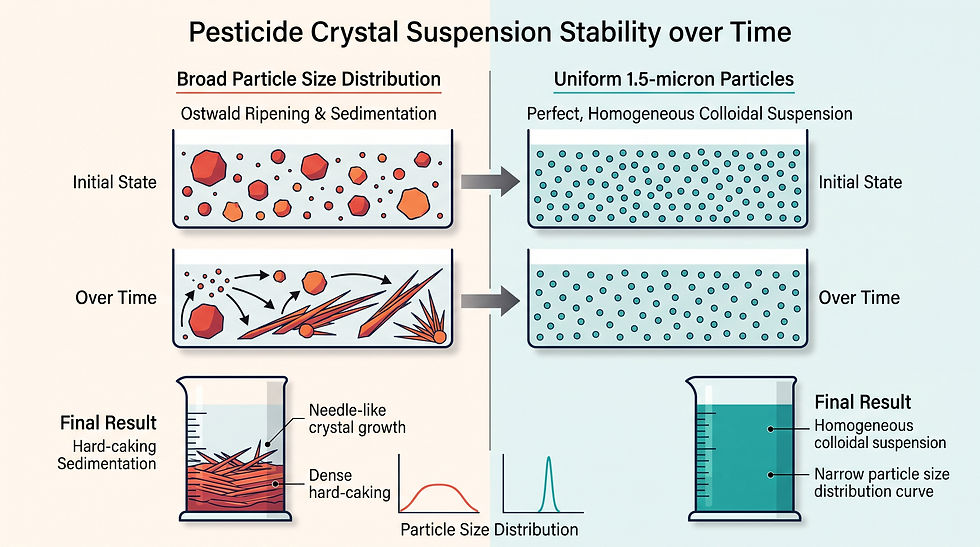
The primary physical instability in pesticide SC formulations is Ostwald ripening, governed by the Gibbs-Thomson equation. Smaller particles possess higher chemical potential and higher solubility than larger particles. Over prolonged storage under ambient diurnal temperature swings, sub-micron fines dissolve into the aqueous continuous phase and redeposit onto coarse particles ($> 5\ \mu\text{m}$), causing large, needle-like crystal growth. These enlarged crystals rapidly settle to the bottom of containers, forming irreversible hard cakes that cannot be resuspended by shaking.
To achieve a 2-year ambient shelf life that complies with FAO/WHO agrochemical specifications, the milling equipment must not merely reduce the mean particle size ($D_{50}$)—it must compress the particle size distribution span:
$$\text{Span} = \frac{D_{90} - D_{10}}{D_{50}} < 1.0$$
with an absolute upper cutoff of $D_{98} < 4.5\ \mu\text{m}$.
Why Conventional Bead Mills Struggle with Low-Melting Active Ingredients
1. Thermal Plasticization and Chamber Jamming
Many high-value fungicides and insecticides have low melting points (e.g., Pyraclostrobin: $63.7^\circ\text{C}$, Tebuconazole: $105^\circ\text{C}$, Pendimethalin: $58^\circ\text{C}$). In conventional bead mills with limited cooling efficiency, mechanical friction elevates localized chamber temperatures above $45\text{–}50^\circ\text{C}$. The active ingredient softens into a sticky plastic paste, wrapping around agitator discs, blinding screens, and stalling the drive motor.
2. Mechanical Seal Abrasive Wear
Agrochemical slurries often contain abrasive auxiliary mineral carriers (kaolin, attapulgite clay) alongside crystalline active ingredients. In horizontal mills, these hard particles scour dynamic mechanical seal faces, leading to seal blowout and barrier cooling fluid leaking directly into the formulation.
3. Static Screen Clogging
When formulations exhibit thixotropic or dilatant viscosity transitions during milling, static slotted discharge sieves in horizontal mills blind easily with media beads, triggering frequent high-pressure shutdowns.
Sanxing Feirong's Seal-Free Vertical Engineering: The SC Formulation Solution
To overcome these formulation challenges, Shenzhen Sanxing Feirong Machinery Co., Ltd. developed the SP Series Vertical Seal-Free Bead Mill for Agrochemical Crop Protection Formulations:
Seal-Free Hydrodynamic Architecture: The main drive shaft and bearings are mounted entirely above the liquid level. By eliminating submerged mechanical contact seals, the risk of barrier fluid leaks, seal wear downtime, and cross-batch contamination is completely eliminated.
High-Efficiency Multi-Zone Cooling Jackets: The grinding chamber incorporates high-flow spiral-baffled cooling jackets paired with high-conductivity ceramic or alloy liners. Chilled water ($5\text{–}8^\circ\text{C}$) removes frictional heat instantly, maintaining bulk slurry temperatures strictly below $28\text{–}30^\circ\text{C}$ and preventing low-melting active ingredients from softening.
Dynamic Centrifugal Media Separation: Replacing static wire screens with a dynamic centrifugal separation rotor, Sanxing mills separate $0.4\text{–}0.8\text{ mm}$ grinding media cleanly through centrifugal acceleration. Slurry flows freely out the top discharge without screen clogging, allowing high-throughput continuous recirculation.
Step-by-Step Production Protocol: Agrochemical SC Wet Grinding
Pre-Dispersion & Wetting: Charge a high-shear mixing tank with water, wetting agent, and dispersant. Gradually add raw technical-grade pesticide powder (initial $D_{50} \approx 50\text{–}100\ \mu\text{m}$) under high-speed agitation until fully wetted into a uniform slurry ($D_{50} < 25\ \mu\text{m}$).
Coarse Wet Milling Stage: Route the premix through a primary Sanxing vertical bead mill charged with $0.8\text{–}1.2\text{ mm}$ media to break down coarse crystalline lumps below $5\ \mu\text{m}$.
Precision Fine Milling: Feed slurry into the Sanxing SP Series Seal-Free Vertical Bead Mill loaded with $0.4\text{–}0.6\text{ mm}$ YSZ beads. Maintain high-flow multi-pass recirculation, regulating chiller cooling to keep slurry below $28^\circ\text{C}$.
In-Line Distribution Verification: Monitor samples via laser diffraction (ISO 13320) until reaching $D_{50} = 1.5 \pm 0.3\ \mu\text{m}$ and $D_{98} < 4.2\ \mu\text{m}$.
Post-Milling Stabilization: Transfer milled slurry to a finishing tank, gently blending in pre-hydrated xanthan gum and biocide under low-shear paddle mixing to build protective yield stress.
Conclusion & Technical Inquiries
Formulating high-stability pesticide suspension concentrates requires narrow particle size distributions, gentle deagglomeration, and strict thermal control. By eliminating mechanical seals and running micro-ceramic media through high-efficiency cooling chambers, Sanxing Feirong Machinery empowers agrochemical manufacturers to achieve long-term physical shelf stability, prevent Ostwald ripening, and maximize biological efficacy.
Visit www.sanxing-machinery.com or contact our engineering team to schedule pilot grinding trials on your SC formulations.
Frequently Asked Questions
Q: How does narrow particle size distribution prevent Ostwald ripening in SC pesticides?
A: Ostwald ripening is driven by the solubility difference between fine and coarse particles. By eliminating both sub-micron fines and coarse particles ($> 5\ \mu\text{m}$), the chemical potential gradient is neutralized, preventing recrystallization and crystal growth during storage.
Q: Why is temperature control so critical during agrochemical bead milling?
A: Many active ingredients have low melting points (some below $60^\circ\text{C}$). If chamber cooling is inadequate, frictional heat softens the active ingredient into a sticky paste that blinds screens and stalls the mill. Sanxing's multi-zone cooling jackets keep slurry below $30^\circ\text{C}$.
Q: What are the advantages of a seal-free vertical bead mill for agrochemical plants?
A: Agrochemical plants frequently switch between different active ingredients. Sanxing's vertical seal-free design eliminates mechanical seals and barrier fluids, reducing contamination risks and enabling rapid CIP cleaning cycles.


Comments