

Bead Mill Grinding Media Selection: Zirconia vs. Glass vs. Steel, and How to Actually Choose

Author: Moeez Ullah Published: September 4, 2026

Bead Mill Grinding Media Selection: Zirconia vs. Glass vs. Steel, and How to Actually Choose
At a Glance | Detail |
Focus keyword | Bead mill grinding media selection |
Media types compared | Zirconia (yttria-stabilized), zirconium silicate, glass, steel |
Typical density range | Glass ~2.5 g/cm³; zirconium silicate ~3.8–4.2 g/cm³; zirconia ~6.0 g/cm³; steel up to ~7.8 g/cm³ |
Typical bead size range | 0.03mm (fine glass) up to 6mm (coarse grinding) |
Core trade-off | Higher density media grinds faster per pass but costs more and wears equipment harder |
Biggest hidden factor | Bead diameter, not just material, has a major independent effect on grinding efficiency |
Almost every process guide we've written mentions grinding media in passing — "fine zirconia beads," "0.3mm media" — without ever explaining why that specific choice was made. This one fills that gap. Bead mill grinding media selection is arguably the single highest-leverage decision in a wet grinding process, and it's usually treated as an afterthought.
Why Grinding Media Choice Matters More Than Most Processors Assume
The grinding media is what actually does the work — the mill provides the energy, but the beads deliver it to the particles through impact and shear. Change the media's density, size, or material, and you change grinding speed, achievable fineness, energy consumption, and contamination risk simultaneously. Getting this choice wrong doesn't just slow things down; it can mean a formulation never reaches its target particle size at all, no matter how long it runs.
The Core Media Types and What Sets Them Apart

Zirconia (Yttria-Stabilized Zirconium Oxide)
Zirconia media sits at the high-performance end of the spectrum, with a density around 6.0 g/cm³ — its high mass delivers the kinetic energy needed for demanding applications like automotive coatings, inks, and high-viscosity formulations. It's also prized for relative chemical inertness in acidic and alkaline processing environments, which is why it shows up across so many of the fine and ultrafine grinding applications we've covered, from battery materials to pharmaceutical nanosuspensions (composite ceramics and grinding media patent, US9764987).
Zirconium Silicate
Zirconium silicate beads offer a middle ground — a density around 3.8–4.2 g/cm³, more affordable than pure zirconia while still outperforming glass. Comparative testing on specific applications has found zirconium silicate beads delivering the best energy efficiency of the materials tested, requiring less specific energy to reach a target degree of milling than either higher-density zirconia or lower-density glass media in that particular process (bead density milling optimization study, patent US10465159) — a reminder that "highest density" and "most efficient" aren't always the same thing for a given application.
Glass Beads
Glass is the budget option, with a density around 2.5 g/cm³. It's widely used specifically because of its low cost and the availability of very small bead sizes — down to as fine as 0.004mm in some formulations — which can enable finer ultimate particle size in certain applications despite the lower mass per bead (grinding media comparison patent, US6193844).
Steel Media
Steel offers the highest specific gravity of common media types, up to roughly 7.8 g/cm³, which increases grinding efficiency through greater impact energy per collision. The trade-off is well documented: metal media carries a real risk of metal contamination in the finished product, which rules it out for many high-purity applications even where cost and grinding speed would otherwise favor it (grinding media comparison patent, US6193844).
Bead Size: The Variable That Matters as Much as Material

Smaller Beads Generally Mean Better Efficiency — To a Point
Comparative testing on identical-density zirconium silicate media across a size range from 0.3mm to 1.7mm found a strong impact of diameter on milling performance: larger beads required significantly more passes and more specific energy to reach the same target fineness, while smaller beads delivered better energy performance and productivity — though the difference between 0.3mm and 0.6mm beads was comparatively modest (bead diameter optimization study, patent US10465159). That's a useful reality check: going smaller helps, but there are diminishing returns below a certain point for a given application.
Matching Bead Size to Target Fineness
Industrial process guidance ties bead diameter directly to grinding category: roughly 0.5–1.5mm for ultra-fine grinding, 1–3mm for fine grinding, and 3–6mm for coarse grinding, with each range corresponding to different achievable particle size targets (grinding mill process control patent, US10569279). Selecting media size without reference to your actual target particle size is one of the most common avoidable inefficiencies in wet grinding operations.
The Trade-off Nobody Talks About: Equipment Wear
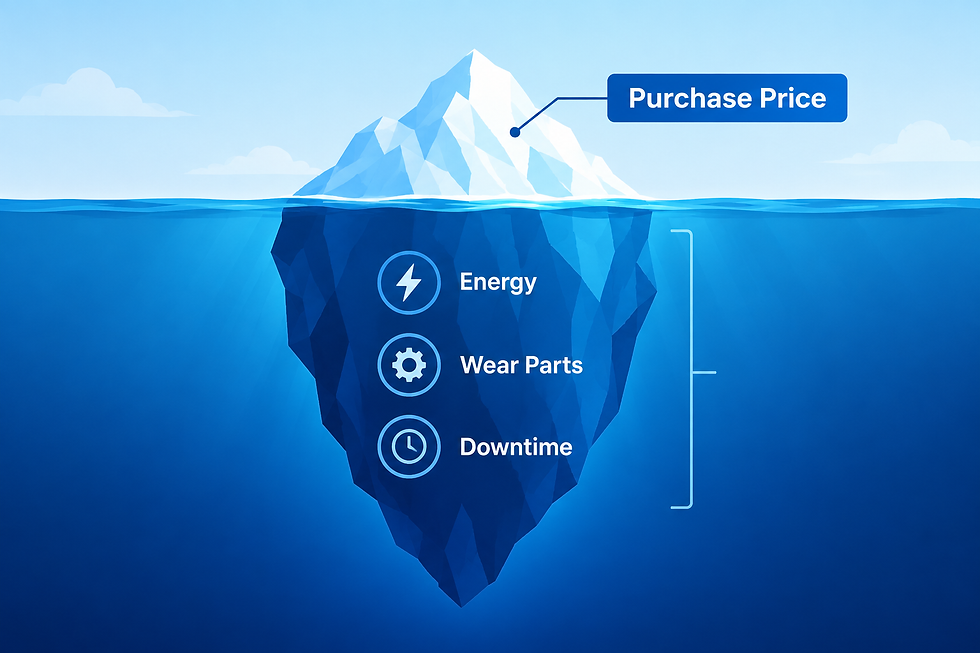
Higher-density, harder media grinds faster, but it also puts more mechanical stress on chamber linings, rotors, and separators — meaning media selection isn't purely a formulation decision, it's an equipment lifecycle decision too. Industry practitioner guidance is blunt about this: the cheapest media per kilogram is often not the best value once you account for wear rate, required mill time, and equipment replacement costs — "cheap can be expensive" is a common refrain among experienced process engineers, who advocate evaluating total value rather than sticker price alone (grinding media selection guide, PCI Mag / Norstone).
Grinding Media Comparison at a Glance

Media Type | Approx. Density | Cost | Best For | Key Limitation |
Glass | ~2.5 g/cm³ | Lowest | Cost-sensitive, less demanding applications | Lower energy delivery per pass |
Zirconium Silicate | ~3.8–4.2 g/cm³ | Moderate | Balanced cost/performance, general industrial grinding | Less inert than pure zirconia in aggressive chemistries |
Zirconia | ~6.0 g/cm³ | Higher | High-viscosity, high-purity, demanding fine/nano grinding | Higher upfront cost |
Steel | Up to ~7.8 g/cm³ | Varies (low–high) | High-impact-energy applications where contamination is tolerable | Metal contamination risk |
How to Actually Choose: A Practical Framework

Start with your contamination tolerance, since it eliminates options fastest: if your product is contamination-sensitive (batteries, pharmaceuticals, electronics, food-contact materials), steel media is generally off the table regardless of its cost advantage. From there, weigh target particle size against budget — zirconia earns its higher price in genuinely demanding fine and nano-scale applications, while zirconium silicate or glass may deliver adequate results at meaningfully lower cost for less demanding targets. Finally, don't treat bead size as secondary to material choice; match diameter to your target fineness category first, since running the wrong size media can undermine even the right material choice.
Why Getting This Right Matters for Every Application We Cover
Every application-specific guide in this series — from seal-free vertical bead mills to nano dispersion for battery materials, sunscreens, and pharmaceuticals — assumes a media selection has already been made correctly. Get media selection wrong, and even the best-specified mill can't consistently hit target particle size, which is why this decision deserves the same deliberate attention as equipment selection itself.
Conclusion
Grinding media isn't a commodity input to grab off the shelf — it's a formulation-specific decision that directly determines whether your process can actually hit its particle size target, and at what cost. Contact Sanxing Feirong Machinery to discuss the right media and bead mill configuration for your specific application.
FREQUENTLY ASKED QUESTIONS
Is zirconia always the best choice for fine grinding?
Not necessarily — while zirconia offers high density and chemical inertness well suited to demanding applications, comparative testing has shown zirconium silicate outperforming both zirconia and glass on energy efficiency for specific applications, so the "best" media depends on the actual process, not density alone.
Why does bead size matter as much as bead material?
Testing across a range of bead diameters at the same density has shown a strong, direct impact on required grinding passes and energy consumption — bead diameter should be matched to your target particle size category (coarse, fine, or ultra-fine), not chosen independently of it.
When should steel grinding media be avoided?
Steel media should generally be avoided for contamination-sensitive applications — batteries, pharmaceuticals, electronics, and similar high-purity products — where even trace metal contamination from media wear could compromise product quality.
Is the cheapest grinding media actually the most cost-effective choice?
Not always — industry guidance emphasizes evaluating total value rather than price per kilogram, since lower-cost media can require more passes, longer grind times, and faster equipment wear that offset the initial savings.
External rESOURCES
https://image-ppubs.uspto.gov/dirsearch-public/print/downloadPdf/9764987
https://image-ppubs.uspto.gov/dirsearch-public/print/downloadPdf/10465159
https://image-ppubs.uspto.gov/dirsearch-public/print/downloadPdf/6193844
https://image-ppubs.uspto.gov/dirsearch-public/print/downloadPdf/10569279
https://www.pcimag.com/ext/resources/Events/CTT/2021ppt/Daniyel-Firestone_Norstone_CTT2021.pdf


Comments