

Complete Automated Wet Grinding System: Slurry Premixing & Seal-Less Vertical Bead Mill

Author: Moeez Ullah Published: October 31, 2026

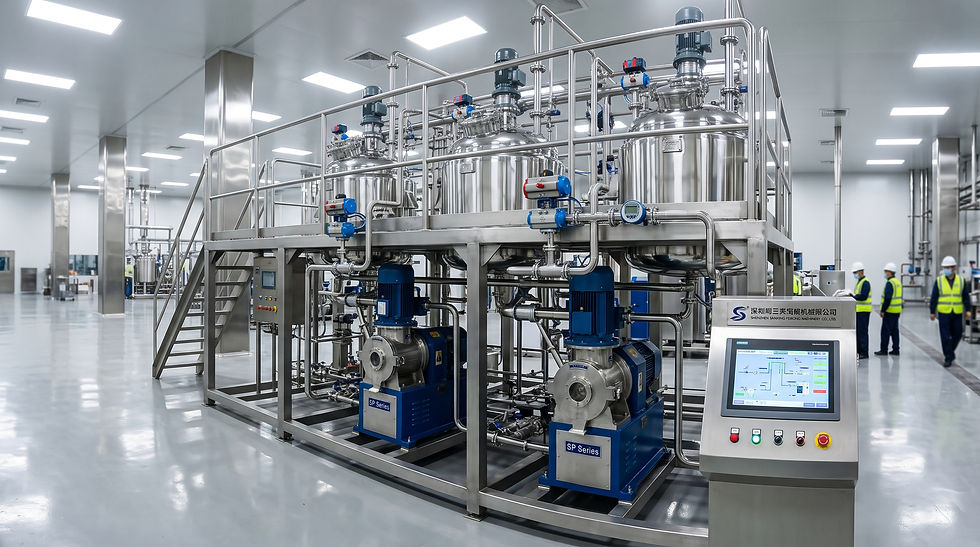
Complete Automated Wet Grinding System: Slurry Premixing & Seal-Less Vertical Bead Mill
System-Level Synergy: A wet grinding process is only as reliable as its pre-dispersion stage; raw agglomerates that are improperly wetted in the mixing tank cause immediate media packing, pressure spikes, and premature wear inside the bead mill.
Closed-Loop Safety & Hygiene: Integrating vacuum powder induction directly into the liquid continuous phase prevents airborne dust emissions, ensuring compliance with strict industrial hygiene and cleanroom standards.
Elimination of Mechanical Seal Leaks: Utilizing a seal-less vertical bead mill as the core milling engine removes dynamic mechanical face seals and pressurized cooling fluids, safeguarding formulations against batch-destroying hydrocarbon leaks.
Continuous Multi-Pass Recirculation: Automated three-way diverter valves and variable-frequency progressive cavity pumps coordinate slurry flow between high-shear premixing vessels and the vertical bead mill, narrowing the residence time distribution and compressing particle size spans (Span<0.85\text{Span} < 0.85Span<0.85).
Centralized Digital Supervision: Industrial PLC architecture synchronizes motor loads, multi-zone chamber temperatures (ΔT\Delta TΔT), in-line filtration differential pressure, and specific energy consumption (kWh/ton\text{kWh/ton}kWh/ton) across the entire line.
The Bottleneck of Disconnected Machinery in Wet Processing
Operating standalone chemical processing equipment joined by flexible temporary hoses and manual operator steps introduces systemic failure points:
Airborne Dust and Incomplete Powder Wetting: When operators manually dump fine powders (such as fumed silica, carbon black, or calcined alumina) into open tanks, floating dust contaminates the facility, while dry powder floating on the liquid surface forms stubborn "fish-eyes" (dry-core agglomerates) that jam downstream milling screens.
Seal Failures and Slurry Contamination: Standard horizontal sand mills rely on mechanical seals pressurized with barrier fluids. Abrasive slurries rapidly wear down seal faces, leaking barrier oils into the formulation and causing complete batch rejection.
Flow Rate & Viscosity Mismatches: If the feed pump delivers slurry faster than the bead mill can process, pressure surges trigger safety shutdowns. Conversely, starving the mill causes localized overheating and media attrition.
Architecture of a Complete Automated Wet Grinding System
A balanced turnkey wet grinding line links four functional processing stages into an enclosed, automated circuit:

Stage 1: Automated Slurry Premixing & Subsurface Powder Induction
The process begins in a jacketed 316L stainless steel mixing vessel:
Subsurface Powder Injection: Rather than top-loading dry materials, vacuum induction introduces fine powders directly into the high-velocity liquid stream beneath the impeller. Dry particles are instantly wetted by surrounding solvent and dispersant molecules, eliminating airborne dust and preventing agglomerate floating.
High-Shear De-agglomeration: High-speed saw-tooth dispersion blades operating at tip speeds of 20–25 m/s20\text{–}25\ \text{m/s}20–25 m/s break macro-clusters down below 25 μm25\ \mu\text{m}25 μm, creating a pumpable, homogeneous premix ready for bead milling.
Thermal Conditioning: Integrated spiral-baffled dimple jackets circulate chilled water or thermal oil to manage the exothermic heat generated during high-shear wetting.
Stage 2: Synchronized Slurry Transfer & Flow Control
Slurry is transferred via variable-frequency progressive cavity or peristaltic pumps that provide positive displacement with minimal shear degradation. Pressure transducers and Coriolis mass flow meters communicate continuously with the system's central PLC, automatically adjusting pump speed to match the optimal fluid dynamics of the vertical bead mill.
Stage 3: The Milling Engine — Seal-Less Vertical Bead Mill
The heart of the system is Sanxing Feirong’s SP Series Seal-Less Vertical Bead Mill:
100% Seal-Less Fluid Dynamics: The drive motor, bearings, and shaft entry are positioned safely above the active liquid level. Hydrodynamic fluid deflectors retain slurry inside the grinding zone without mechanical contact seals, eliminating dynamic seal wear and removing the risk of barrier fluid leaks.
All-Ceramic Grinding Circuit: Inner chamber liners, agitator pin arrays, and dynamic separation wheels are fabricated from solid sintered Silicon Carbide (SiC\text{SiC}SiC) or Yttria-Stabilized Zirconia (ZrO2\text{ZrO}_2ZrO2), ensuring foreign metallic pickup remains strictly below 2 ppm2\text{ ppm}2 ppm.
Dynamic Centrifugal Media Separation: Rotating ceramic vanes project 0.05–0.3 mm0.05\text{–}0.3\text{ mm}0.05–0.3 mm micro-media outward into the grinding zone, allowing slurry to exit along the central low-pressure axis without passing through static wire screens that choke and blind under viscosity surges.
Stage 4: Continuous Multi-Pass Recirculation & In-Line Finishing
The slurry routes through an automated 3-way pneumatically actuated diverter valve:
High-Flow Multi-Pass Mode: Slurry cycles continuously between the premix vessel and the vertical mill at high volumetric turnover rates (10–20 passes/hour10\text{–}20\ \text{passes/hour}10–20 passes/hour). This high-flow recirculation eliminates dead zones, ensuring every fluid packet receives equal grinding exposure and compressing the particle size distribution span.
Automated Batch Transfer: Once the target specific energy input (kWh/ton\text{kWh/ton}kWh/ton) is reached, the valve automatically shifts, directing the finished slurry through a duplex in-line filtration skid (0.5–1.0 μm0.5\text{–}1.0\ \mu\text{m}0.5–1.0 μm absolute bags) to catch trace oversize particulates before transfer to downstream coating, spray drying, or filling lines.
System Integration: Manual Processing vs. Automated Turnkey Production
Feature / Operational Factor | Traditional Disconnected Setup | Complete Automated System (Sanxing Turnkey) |
Powder Charging Method | Open-top manual bag dumping (Dust hazard) | Enclosed vacuum subsurface powder induction |
Initial Agglomerate Wetting | Inconsistent; prone to floating "fish-eyes" | Uniform high-shear wetting (D50<25 μm) |
Shaft Sealing Architecture | Submerged double mechanical seal + barrier oil | Patented Seal-Less hydrodynamic fluid barrier |
Cross-Contamination Risk | High (Barrier fluid leaks & metal wear) | Zero (All-Ceramic fluid circuit, Fe<2 ppm) |
Separation of Micro-Media | Static wire screens (Frequent plugging) | Dynamic centrifugal ceramic rotor (Non-clogging) |
Process Control Mode | Manual operator logging & valve trimming | Automated PLC specific energy targeting (kWh/ton) |
Cleaning & Changeover Time | 4–6 hours manual strip-down & solvent wash | 30–45 minute automated Clean-In-Place (CIP) |
Overall Production Efficiency | Baseline | +35% to +45% higher throughput per shift |
Real-Time PLC Control Architecture: The Digital Thread
The entire automated wet grinding line is orchestrated by an industrial Siemens S7-1500 or Allen-Bradley PLC connected to an IP65 touchscreen console:
Specific Energy Mode: Operators enter the target energy required for the batch (e.g., 95 kWh/ton95\text{ kWh/ton}95 kWh/ton). The PLC automatically manages agitator RPM and pump feed rates, terminating the cycle or transferring the batch precisely when the energy setpoint is satisfied.
Thermal Interlocks: Multi-point RTD temperature sensors continuously track vessel, mill inlet, mill outlet, and cooling jacket return temperatures. If thermal thresholds are approached, the system adjusts cooling valves or throttles motor speed instantly.
Automated Clean-In-Place (CIP): At the conclusion of a production run, the system executes an automated cleaning cycle: pumping wash solvent or hot water through the vessel, transfer lines, vertical mill, and filtration skid, reducing hazardous chemical exposure for plant staff.
Step-by-Step Production Protocol: Commissioning a Turnkey System
Formulation & Recipe Selection: On the central PLC touchscreen, select the programmed product recipe (e.g., "Automotive Ceramic Dispersion" or "Water-Based Inkjet Slurry"), setting target batch volume, agitator tip speed, and energy setpoint.
Liquid Pre-Charging: The system automatically meters solvents, deionized water, and liquid wetting agents into the sanitary jacketed vessel via mass flow meters.
Vacuum Powder Charging: Engage the high-shear disperser and activate the vacuum induction valve. Solid active powders are drawn into the mixing vortex at controlled rates without generating airborne dust.
Initiating Continuous Milling Recirculation: Once pre-dispersion reaches target viscosity and fineness (D50<25 μmD_{50} < 25\ \mu\text{m}D50<25 μm), the progressive cavity feed pump engages, transferring slurry into the seal-less vertical bead mill charged with 0.1 mm0.1\text{ mm}0.1 mm YSZ beads.
Continuous Closed-Loop Cycling: Slurry recirculates through the high-efficiency vertical mill and returns to the mixing vessel until the PLC confirms the target specific energy has been delivered.
In-Line Filtration & Transfer: The automated diverter valve switches, routing the finished sub-micron slurry through duplex cartridge filters into intermediate holding tanks, followed by an automated CIP cycle.
Conclusion & Turnkey Engineering Services
Operating high-efficiency nanomaterial production lines requires moving beyond disconnected, manual equipment. By uniting automated subsurface powder induction, sanitary high-shear premixing, and seal-less vertical bead mills into a single, closed-loop automated system, manufacturers eliminate contamination risks, protect operator safety, and ensure reproducible sub-micron particle distributions.
Partner with Shenzhen Sanxing Feirong Machinery Co., Ltd.:
Discover our flagship SP Series Vertical Bead Mill (Seal-Free) engineered for automated industrial production lines.
Review our Turnkey Wet Grinding Production Lines complete with mixing vessels, piping skids, and PLC automation.
Contact Sanxing Feirong Machinery to consult with our process engineering department, review your factory floor layout, and request a detailed turnkey proposal today.
Frequently Asked Questions
Why is subsurface vacuum powder induction superior to open tank charging?
Open-top powder charging creates airborne dust clouds that compromise cleanroom air quality and cause material loss. Furthermore, ultra-fine powders float on the liquid surface, forming dry-core agglomerates that are difficult to wet out. Subsurface vacuum induction draws dry powder directly into the high-shear mixing zone, instantly wetting every particle.
How does a seal-less vertical bead mill handle high-flow recirculation?
Traditional horizontal mills choke at high recirculation flow rates because the axial fluid drag packs micro-beads against the static discharge screen. Sanxing's vertical bead mill utilizes dynamic centrifugal separation: rotating ceramic vanes throw beads outward into the grinding zone, allowing slurry to exit smoothly through the central low-pressure axis at high flow rates (>400–1,000 L/h>400\text{–}1,000\text{ L/h}>400–1,000 L/h).
Can this automated system handle both solvent-based and water-based formulations?
Yes. Mixing vessels and piping circuits are manufactured from electropolished 316L stainless steel, while the bead mill grinding chamber is fabricated from chemically inert Silicon Carbide (SiC\text{SiC}SiC) or Zirconia (ZrO2\text{ZrO}_2ZrO2). The system is compatible with aggressive organic solvents (NMP, xylene, ketones) as well as aqueous, pH-sensitive formulations.
How does centralized specific energy control ensure batch-to-batch repeatability?
Traditional time-based milling produces inconsistent results because slurry viscosity, ambient temperature, and raw material variations alter the rate of energy transfer. By measuring net electrical kilowatt-hours delivered per ton of product (kWh/ton\text{kWh/ton}kWh/ton), the PLC guarantees that every batch receives identical grinding energy, regardless of raw material fluctuations.


Comments