

Three Roll Mill vs Bead Mill: Which One Actually Fits Your Dispersion Process

Author: Moeez Ullah Published: September 3, 2026
At a Glance | Detail |
Focus keyword | Three roll mill vs bead mill |
Core mechanism difference | Three roll mill uses pure shear between rollers; bead mill uses impact and shear from grinding media |
Viscosity range | Three roll mill: handles 100,000+ cP pastes; bead mill: generally most effective up to ~10,000 cP |
Achievable fineness | Three roll mill: typically 1–20µm (down to sub-5µm for fine pastes); bead mill: micron down to nanoscale |
Contamination risk | Three roll mill: lower (no media); bead mill: managed through media/lining material selection |
Best-fit materials | Three roll mill: thick pastes (inks, cosmetics, electronic pastes); bead mill: liquid-to-medium-viscosity slurries needing fine/nano particle size |
"Should I use a three roll mill or a bead mill?" is one of the most common equipment questions in dispersion processing — and the honest answer is that they're built to solve different problems, not compete head-to-head on the same one. This guide breaks down exactly where each machine wins, and how to make the call for your specific material.
How Each Machine Actually Works

Three Roll Mill: Pure Shear Between Rollers
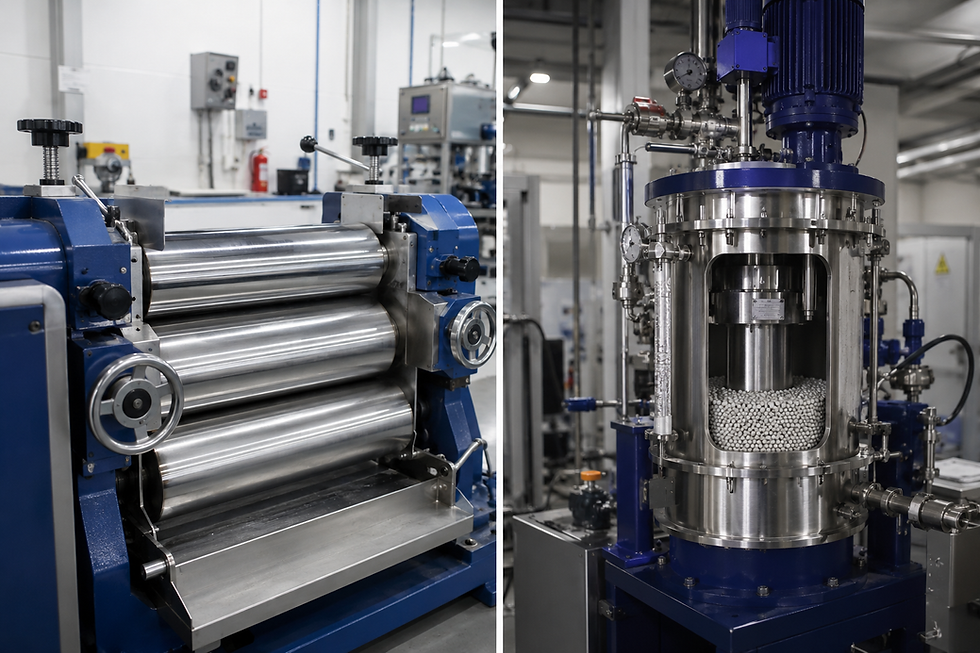
A three roll mill uses three horizontally arranged rollers — feed, center, and apron — rotating at progressively increasing speeds, applying shear stress to material passed through the narrow gaps between them. This mechanism tears apart particle agglomerates through shear alone, without impact force and without grinding media, which is a fundamentally different approach than milling with beads.
Bead Mill: Impact and Shear From Grinding Media
A bead mill instead suspends the material in a chamber filled with grinding beads, driven by a high-speed rotor. Particle size reduction happens through the combination of impact and shear generated as beads collide with each other and with suspended particles — a mechanism that works well across a much wider viscosity and particle size range than roller-based shear alone.
The Deciding Factor: Viscosity

Why Three Roll Mills Dominate at High Viscosity
This is where the two technologies diverge most sharply. Comparative technical guidance places the practical crossover point clearly: three roll mills excel with materials above roughly 100,000 cP, while bead mills generally struggle to maintain effective dispersion performance once viscosity climbs past about 10,000 cP (three-roll mill technical guide, Zili Machinery). If your material is a thick paste rather than a pourable slurry, that gap alone often settles the decision before particle size or throughput even enter the conversation.
Why Bead Mills Dominate for Liquid-to-Medium Viscosity Slurries
Below that high-viscosity threshold, bead mills generally offer better throughput, continuous processing capability, and — critically — the ability to reach much finer particle sizes than a three roll mill can achieve, including submicron and nanoscale targets that roller-based shear alone typically cannot reach efficiently.
Achievable Particle Size: A Closer Look
Three Roll Mill Fineness Ranges
Published selection guidance for three roll mills places typical industrial output in the 1–20 micron range, with premium pigmented pastes commonly reaching below 10 microns in 2–3 passes, and demanding applications like electronic silver pastes and cosmetic foundations hitting below 5 microns with 3–5 passes (three roll mill selection guide, IDA Equipment). That's genuinely fine dispersion — but it has a practical floor that bead mills, particularly nano-grade configurations, can push well past.
Where Bead Mills Extend Further
For applications targeting true nanoscale dispersion — sub-500nm or even sub-200nm particle sizes, as covered in several of our other equipment guides — bead mills with fine grinding media remain the more practical route. Three roll mills can achieve fine dispersion for many pigmented and pasty formulations, but the mechanism has practical limits that make bead milling the better fit once nanoscale targets are the actual goal.
Contamination Risk and Process Considerations
No Media Means Lower Contamination Risk — With a Trade-off
Because a three roll mill doesn't use grinding media, it inherently avoids the media-wear contamination risk that bead mills have to manage through material and lining selection — a genuine advantage for contamination-sensitive formulations. The trade-off is volatile solvent loss during processing, since the paste's large open exposure across the rollers allows more evaporation than an enclosed bead mill chamber does (three roll mill and ball mill properties across industries, Nanografi).
Shear-Only vs. Impact-Plus-Shear: Why It Matters for Fragile Materials
A three roll mill applies shear stress that tears apart agglomerates without fracturing or damaging individual particles — an important distinction for materials where preserving particle structure matters more than reducing primary particle size. Bead mills, by combining impact with shear, can be tuned toward gentler or more aggressive processing depending on rotor speed and media selection, but the impact component means particle structure preservation requires more deliberate process control than with roller-based shear alone.
Three Roll Mill vs Bead Mill: Side-by-Side

Factor | Three Roll Mill | Bead Mill |
Best viscosity range | Above ~100,000 cP (thick pastes) | Up to ~10,000 cP (liquid to medium-viscosity slurries) |
Typical fineness achievable | 1–20µm, down to sub-5µm for fine pastes | Micron down to nanoscale (sub-200nm achievable) |
Grinding mechanism | Pure shear, no media | Impact + shear via grinding media |
Contamination risk | Lower (no media) | Managed via media/lining selection |
Continuous processing | Batch-oriented, multi-pass | Well-suited to continuous/circulation grinding |
Typical applications | Inks, cosmetics, electronic paste, adhesives | Battery slurries, paint, pigment dispersion, nano-materials |
How to Decide: A Practical Framework

Start with viscosity, since it's the single strongest predictor of which technology fits: if your material is a thick, high-viscosity paste that barely flows, a three roll mill is very likely the right starting point regardless of target particle size. If your material is a pourable-to-moderately-thick slurry and you need fine or nanoscale particle size, a bead mill is almost always the better fit — and it's the only realistic route once your target drops into submicron or nanoscale territory. For formulations sitting in the middle — moderately viscous pastes without an extreme nanoscale requirement — the decision often comes down to secondary factors: contamination sensitivity, solvent volatility concerns, batch size, and whether continuous production throughput matters more than ultimate fineness.
Why This Comparison Matters for Equipment Buyers Right Now
Manufacturers evaluating dispersion equipment for the first time, or expanding into a new product line, often default to whichever technology their team already knows — without checking whether it actually fits the new material's viscosity and particle size requirements. Getting this choice wrong early doesn't just cost equipment budget; it costs the reformulation time needed to correct a product that was developed around the wrong dispersion technology from the start.
Conclusion
Three roll mills and bead mills aren't competitors so much as specialists — one built around extreme-viscosity shear, the other around fine and nanoscale particle size across a wider viscosity range. Matching the technology to your material's actual viscosity and particle size target, rather than defaulting to familiar equipment, is what determines whether your dispersion process actually works. Contact Sanxing Feirong Machinery to discuss which bead mill configuration fits your specific dispersion requirements.
FREQUENTLY ASKED QUESTIONS
Can a three roll mill achieve nanoscale particle size?
Generally no — three roll mills typically reach the 1–20 micron range, with fine formulations pushing below 5 microns, but true nanoscale dispersion (sub-200nm) is more reliably achieved with a bead mill using fine grinding media.
Why would someone choose a three roll mill over a bead mill if bead mills can go finer?
Because three roll mills handle much higher viscosity materials than bead mills can process effectively, and they avoid grinding-media contamination risk entirely — both major advantages for thick pastes in cosmetics, electronic paste, and ink applications.
Is one technology simply "better" than the other?
No, they're suited to different viscosity ranges and particle size targets. The right choice depends on your specific material's viscosity, target fineness, and contamination sensitivity, not a general quality ranking between the two.
Can bead mills process thick pastes at all?
Bead mills are generally most effective up to roughly 10,000 cP; beyond that, dispersion efficiency drops off, which is exactly the range where three roll mills become the more practical option.


Comments