

Turnkey Powder Processing Production Line: The Complete EPC Solution for Industrial Manufacturers


If you've ever bought a bead mill, then separately sourced a feeding system, then a drying unit, then an automation panel — only to find none of it talks to the others properly — you already understand the problem a turnkey powder processing production line is built to solve.
For manufacturers scaling up from lab-scale R&D to full industrial output, buying individual machines is rarely the bottleneck. The real bottleneck is making everything work together: process flow, automation, safety systems, and long-term stability. That's the gap EPC (Engineering, Procurement, Construction) delivery closes — and it's the service our customers ask us about most.
What Is a Turnkey EPC Production Line?
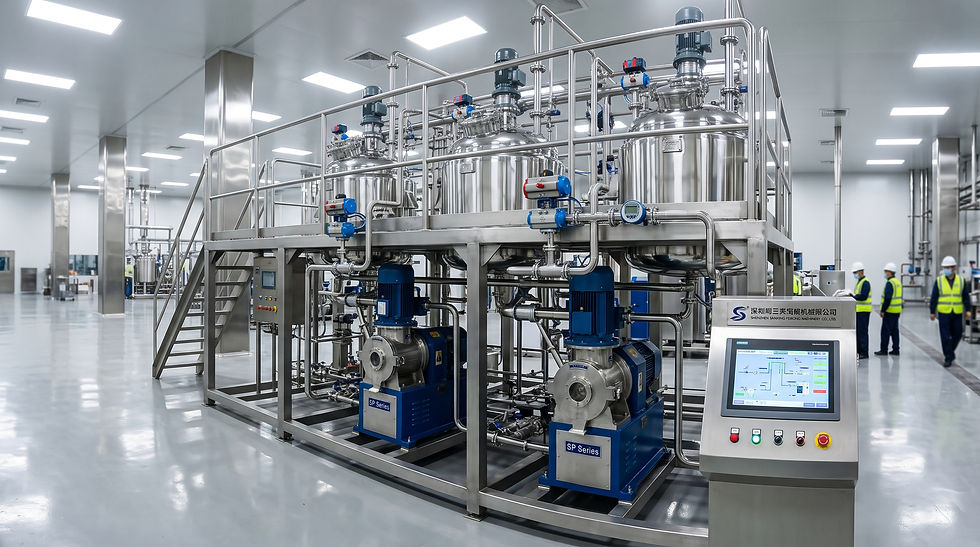
A turnkey EPC production line is a complete, engineered system delivered as one project rather than a list of separate machines. Instead of a customer piecing together a mill here, a classifier there, and a control panel from a third vendor, the manufacturer takes ownership of the entire lifecycle:
Process design based on the customer's material and output targets
Equipment engineering and fabrication
Automation and control system integration
On-site installation and commissioning
Ongoing technical support after startup
The result is a production line that's been designed to work as a single system from day one — not retrofitted into one.
The Problem With Buying Individual Machines
Manufacturers who assemble a production line piece by piece typically run into the same five issues:
Mismatched capacities. A mill rated for one throughput paired with a feeder rated for another creates a hidden bottleneck nobody notices until the line is running.
No unified automation. Machines from different suppliers rarely share a control architecture, which means manual intervention at every stage.
Safety gaps. Explosion-proofing and energy-saving configurations are hard to bolt on after the fact — they need to be designed into the system from the start, especially for fine powders and combustible dusts.
No single point of accountability. When something goes wrong, multi-vendor lines mean pointing fingers instead of getting a fix.
Slower time to stable production. Every extra integration step is another delay between installation and consistent output.
A turnkey line is engineered to remove all five at once.
Inside a Turnkey EPC Production Line Process
Process Design & Feasibility

Every project starts with the material, not the machine. Particle size targets, viscosity, throughput, and end-use application (battery material, ceramic, pigment, mineral) determine the process flow before any equipment is specified. This step is what prevents the "mismatched capacity" problem later.
Equipment Engineering & Fabrication
Once the process is mapped, equipment — bead mills, classifiers, drying and feeding systems — is engineered specifically for that process, not selected off a generic catalog. This is where 32 years of grinding and dispersion experience becomes the difference between a line that meets spec and one that needs constant adjustment.
Automation Integration
A unified control system ties the entire line together, allowing operators to monitor and adjust the process from a single interface instead of managing each machine independently. This is also where energy-saving configurations get built in — automation reduces idle run time and optimizes power use across the line.
Explosion-Proof & Safety Systems

For fine powders, combustible dust risk is a real operational concern. Explosion-proof systems are integrated into the line design itself — motor housings, electrical systems, and dust collection are all specified to the relevant safety standard for the material being processed.
Installation & Commissioning
Engineers handle on-site installation and run the line through commissioning until it consistently hits target output and particle specifications — not just "runs," but runs to spec.
After-Sales Support
A turnkey relationship doesn't end at commissioning. Ongoing technical support means the customer has one point of contact for troubleshooting, spare parts, and future capacity upgrades.
Industries That Rely on Turnkey Production Lines

Turnkey EPC delivery matters most where consistency and scale both matter:
Lithium battery materials — cathode, anode, and solid electrolyte production where particle consistency directly affects battery performance
Advanced ceramics — including ballistic protection materials, where uniform particle characteristics are a safety requirement, not just a quality preference
Digital inkjet materials — where dispersion uniformity affects color consistency and jetting reliability at scale
Industrial minerals — calcium carbonate, talc, kaolin, and silica processing at high purity and volume
Do You Need a Turnkey Line, or Just a Machine?
Not every project needs full EPC delivery. As a general guide:
A standalone machine (like a lab bead mill) usually fits R&D, small-batch testing, or facilities that already have compatible infrastructure in place.
A turnkey production line fits manufacturers scaling from pilot to full production, entering a new material category, or replacing a multi-vendor line that's become a maintenance burden.
If you're not sure which category your project falls into, that's exactly the kind of question a process design consultation is meant to answer before any equipment gets specified.
Why Manufacturers Choose Sanxing Feirong Machinery for EPC Projects
Sanxing Feirong Machinery has spent 32 years focused specifically on ultra-fine grinding and dispersion technology, backed by 25 patents and 15 software copyrights. That focus means turnkey lines are engineered by people who understand the grinding and dispersion process at a technical level — not assembled from generic industrial components. Every line is ISO 9001 certified in design and manufacture, with CE-compliant systems for international deployment.
Frequently Asked Questions
What does "EPC" mean in industrial equipment terms?
EPC stands for Engineering, Procurement, and Construction — a delivery model where one company designs, builds, and installs a complete production line rather than supplying individual machines.
How long does a turnkey production line project typically take?
Timelines vary by scope, but they generally include process design and feasibility review, equipment fabrication, and on-site installation and commissioning as sequential phases. Exact timelines depend on capacity requirements and material complexity.
Can an existing production line be upgraded to a turnkey system?
Yes. Many projects start as an assessment of an existing multi-vendor line, followed by a redesign that consolidates automation and safety systems around the customer's current equipment where possible.
Is a turnkey line more expensive than buying machines separately?
Upfront cost depends on scope, but turnkey delivery typically reduces total cost of ownership by avoiding integration rework, unplanned downtime, and the inefficiencies of mismatched equipment.
What industries benefit most from turnkey EPC production lines?
Lithium battery materials, advanced ceramics, inkjet and pigment materials, and high-purity industrial minerals — any application where particle consistency and safety at scale are critical.


Comments